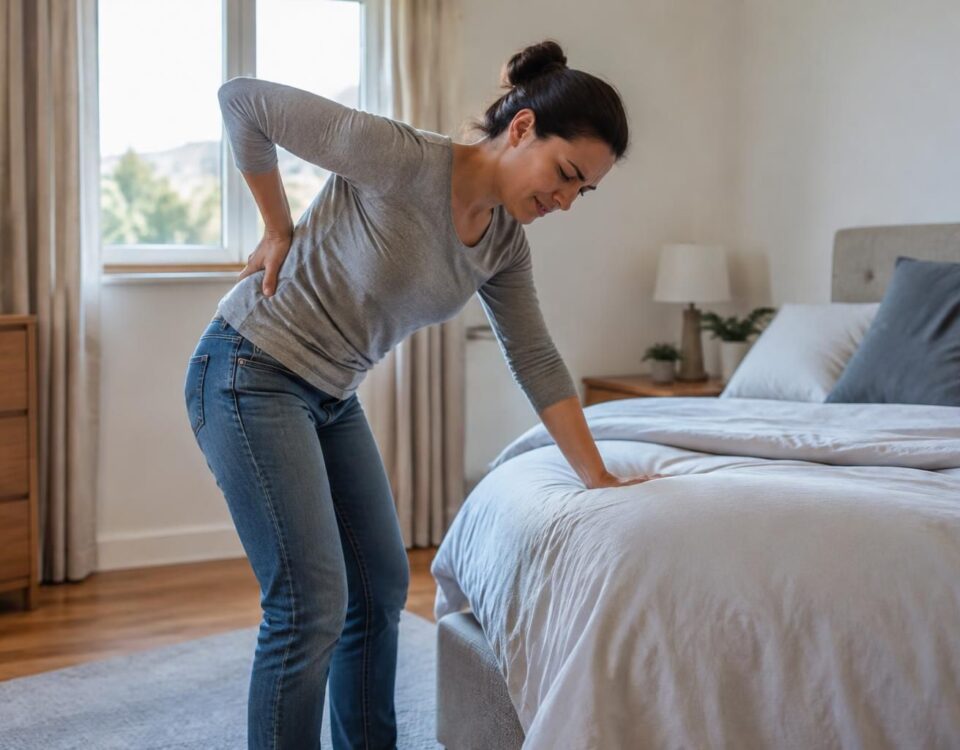
Herniated disc and sciatica: morning pain and lumbar stiffness
04/10/2026
Sciatica L4-L5 in Montreal: understanding possible symptoms
05/10/2026
IN BRIEF Sciatica is pain related to the irritation of a nerve, which can extend from the lower back down to the leg. Walking with sciatica is often possible and helps to maintain mobility, provided you move slowly, take short outings, and listen to your tolerance. Slow down or take a break if the pain increases. A healthcare professional can tailor the return to activity to your situation. |
In case of sciatica, walking is often possible if it respects your tolerance. Start with short outings at a moderate pace, on even ground, and gradually increase based on how you feel. Slow down or take a break if the pain intensifies in the leg, without trying to push through. Comfortable shoes and the advice of a healthcare professional can help you adjust your return to activity.
Daily walking is often possible with sciatica, but its duration and pace should follow your symptoms. Start with short outings, slow down if the pain increases, and stop if it becomes severe or is accompanied by unusual symptoms. Prolonged rest is usually not necessary, but a healthcare professional can help you adjust your activities based on your situation.
Understanding the Effect of Sciatica on Walking
Sciatica corresponds to pain related to the irritation or compression of a nerve root in the lower back. The pain can radiate into the buttock and leg, sometimes reaching the foot. It may be accompanied by tingling, numbness, or weakness.
Walking may then feel less natural. The pain may alter your posture or the way you place your foot. An asymmetric gait can also increase tension and maintain discomfort. To better understand this link, refer to this article on modified gait in case of sciatica.
A herniated disc or spinal canal narrowing may contribute to the symptoms, but an MRI scan alone does not always explain the pain. Imaging results should be interpreted alongside your symptoms and a clinical examination. To learn more, read this article on what an MRI can or cannot determine in case of herniated disc and sciatica.

Sciatica and floor washing: prolonged bending and pain
IN BRIEF Sciatica is a pain related to irritation of the sciatic nerve; mopping the floor while remaining bent for a long time can worsen it. To limit discomfort, use a long handle, keep your back as neutral as possible,…
Walking Without Exceeding Tolerance
Your tolerance varies depending on the day, fatigue, and the intensity of the pain. There is no ideal duration that suits everyone. The right guideline is to choose a walk that does not lead to a significant or lasting worsening of symptoms.
Start with a Short Duration
Start with a short outing, on even ground and close to home. If your condition remains stable during the walk and after returning, you can repeat this duration. Do not increase speed, distance, and frequency at the same time: change only one element at a time.
If the pain increases, slow down or take a break. You can also return earlier. Several short outings may be easier to tolerate than one long walk. Additional tips are presented in this guide on walking with sciatica and in this article dedicated to questions to ask before walking.
Monitor Symptoms During and After Walking
Note where the pain is located and if it radiates further down the leg. Pain that spreads more, intensifying tingling, or new weakness are signs that warrant reducing activity and seeking medical advice.
Also observe your condition after the outing. A slight discomfort that quickly returns to its usual level does not mean the same thing as significantly stronger pain that persists for several hours. These indicators help you adjust the next walk without trying to force it.

Sciatica and vacuuming: repetitive movement to watch out for
IN BRIEF Vacuuming with a sciatica can trigger pain because repeated bending and twisting strain the back. Break up the cleaning, keep the device close to you, and turn with your feet rather than twisting. Take a break if the…
Adjusting Pace, Route, and Shoes
Walk at a comfortable and steady pace. Avoid sudden accelerations, long climbs, and uneven paths if these conditions exacerbate your symptoms. Choose stable and comfortable shoes, with support suitable for your feet.
Maintain a natural posture. Do not force yourself to walk with a stiff back or hold a position that increases pain. If you are limping, shorten the outing and check in with a healthcare professional, especially if this gait persists.
The transitions between sitting and standing can also trigger pain in some individuals. Move without rushing and take the time to regain your balance before starting. This article describes sciatic pain during sit-to-stand transitions.
Practical recommendations on choosing pace and precautions are also found in this guide for walking with sciatica and this article on the benefits and precautions of walking.

Sciatica and household chores: twists, bends, and loads
IN BRIEF Sciatica can be aggravated by bending, twisting, and carrying loads while doing housework. Breaking tasks into smaller parts, taking breaks, and adjusting movements help manage effort without necessarily stopping everything. In Montreal, an assessment can help tailor activity…
When to Reduce Walking or Seek Advice
Reduce the duration or stop walking if the pain becomes sharp, if it radiates further down the leg, or if your gait deteriorates. Do not try to “tough it out” through significantly increasing pain. Persistent nocturnal pain or a gradual worsening also warrants medical attention. You can read about the signs to watch for in this article on nocturnal pain associated with a herniated disc and sciatica.
Quickly consult a healthcare professional if you experience new weakness in the leg or foot, significant loss of sensation, or worsening symptoms. Loss of bladder or bowel control, or numbness in the area between the legs, requires urgent medical evaluation. To differentiate usual symptoms from more concerning signs, refer to this article on nervous symptoms not to be taken lightly.
A professional can assess your situation and help determine which activities are appropriate. They can also check if your pain corresponds to sciatica and whether another issue requires management. General advice does not replace individual evaluation.

Sciatica and Making the Bed: Repeated Flexion and Lumbar Irritation
IN SHORT Sciatica is pain related to irritation or compression of the sciatic nerve. Making your bed can strain the lower back if bending is repeated, especially when rounding the back or twisting the torso. To limit lumbar irritation, bend…
Avoid Movements that Increase Symptoms
Do not force a movement that triggers stronger pain or worsens symptoms in the leg. Tolerance depends on the cause of sciatica and its progression. If you are unsure about an activity, consult your doctor rather than follow a program found online.
Some gestures and movements may be poorly tolerated during a flare-up. For examples of movements to watch for, refer to this article on exercises to avoid in case of sciatica. This information alone cannot determine what is suitable for your situation.
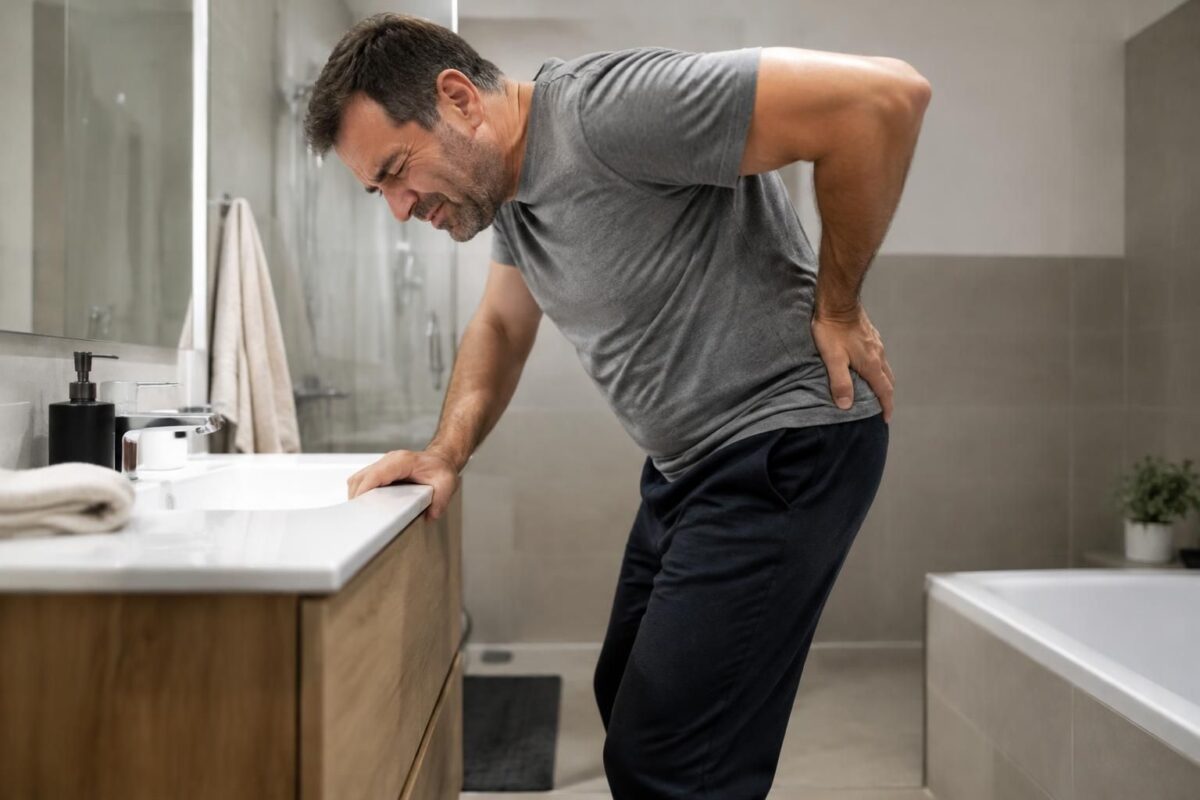
Sciatica and bending over the sink: pain in the leg
IN BRIEF Sciatica is pain related to irritation or compression of the sciatic nerve, which can extend from the lower back down to the leg. Bending over the sink can exacerbate the pain, especially if this position increases pressure on…
Track your progress without testing yourself
You can note the duration of each outing, the intensity of pain before and after, as well as symptoms in the leg. This simple tracking allows you to identify activities that are better tolerated and those that seem to increase discomfort.
Progress through small adjustments. If a duration remains comfortable several times, you may consider a moderate increase. If symptoms worsen or do not improve, have the situation assessed by a healthcare professional. Walking should remain an activity suitable for your condition at the time, not a test of endurance.
Medical disclaimer: The information and advice provided on this site do not replace the opinion, diagnosis, or treatment of a healthcare professional. Please note that Sylvain Desforges, B.Sc., D.O., N.D., Doctor of Osteopathy, is neither a medical doctor nor a physician, and is not specialized in a medical specialty as defined by the Collège des médecins du Québec. Manual medicine, functional medicine, and sports medicine as described on this site exclude any treatment or medical diagnosis made by a primary care physician or specialist. Always consult your doctor for any medical questions. For more details, please read our full Legal Notice.
Adapt the outing
- Start with a short walk, at a moderate pace.
- Choose even terrain and comfortable shoes.
- Take breaks or shorten the distance according to your tolerance.
Listen to the signals
- Slow down if the pain increases or travels further down the leg.
- Stop if the discomfort becomes intense or unusual.
- Seek advice from a healthcare professional if symptoms persist or worsen.

Walking with sciatica is often possible, provided that the duration, pace, and terrain are adjusted to your feelings. The goal is not to push through the pain, but to maintain gentle movement without causing lasting aggravation. Start gradually, take breaks, and seek advice from a healthcare professional if you have doubts or if your symptoms change.

Sciatica and washing feet: lumbar flexion to monitor
IN BRIEF Sciatica can make washing your feet uncomfortable, as bending forward accentuates lumbar flexion and may trigger pain. To limit strain, sit down, bring your foot closer to you, or use a long-handled aid. These adjustments make personal hygiene…
Assess your tolerance before setting off
Sciatica can cause pain that starts in the lower back or buttock and radiates down the leg, sometimes as far as the foot. Its intensity and triggers vary from person to person. Before heading out, identify your level of discomfort and the movements that exacerbate it. A suitable walk should remain bearable: there is no need to aim for a specific distance or to walk despite significantly increasing pain.
If you are resuming after a period of inactivity, choose a short and familiar route. A few minutes may be enough at the start. You can then gradually increase the duration, but only if your body tolerates it. It is often better to plan several short outings than one long walk that exhausts your resources.

Sciatica and dressing: daily gestures to adapt
IN BRIEF Sciatica can make dressing uncomfortable, but a few simple gestures help limit tension. Sit down to put on pants, socks, and shoes, choose easy-to-wear clothing, and avoid bending or twisting suddenly. These adjustments make daily dressing easier without…
Adjust the pace and route
Advance without forcing
Adopt a comfortable and steady pace. Avoid sudden accelerations, large steps, and abrupt directional changes. Keep your back in a natural position, shoulders relaxed, and eyes looking forward, without tensing up to maintain perfect posture. Stable, well-fitting shoes with adequate cushioning can make movement more comfortable.
Choose an easy terrain
Prefer flat and predictable ground, especially during the first outings. Uneven paths, steep slopes, or long flights of stairs can increase strain and make footing less secure. If pain travels further down the leg, slow down, stop for a moment, or return earlier. A break is not a failure: it helps you respect your current limits.
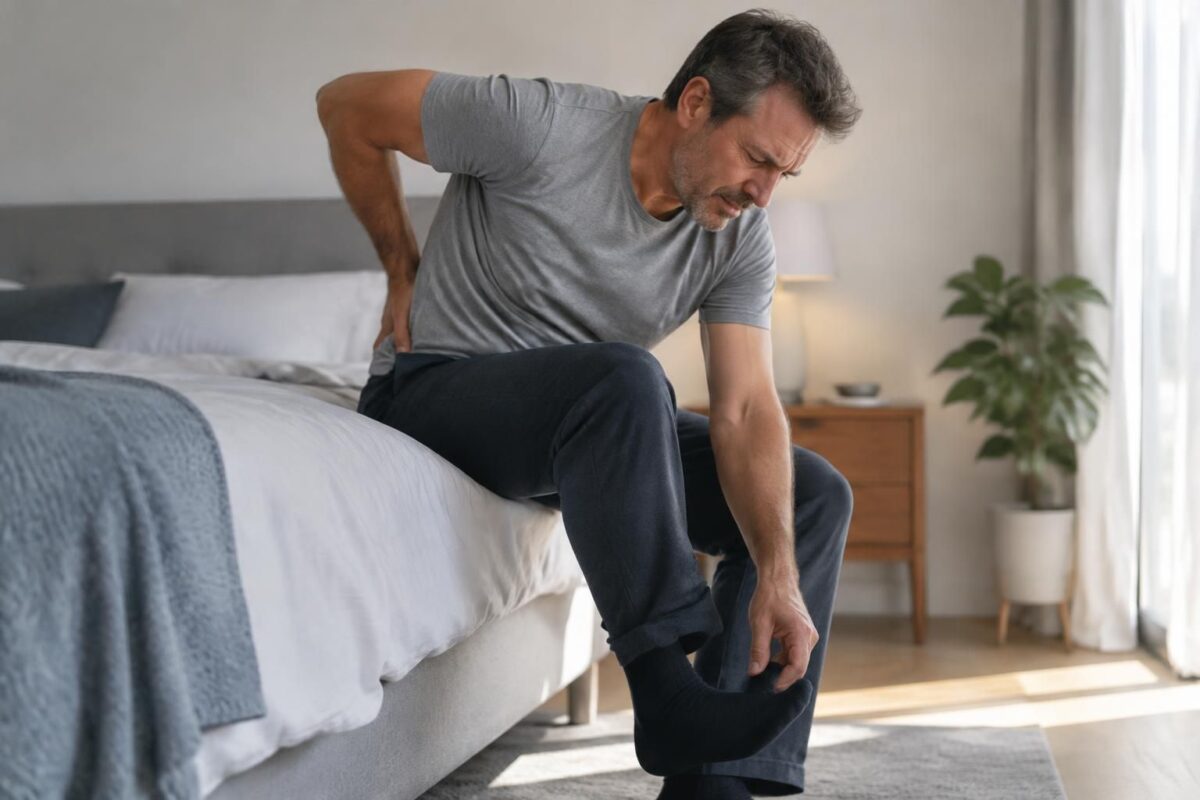
Sciatica and putting on socks: bending and pain in the leg
IN BRIEF Sciatica can make it difficult to put on your socks: bending over can increase the pain that radiates down the leg. Sitting down, using a sock aid, or avoiding painful bends can make this daily task easier. If…
Monitor reactions during and after walking
Observe the evolution of your symptoms throughout the outing. Slight and stable discomfort may sometimes be tolerated, but pain that intensifies, becomes electric, or radiates lower down the leg should prompt you to reduce your effort. Adjust your pace or stop walking if necessary, rather than trying to “push through.”
Also assess your condition after the outing and in the following hours. If symptoms quickly return to their usual level, your effort may have been appropriate. If they remain significantly worsened, shorten the next outing and seek advice from a professional. Note the duration, terrain, and sensations experienced: these markers can help adjust your return.
When to seek medical advice
Strict and prolonged rest is generally not advised for common sciatica, but each situation is different. A doctor or physiotherapist can help you define a suitable activity, especially if the pain persists, disrupts your sleep, or significantly limits your mobility. Do not modify a prescribed treatment without discussing it with the professional overseeing your care.
Consult urgently if you experience new weakness in the leg or foot, unusual urinary or intestinal troubles, or numbness in the area between the legs. These signs require rapid medical evaluation. For other issues, a gradual return, guided by your feelings and adjusted as needed, helps you maintain movement without exceeding your tolerance.
Sciatica and Daily Walking: Respecting Your Tolerance
| Situation | Practical Guideline |
|---|---|
| Beginning of the walk | Start with a few minutes at a moderate pace. |
| Bearable and stable pain | Continue gently, without increasing the pace. |
| Pain intensifying or radiating further down the leg | Slow down, take a break, or stop the outing. |
| Long route | Break it down and plan regular breaks. |
| Uneven terrain or uncomfortable shoes | Choose stable ground and well-cushioned shoes. |
| After the walk | Monitor the evolution of symptoms and adjust the next outing. |
| Leg weakness, perineal numbness, or urinary issues | Seek urgent medical evaluation. |
Sciatica and Daily Walking: Testimonials to Respect Your Tolerance
The testimonials below are illustrative examples. Each sciatica evolves differently: consult a healthcare professional to adapt your activity to your situation.
“At first, I wanted to go for my usual walk despite the pain. I realized it was better to break it up: a few minutes in the morning, then another short outing later. By going at my own pace and taking breaks, I felt more comfortable.” — Marc, 52 years old
“When the pain radiated further down my leg, I slowed down or stopped. I learned not to turn every walk into a challenge. My physical therapist helped me find a suitable duration and gradually get back to it.” — Sophie, 44 years old
“I thought I had to stay lying down until the pain was completely gone. My doctor advised me to keep moving a little, without pushing. Short walks on flat ground allowed me to move while monitoring my sensations.” — Alain, 61 years old
“I switched my shoes and chose a more regular route. I now walk at a comfortable pace, without trying to go fast. If the discomfort increases or doesn’t decrease after a break, I go home and talk to my healthcare professional.” — Nadia, 39 years old
“Some days, I can walk longer; on others, I have to stop after a few minutes. Accepting this variation has prevented me from feeling guilty and pushing my limits. I ease back into it rather than compensating the next day.” — Éric, 57 years old
If walking causes a clear or lasting worsening of pain, adjust the effort and consult a healthcare professional. New weakness in the leg or foot, perineal numbness, or urinary issues require urgent medical evaluation.
Sciatica and Daily Walking: Respecting Your Tolerance with Sylvain Desforges’ Approach
Sylvain Desforges is an expert in osteopathy, naturopathy, and manual medicine. Founder and president of TAGMED clinics and the ACMA association, he has dedicated his career to innovation in health and supporting individuals suffering from persistent pain. His approach emphasizes care based on scientific data, tailored to the needs and abilities of each patient.
Sciatica can make daily activities like walking difficult. Pain, tingling, or a burning sensation can start from the lower back and radiate to the buttock, thigh, or even the calf or foot. Since causes and symptoms vary from person to person, there is no duration or walking pace suitable for everyone. The key is to stay active without ignoring your body’s signals.
In personalized care, walking can be gradually resumed when symptoms allow. Rather than immediately aiming for a long walk, it is often better to start with short periods at a comfortable pace and then adjust based on how the body responds. Breaking walks into segments and taking breaks can help maintain movement without exceeding tolerance. The goal is not to walk “despite everything,” but to find an activity that does not cause lasting aggravation.
To guide this process, Dr. Desforges focuses on managing chronic pain and integrating advanced technologies, including spinal decompression, laser, and shockwave therapy. These tools do not replace individual evaluation: their relevance depends on the situation and the assessment made by a professional. Serious care also considers the evolution of symptoms, movement habits, and activities that the person wishes to resume.
In daily life, a few adaptations can make walking more comfortable. Choosing even terrain, wearing supportive shoes, and maintaining a moderate pace are helpful guidelines. It is also possible to shorten the route, stop before discomfort becomes significant, or change positions throughout the day. The posture should remain natural: trying to stand upright without tensing can be more comfortable than attempting to control every step.
After a walk, observe how symptoms evolve. Mild and temporary discomfort does not have the same significance as pain that intensifies, radiates further down the leg, or remains clearly worsened. In the latter case, reduce the duration or intensity of the walk and consult a healthcare professional. Also, avoid starting exercises or treatments without ensuring they are suitable for your situation.
Sylvain Desforges’ professional background combines manual medicine, naturopathy, and therapeutic innovation around one goal: to provide individualized care aimed at improving health and well-being. In the face of sciatica, this approach involves taking into account each person’s tolerance and re-evaluating choices as recovery progresses. New leg weakness, urinary issues, or perineal numbness require urgent medical evaluation.
With a sciatica, walking can remain possible if it is adapted to your sensations: start gently, prioritize short and regular routes, then adjust the pace and duration according to your tolerance. The goal is not to push, but to maintain comfortable mobility, seeking advice from a healthcare professional if the pain worsens or if you have any doubts.
Respecting Your Daily Tolerance
The right amount of walking varies from person to person and can change from day to day. Start with a few minutes on level ground at a leisurely pace. If the pain remains stable or eases, gradually increase the duration. Conversely, if it intensifies, radiates further down the leg, or persists after exertion, slow down, take a break, or shorten the outing. Tips for adjusting duration, pace, and precautions are provided in these resources on walking with sciatica, its benefits and precautions to take, and the recommended walking pace.
Breaking up the activity is often easier than aiming for a long walk: several short outings can help you stay mobile without exceeding your current capabilities. Alternate walking, breaks, and position changes, especially if the transitions between sitting and standing trigger the pain. You can find information about this type of discomfort during sitting-standing transitions.
A relaxed posture, a steady pace, and comfortable shoes can make movements more enjoyable. Choose a stable route and avoid, when your symptoms are sensitive, slippery or uneven surfaces, which can cause reflex tension. These precautions are detailed in articles on walking on icy pavements and the possible influence of shoes on sciatic pain. Other practical guidelines are also available regarding the compatibility between sciatica and walking.
Do not try to apply a standard exercise program without taking your situation into account. The origin of the symptoms and their evolution influence the movements that suit you. Morning pain or lumbar stiffness, for example, may require adjustments to your movements and activity resumption; you will find information on waking stiffness associated with a herniated disc. Furthermore, a visible anomaly on imaging does not always correspond to the severity of the symptoms: this article explains why a herniated disc can be observed without pain.
If you wish to complement walking with targeted movements, do them without provoking additional pain and stop those that significantly worsen the symptoms. To know which exercises can be considered and which to avoid depending on the phase of sciatica, consult this guide on exercises to do or avoid. A physiotherapist or doctor can help you choose suitable activities and gradually resume them.
Seek medical advice promptly if the pain is accompanied by new weakness in the leg or foot, numbness in the perineal area, urinary issues, or fever. These signs require immediate evaluation. Outside of these situations, use your response to activity as a guide: proceed step by step, adjust without guilt, and consult a professional if the pain persists or evolves in a concerning way.

Sylvain Desforges, B.Sc., D.O., N.D., docteur en ostéopathie
Dr Sylvain Desforges, B.Sc., D.O., N.D., osteopath, is the founding president of TAGMED and of the ACMA association. He dedicates his practice to chronic spinal pain, low back pain and symptoms compatible with sciatica, particularly when pain radiates toward the buttock, leg, calf, foot or toes.
Through SOS Sciatique, he publishes educational content on sciatica symptoms, possible causes such as disc herniation, disc narrowing, foraminal stenosis or irritation of a lumbar nerve root, as well as non-surgical approaches that may be considered according to the evaluation. At Clinique TAGMED, care may include, depending on the case, motorized neurovertebral decompression, specific osteopathic care or precision percussion.
For an evaluation related to sciatica treatment in Montreal / Mount Royal or sciatica treatment in Terrebonne, please consult the services available at Clinique TAGMED.
Medical disclaimer
The information published on SOS Sciatique is provided for educational purposes only and does not replace a consultation, diagnosis, opinion or treatment provided by a physician or another authorized healthcare professional. The author of this article is neither a medical doctor nor a specialist in a medical specialty recognized by the Collège des médecins du Québec. The osteopathic, manual medicine or functional support approaches described on this site do not constitute medical acts and are not intended to replace medical follow-up.
Consult a physician or emergency service in cases of loss of bladder or bowel control, anesthesia in the saddle area, significant or progressive weakness in the leg or foot, fever, recent trauma, severe pain or rapid worsening of symptoms. For more details, please read our Legal Notice.