Sciatica and pain in lying position
12/10/2026
Sciatica and stationary bike: useful or aggravating depending on the case
12/10/2026
IN BRIEF
| A disc herniation is a disc that bulges beyond its contour; tingling in the toes can sometimes be related to irritation of a lumbar nerve, without MRI sufficiently confirming the cause. An examination connects the image, symptoms, and strength to guide management. Consult quickly in case of progressive weakness or urinary or bowel disturbances. |
A disc herniation can sometimes irritate a nerve root and cause tingling that travels down the leg to the toes. However, this symptom alone does not confirm that the herniation is the cause: MRI must be interpreted alongside symptoms and clinical examination. Consult a healthcare professional, especially if the tingling persists or is accompanied by weakness. Progressive weakness, loss of bladder or bowel control, or loss of sensation in the saddle area require urgent evaluation.
A disc herniation can sometimes irritate a nerve root and cause tingling all the way to the toes. But a visible abnormality on MRI does not, on its own, prove the cause of the symptoms. The affected level, the path of sensations, the medical examination, and their evolution help guide management. Certain signs, such as progressive weakness or loss of bladder control, require urgent medical advice.
Disc herniation and tingling in the toes: what connection?
Intervertebral discs are located between the vertebrae. They help distribute stresses and allow movements of the spine. A disc herniation refers to the disc bulging beyond its normal shape. This term describes its appearance; it does not specify, on its own, whether a nerve is compressed or whether the herniation causes pain.
In the lower back, irritation of a nerve root can lead to sensations that radiate towards the buttock, leg, foot, or toes. Depending on the affected nerve, a person may experience tingling, numbness, shooting pain, or decreased sensitivity. These signs can appear with or without lower back pain.
A herniation can also be discovered incidentally. Some people have an abnormal image without corresponding symptoms. To understand the connection between symptoms and imaging, consult our page on sciatica and disc herniation.
Disc bulge and diagnosis not to be simplified
IN BRIEF A disc bulge is a protrusion of a disc visible on imaging; it is not sufficient on its own to explain pain or to make a diagnosis. Its interpretation must take into account symptoms, clinical examination, and context.…
Disc bulge and lumbar osteoarthritis
IN BRIEF A disc bulge is a protrusion of the lumbar disc; wear can also contribute to lumbar osteoarthritis and lower back pain. Symptoms vary by individual and may sometimes radiate into the leg. Motion imaging may be considered by…
Which toes can be affected?
The area of tingling can provide an indication of the affected nerve, but it does not allow for self-diagnosis. The sensations may affect the big toe, other toes, the top of the foot, or the sole of the foot. Their distribution varies from person to person.
Lumbar involvement, for example at the L4-L5 or L5-S1 levels, can sometimes be accompanied by symptoms in the foot. The MRI report identifies an abnormality, but the healthcare professional must verify if this level corresponds to the sensations, strength, and examination results.
Tingling may also stem from a cause other than a disc, such as irritation of a nerve in the leg or foot, a circulation problem, or another medical condition. Thus, one should avoid concluding that any sensation in the toes originates from a herniation.

Disc bulge and narrowed foramen
IN BRIEF A disc bulge is a protrusion of the disc that can contribute to narrowing the foramen, the opening where a nerve root passes through. If this is irritated or compressed, pain, tingling, or weakness may occur, sometimes extending…

Disc bulge and loss of disc height
IN BRIEF A disc bulge is a protrusion of the disc between the vertebrae; a loss of disc height means that the disc has thinned. These changes may be related to wear and sometimes contribute to pain, stiffness, or nerve…
Tingling, sciatica, and nerve irritation
Sciatica describes pain related to irritation of a lumbar nerve root, generally radiating into the buttock and leg. Tingling may accompany it, but it is not present in all cases. Pain may also radiate down the leg without significant pain in the lower back. To learn more, read our article on pain radiating down the leg without back pain.
A herniation can contribute to nerve irritation if its position and other visible changes in the spine correspond with the symptoms. However, the presence of contact on an image does not automatically demonstrate significant compression. The meaning of the term “conflict” must be verified based on the examination and clinical picture. Our page on mechanical compression of a nerve presents this distinction.

Disc bulging and disc degeneration
IN SHORT A disc bulge is a protrusion of the disc, sometimes associated with disc degeneration related to aging. These visible changes on imaging do not always cause symptoms. Their significance is determined by comparing the MRI to pain, strength,…

Herniated disc and recurring pain
IN BRIEF A disc bulge is a disc that protrudes without necessarily being ruptured; it does not always cause pain. When pain returns, it may be related to nerve irritation, but a professional must verify the link with the symptoms.…
How to interpret MRI results?
The MRI shows the structures of the spine, including the discs and the tissues around the nerves. It complements the evaluation but does not replace the medical examination. An image that appears significant may not explain the symptoms. Conversely, an abnormality described as subtle may be relevant if it corresponds to the observed signs.
To prepare for a consultation, keep the complete report and note:
- how long the tingling has been present;
- which toes and parts of the foot are affected;
- whether the sensations remain stable, decrease, or extend;
- whether pain radiates down the leg or if strength has changed;
- what becomes difficult daily, such as walking, sleeping, or working.
This description helps the professional compare the image, symptoms, and examination. The page on the evolution of pain trajectory explains why changes in symptoms deserve to be reported.

Disc bulge and pain after exertion
IN BRIEF A disc bulge is a disc that slightly protrudes between two vertebrae; after exertion, it may be associated with low back pain, sometimes radiating into the leg. An imaging result alone is not enough to explain the pain…

Disc bulge and tingling in the foot
IN SHORT A disc bulge refers to a disc that bulges beyond its boundary; if it irritates a nerve root, it can contribute to tingling in the foot, numbness, or pain in the leg. However, MRI alone is not sufficient…
When to seek prompt consultation?
Medical advice is indicated if tingling persists, worsens, spreads, or is accompanied by decreased strength. Rapid evaluation is necessary in case of new or marked symptoms, especially if the individual has difficulty raising the foot or walking normally.
Contact emergency services immediately if you experience loss of control of the bladder or bowels, new difficulty urinating, loss of sensation around the perineum, or significant progressive weakness of a leg. A fever, recent trauma, or rapidly worsening pain also justify a rapid medical evaluation.
These signs do not allow for predicting the cause from a distance. They indicate that evaluation should not be delayed. Information on a possible acute sciatica may help prepare questions, but it does not replace urgent care if warning signs appear.
Management of a disc protrusion
Treatment depends on the pain, neurological signs, their duration, and their effect on activities. There is no single treatment suited to everyone. The doctor can discuss options with you regarding monitoring, pain relief, specialist referral, or other options based on the assessment.
Medications are not always suitable for everyone. Contraindications, ongoing treatments, pregnancy, or certain illnesses can alter available choices. Consult a doctor or pharmacist before starting, modifying, or extending a medication.
Surgery is not decided solely based on the presence of the word “protrusion” in a report. It may be discussed in certain situations, particularly in the presence of neurological deficits or persistent and debilitating symptoms after a proper evaluation. Options are considered based on the benefits and risks for the individual.
Additional Assessment at TAGMED Clinic
The TAGMED Clinic offers evaluations and non-surgical care that may include, depending on the situation, specific osteopathy, precision percussion, or motorized neurovertebral decompression. These approaches do not replace a medical diagnosis and are not suitable for all cases. An evaluation helps determine if they can be considered as a complement to medical follow-up.
To learn about available services, check the pages on sciatica treatment in Montreal and Mont-Royal or sciatica treatment in Terrebonne.
Frequently Asked Questions
Can a disc protrusion cause tingling in the toes?
Yes, if it contributes to irritating a lumbar nerve root. However, it must be verified that the imaging location corresponds to the symptoms. Other causes can also lead to tingling in the foot.
Do tingling sensations mean the nerve is severely compressed?
No. Tingling indicates an abnormal sensation, but it does not solely measure the severity of a compression. The medical examination specifically checks strength, sensitivity, and symptom progression.
Does a disc protrusion require surgery?
No, not automatically. The decision depends on symptoms, examination, progression, and response to the proposed care. An image alone is not sufficient to determine that surgery is necessary.
Can you have sciatica without back pain?
Yes. Some nerve-related pains can radiate into the buttock or leg without marked lower back pain. It remains necessary to assess any persistent symptoms or those accompanied by weakness.
About the Author
Sylvain Desforges, B.Sc., D.O., N.D., Doctor of Osteopathy, is the founding president of TAGMED and the ACMA association. He dedicates his practice to chronic spinal pain, lower back pain, and pain compatible with sciatica, particularly when the pain radiates towards the buttock, leg, calf, foot, or toes.
Through SOS Sciatique, he publishes educational content on sciatica symptoms, possible causes like disc herniation, disc pinching, foraminal stenosis, or irritation of a lumbar nerve root, as well as on non-surgical approaches that may be considered based on the evaluation. At the TAGMED Clinic, care may include, depending on the case, motorized neurovertebral decompression, specific osteopathy, or precision percussion.
For an evaluation related to the sciatica treatment in Montreal / Mont-Royal or the sciatica treatment in Terrebonne, check the available services at the TAGMED Clinic.
Medical Disclaimer
The information and advice provided on this site do not replace the opinion, diagnosis, or treatment of a healthcare professional. Please note that Sylvain Desforges, B.Sc., D.O., N.D., Doctor of Osteopathy, is neither a medical doctor nor a physician and is not a specialist in a medical specialty as defined by the Collège des médecins du Québec. Manual medicine, functional medicine, and sports medicine as described on this site exclude any treatment or medical diagnosis by a physician or medical specialist. Always consult your doctor for any medical questions. For more details, please read our Complete Legal Notice.
To Observe
- Tingling may suggest nerve irritation, without proving that the protrusion is the cause.
- Note the affected toes, the duration, and the progression of sensations.
- A new or progressive weakness warrants prompt medical advice.
To Do
- Ensure that the MRI is correlated with the symptoms and clinical examination.
- Consult if the tingling persists, extends, or worsens.
- In case of urinary or intestinal issues, or perineum numbness, seek emergency care.

Tingling in the toes can sometimes be associated with a lumbar disc protrusion, particularly if it irritates a nerve root. However, an MRI image alone is not sufficient to establish the cause of the symptoms. Their location, duration, associated signs, and clinical examination help determine the course of action. Here are some guidelines to act cautiously and prepare for a useful consultation.
Understanding the Possible Link Between the Disc and the Toes
A disc protrusion corresponds to a bulge of the disc between two vertebrae. If it is located in the lower back and irritates a nerve root, it can contribute to sensations of tingling, numbness, or burning that descend into the buttock, leg, and sometimes down to the foot or toes.
The path of the sensations can guide the evaluation, but it cannot alone lead to a diagnosis. Tingling may also have other causes, such as localized nerve compression, certain diseases, or medication effects. A protrusion visible on MRI may also provoke no symptoms. Therefore, it is necessary to relate the imaging to what you feel and to the examination conducted by a professional.
Observe symptoms without jumping to conclusions
Note their evolution
Identify how long the tingling has been present, which toes are affected, whether it concerns one foot or both, and whether it is continuous or intermittent. Also, note the positions or activities that change these sensations, as well as their influence on walking, sleeping, and daily activities. This information can help the doctor assess the situation.
Especially watch for the onset of weakness, such as difficulty in lifting the foot, walking on heels, or maintaining balance. An expanding loss of sensation or worsening pain should also be reported promptly.
Adapt activity and prepare for a consultation
In the absence of signs of urgency, avoid staying still for long if it increases discomfort. Changes in position and gentle activity, such as short walks according to your tolerance, may be preferable to prolonged bed rest. However, do not force a movement that clearly triggers pain or tingling, and avoid starting intense exercises without appropriate advice for your situation.
If symptoms persist, return, or limit your activities, make an appointment with a healthcare professional. Bring the imaging report, if you have one, and a list of treatments you have already tried. Ask how the MRI results correspond to your symptoms and what signs should lead to a reevaluation. Do not alter a treatment on your own and seek advice before taking a medication, especially if you have other health issues or are already on medication.
Recognize signs that require prompt help
Consult immediately in case of loss of control of the bladder or bowels, numbness in the perineal area, or significant or progressive weakness of a leg or foot. Severe pain that worsens rapidly, fever, or recent trauma also justifies prompt medical advice. These signs require urgent evaluation, regardless of what is indicated on the MRI.
About the author
Sylvain Desforges, B.Sc., D.O., N.D., Doctor of Osteopathy, is the founding president of TAGMED and the ACMA association. His practice focuses particularly on chronic spinal pain, lower back pain, and pain compatible with sciatica. The proposed treatments may include, depending on the evaluation, specific osteopathy, motorized neurovertebral decompression, or precision percussion.
Medical disclaimer
This information is educational and does not replace a consultation, diagnosis, or treatment by a licensed healthcare professional. The author is neither a doctor nor a specialist in a medical specialty recognized by the Collège des médecins du Québec. Manual or functional approaches do not replace medical follow-up.
| Marker | To remember |
|---|---|
| Disc protrusion | A bulge of the disc, which does not alone prove the cause of the symptoms. |
| Tingling in the toes | Can indicate nerve irritation, depending on their path and associated signs. |
| Link with MRI | The location must correspond to the symptoms and clinical examination. |
| To note | How long, which toes are affected, and whether discomfort extends to the leg. |
| When to consult | If tingling persists, worsens, or is accompanied by a decrease in strength. |
| Urgency | Progressive weakness, loss of bladder or bowel control, or numbness of the perineum. |
Illustrative testimonies: disc protrusion and tingling in the toes
Note: the stories below are fictional examples created to illustrate possible situations. They do not correspond to identifiable patients and do not allow for a diagnosis. Tingling in the toes can have various causes; their link to a disc protrusion should be evaluated by a healthcare professional.
Marc, 46 years old — tingling appeared with low back pain
“I had been in pain in my lower back for several days, then tingling appeared in a few toes. While reading my MRI report, I saw the mention of a disc protrusion and immediately thought that everything stemmed from there. My doctor compared the image with the path of the pain and the examination of my leg. I understood that the MRI result needed to be interpreted in the context of my symptoms, not in isolation.”
Julie, 39 years old — discomfort mainly in a seated position
“The tingling was more pronounced after a long period of sitting and sometimes decreased when I changed positions. The mention of a lumbar protrusion worried me, but I didn’t know if it truly explained what I was feeling. I reported to the healthcare professional the moments when the tingling occurred, its duration, and the actions that changed it. This description made the consultation more concrete.”
Karim, 58 years old — symptoms that evolved
“At first, I felt only slight tingling in my toes. When unusual weakness appeared in my foot, I sought medical advice quickly instead of waiting or relying solely on my MRI. The evaluation helped me clarify the next steps to take.”
Élise, 51 years old — a protrusion discovered on an MRI
“My imaging exam mentioned a disc protrusion, but my tingling was intermittent and I didn’t always have back pain. I learned that an image is not enough to confirm the cause of sensations in the toes. I noted their location, frequency, and other symptoms, then discussed them with my doctor.”
These examples remind us that a protrusion visible on an MRI and tingling can coexist without the image necessarily explaining the symptoms alone. The level of the disc, the path of the sensations, the strength, and the clinical examination help the professional assess the situation.
In case of significant or progressive weakness, loss of bladder or bowel control, or numbness in the saddle area, seek medical evaluation quickly. These signs require urgent attention.
Disc protrusion and tingling in the toes: understanding the link
Discovering a disc protrusion on an MRI can raise concerns, especially when tingling appears in the toes. However, these two elements are not automatically linked. A protrusion describes an intervertebral disc that bulges out of its usual shape, but this term alone does not suffice to determine the cause of the symptoms, their severity, or the necessary treatment. The interpretation notably depends on the clinical examination and the correlation between the image and the sensations experienced.
The discs located between the vertebrae help absorb the stresses on the spine. A lumbar protrusion, for example at L4-L5 or L5-S1, can sometimes reduce the space available near a nerve root. If this root is irritated, symptoms may appear in the buttock, leg, or foot. The tingling in the toes, a sensation of numbness, or pain radiating down the leg may then be part of the symptoms to be assessed. However, their presence alone does not prove that a protrusion is responsible.
The path of sensations provides useful information to the healthcare professional. It may be relevant to note which toes are affected, whether the tingling occurs on one side only, how long it has been present, and whether it varies with certain positions or activities. Low back pain accompanied by radiation towards the foot is not understood in the same way as isolated tingling. Other causes, such as nerve irritation from another level, a peripheral issue, or certain medical conditions, can also lead to similar sensations.
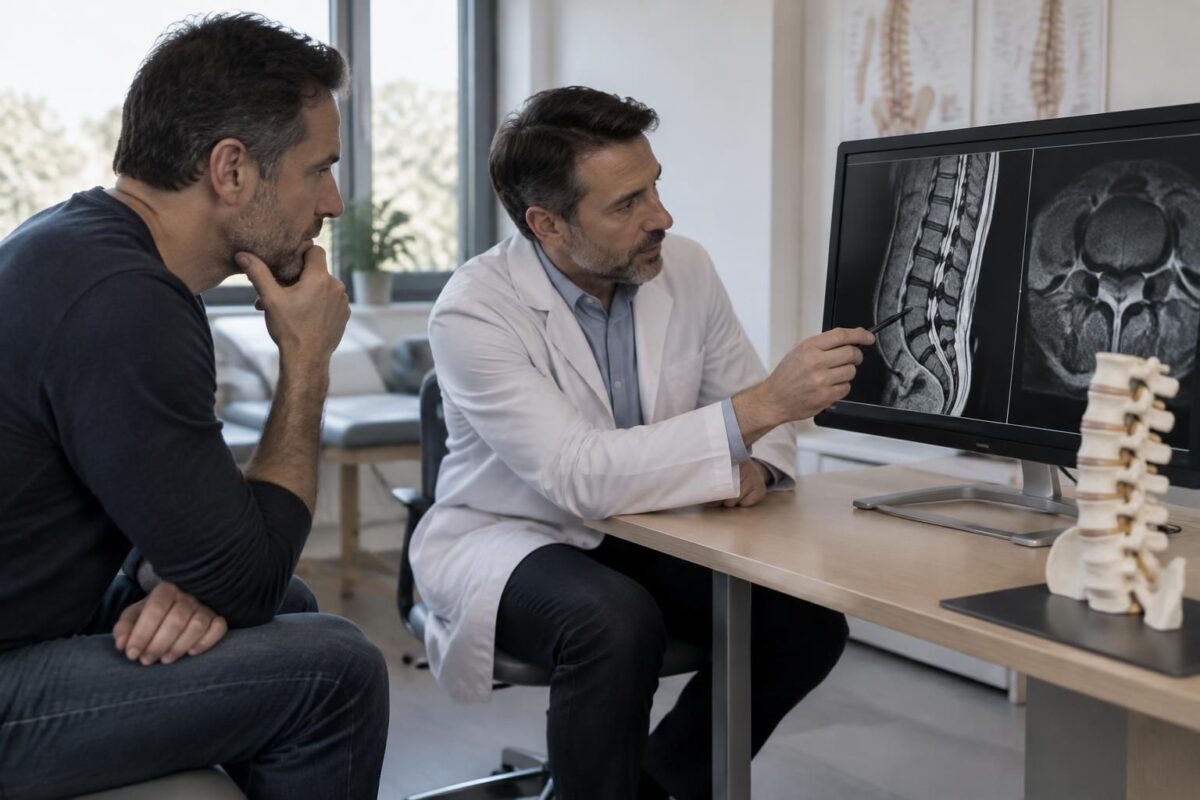
The MRI report must therefore be compared with the symptoms and the examination. The professional can check sensitivity, strength, and certain movements, then determine whether the level indicated by the imaging corresponds to the observed picture. A protrusion may be visible without causing discomfort, while significant pain may result from multiple factors. It is best to avoid drawing a conclusion from a single word in the report or modifying one’s activities and treatments independently.
Management is tailored to each situation. Depending on the assessment, it may include medical follow-up, a gradual return to tolerated activities, physiotherapy, or measures aimed at managing pain. Medications are not suitable for everyone: their choice depends on medical history, treatments already taken, and contraindications. A pharmacist or doctor can help check their relevance. A surgical intervention is not decided solely based on the presence of a protrusion on an MRI; it is discussed based on all symptoms, their evolution, and the results of the examination.
Certain signs require rapid evaluation: a new or progressive weakness of the foot or leg, loss of bladder or bowel control, or loss of sensitivity in the saddle area. Medical advice should also be sought in case of fever, recent trauma, severe pain, or rapid deterioration. To prepare for a consultation, bring the imaging report and clearly describe the evolution of the tingling, the affected areas, and difficulties in your daily activities.
About the author
Sylvain Desforges, B.Sc., D.O., N.D., Doctor of Osteopathy, is the founding president of TAGMED clinics and the ACMA association. His practice focuses on managing chronic pain and integrating approaches and technologies, including neuro-vertebral decompression, laser, and shockwave therapy. The care provided is determined according to the evaluation of each individual.
Medical Disclaimer
This content is provided for educational purposes and does not replace a consultation, diagnosis, or treatment by a physician or other authorized healthcare professional. The author is neither a doctor nor a specialist in a medical specialty recognized by the Collège des médecins du Québec. Osteopathy, manual medicine, and functional support approaches do not constitute medical acts and do not replace medical follow-up. In case of urinary or bowel issues, numbness in the saddle area, significant or progressive weakness, fever, recent trauma, or rapid deterioration, promptly consult a healthcare professional or emergency service.
A disc protrusion can sometimes irritate a nerve root and be accompanied by tingling in the toes, but an MRI image alone is not enough to establish the cause of the sensations. The course of the symptoms, their duration, sensitivity, and strength must be evaluated together. Progressive weakness, numbness in the saddle area, or urinary or bowel issues warrant urgent evaluation.
A protrusion corresponds to a bulge of the intervertebral disc. It may be visible on an MRI without causing symptoms; conversely, tingling may occur with nerve irritation whose extent must be determined by a professional. To better understand what the imaging report may — and may not — indicate, consult this presentation on disc protrusion, MRI and symptoms.
When the problem concerns the lower back, a protrusion at L4-L5 may be examined in relation to pain radiating towards the buttock or leg. However, the presence of tingling in the toes does not, by itself, affirm that this level is involved. The professional checks whether the path of sensations, the clinical examination, and the images correspond. Additional reference points are presented in this article on L4-L5 protrusion and possible sciatica signs, as well as in this file dedicated to L4-L5 disc protrusion.
Sensations to describe precisely
To help guide the assessment, note which toes are affected, whether the tingling affects one foot or both, when it started, and whether it is continuous or intermittent. Also specify whether it appears with low back pain, radiation in the leg, numbness, or difficulty walking. Tingling lasting several days deserves appropriate attention: it can have various causes and is not necessarily attributable to a disc. You can read general information on persistent tingling in the toes.
Pain that descends to the calf or foot can also be described by specifying its evolution and the movements that modify it. The calf pain associated with a disc protrusion and pain that extends lower after a movement are situations to discuss based on symptoms and examination, as this content on pain that descends the leg after a movement reminds us.
What signs require prompt attention?
A new or progressive loss of strength in the foot or leg, increasing difficulty lifting the foot, significant loss of sensitivity, or rapidly worsening pain require contacting a healthcare professional without delay. Weakness in the foot should not be minimized: it needs to be evaluated, especially when accompanied by pain radiating down the leg. To better understand this sign, refer to this article on the weakness of the foot.
If you have difficulty urinating, incontinence, loss of bowel control, or numbness around the perineum, seek emergency services immediately. These signs should not wait for a routine consultation or be interpreted solely from MRI findings.
Evaluation and Management
The healthcare professional correlates symptoms, strength and sensitivity examinations, as well as imaging results. Treatment depends on this evaluation and its impact on walking, sleeping, and daily activities. It may include conservative management and a gradual return to activities, with appropriate support. A general overview of the options is available on the causes, symptoms, and treatments of disc protrusion.
Avoid resuming exercises that increase tingling or cause pain to descend further down the leg on your own. Some movements may be poorly tolerated depending on the situation; seek advice before continuing them. You can consult these explanations on the stretches that may worsen certain symptoms and on physical therapy in daily life for disc protrusion.
For the appointment, bring the complete report and summarize how long the sensations have been present, their distribution, the actions that trigger them, and any changes in strength or walking. This information helps the professional decide if further tests or referrals are necessary.
About the Author
Sylvain Desforges, B.Sc., D.O., N.D., Doctor of Osteopathy, is the founding president of TAGMED and the ACMA association. He dedicates his practice to chronic spinal pain, low back pain, and pain compatible with sciatica, particularly when the pain descends toward the buttock, leg, calf, foot, or toes.
Through SOS Sciatique, he publishes educational content on sciatica symptoms, possible causes like disc herniation, disc pinching, foraminal stenosis, or irritation of a lumbar nerve root, as well as on non-surgical approaches that may be considered based on the evaluation. At the TAGMED Clinic, care may include, depending on the case, motorized neurovertebral decompression, specific osteopathy, or precision impact therapy.
For an evaluation related to sciatica treatment in Montreal / Mont-Royal or sciatica treatment in Terrebonne, check the services available at Clinique TAGMED.
Medical Disclaimer
The information published on SOS Sciatique is provided for educational purposes and does not replace a consultation, diagnosis, advice, or treatment performed by a physician or another licensed healthcare professional. The author of this article is neither a physician nor a specialist in a medical specialty recognized by the Collège des médecins du Québec. The osteopathy, manual medicine, or functional support approaches described on this site do not constitute medical acts and are not intended to replace medical care.
Consult a doctor or emergency service in case of loss of urinary or bowel control, numbness in the saddle area, significant or progressive weakness in the leg or foot, fever, recent trauma, severe pain, or rapid deterioration. For more details, please read our Legal Notice.

Sylvain Desforges, B.Sc., D.O., N.D., docteur en ostéopathie
Dr Sylvain Desforges, B.Sc., D.O., N.D., osteopath, is the founding president of TAGMED and of the ACMA association. He dedicates his practice to chronic spinal pain, low back pain and symptoms compatible with sciatica, particularly when pain radiates toward the buttock, leg, calf, foot or toes.
Through SOS Sciatique, he publishes educational content on sciatica symptoms, possible causes such as disc herniation, disc narrowing, foraminal stenosis or irritation of a lumbar nerve root, as well as non-surgical approaches that may be considered according to the evaluation. At Clinique TAGMED, care may include, depending on the case, motorized neurovertebral decompression, specific osteopathic care or precision percussion.
For an evaluation related to sciatica treatment in Montreal / Mount Royal or sciatica treatment in Terrebonne, please consult the services available at Clinique TAGMED.
Medical disclaimer
The information published on SOS Sciatique is provided for educational purposes only and does not replace a consultation, diagnosis, opinion or treatment provided by a physician or another authorized healthcare professional. The author of this article is neither a medical doctor nor a specialist in a medical specialty recognized by the Collège des médecins du Québec. The osteopathic, manual medicine or functional support approaches described on this site do not constitute medical acts and are not intended to replace medical follow-up.
Consult a physician or emergency service in cases of loss of bladder or bowel control, anesthesia in the saddle area, significant or progressive weakness in the leg or foot, fever, recent trauma, severe pain or rapid worsening of symptoms. For more details, please read our Legal Notice.