Sciatica and difficulty walking on heels: possible L5 root
06/09/2026
Sciatica and walking: helpful or aggravating?
06/09/2026IN BRIEF
| In brief, a herniated disc is a prolapse of the intervertebral disc that can lead to mechanical compression of the nerve root, causing pain and numbness that often radiate down the leg. This compression explains radiculopathy and sensations of burning or tingling. Its main advantages lie in a rapid evaluation that distinguishes between urgency and discomfort, effective conservative management in most cases, and prevention of nerve damage; surgery remains rare and reserved for progressive or severe deficits. In practice, it guides toward simple actions and exercises to relieve pressure, improve posture, and promote pain-free activity resumption, while staying alert to warning signs that require immediate consultation. |
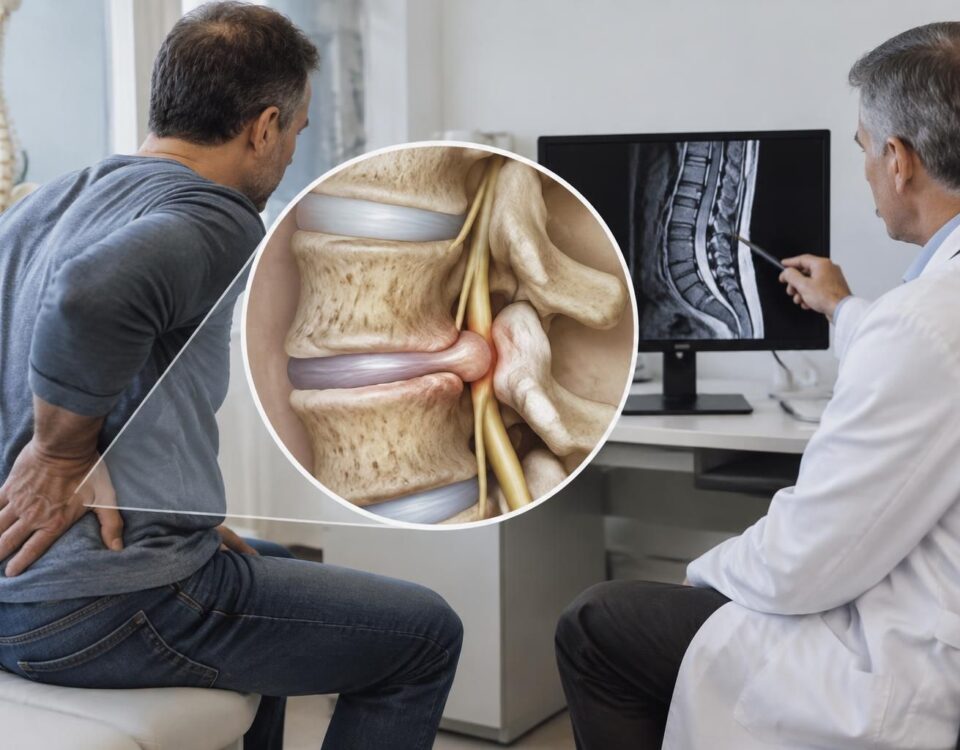
A herniated disc occurs when the nucleus pulposus of an intervertebral disc migrates through a tear in the fibrous ring and compresses a neighboring nerve root. This mechanical compression is the primary cause of pain and symptoms that radiate along the affected nerve.
The hallmark sign is pain that can radiate down the leg (sciatica) sometimes accompanied by numbness, tingling, and in some cases, muscle weakness that limits walking or foot lifting.
Emergency signs:
- Motor deficit (loss of strength, foot drop)
- Cauda equina syndrome (urinary issues, perineal anesthesia) — immediate surgical emergency
- Severe pain that does not subside with rest and treatment
The diagnosis relies on MRI or CT imaging. The initial treatment is conservative: appropriate activity resumption, analgesics, anti-inflammatories, and physical therapy; some cases may require injections or surgery if deficits progress or persist.
On average, symptoms improve without surgery over several weeks; most hernias partially or completely resolve over several months.
This guide, written by a health professional expert in osteopathy, clearly presents how a herniated disc can cause mechanical compression of the nerve. You will discover the mechanisms, signs, diagnosis, management options, and emergency signs to know. The goal is to help distinguish common discomfort from urgency and guide toward appropriate management without unnecessarily resorting to inappropriate exercises in the context of neurovertebral decompression.
About the Author
Dr. Sylvain Desforges, B.Sc., D.O., N.D., osteopath, is the founding president of
TAGMED
and of the ACMA association. He dedicates his practice to chronic pain of the spine, low back pain, and pain compatible with sciatica, especially when the pain radiates toward the buttock, leg, calf, foot, or toes.
Through SOS Sciatique, he publishes educational content on the symptoms of sciatica, possible causes such as herniated disc, disc pinch, foraminal stenosis, or irritation of a lumbar nerve root, as well as non-surgical approaches that may be considered based on the evaluation. At TAGMED Clinic, care may include, depending on the case, motorized neurovertebral decompression, specific osteopathy, or precision percussion.
For an evaluation related to
sciatica treatment in Montreal / Mont-Royal
or to
sciatica treatment in Terrebonne,
please consult the available services at the
TAGMED Clinic.
Medical Disclaimer
The information published on SOS Sciatique is provided for educational purposes and does not replace a consultation, diagnosis, advice, or treatment provided by a physician or another authorized healthcare professional. The author of this article is neither a physician nor a specialist in a medical specialty recognized by the Collège des médecins du Québec. The approaches of osteopathy, manual medicine, or functional support described on this site do not constitute medical acts and are not intended to replace medical follow-up.
Mechanical compression comes from a shift in the content of the intervertebral disc when its gelatinous nucleus pushes through the fibrous ring. This protrusion or herniated disc can then directly press on a neighboring nerve root, generating radicular pain and sensory or motor disturbances.
How Compression Occurs
The intervertebral disc acts as a cushion between vertebrae. Its core is gelatinous and its casing is robust. Sometimes, the nucleus leaks through this torn casing. This displaced material can then compress the adjacent nerve root. This mechanical compression disrupts the transmission of nerve messages to the leg and foot.
The affected nerve is often the sciatic nerve, the longest in the body. It starts in the lower back, travels through the buttock, and continues down the leg to the foot. An upstream compression affects its pathway, resulting in symptoms that radiate from the back to the foot.
To enrich your understanding, you can consult specific resources on the evaluation and mechanisms related to disc pathology through the following pages:
Sequestered herniated disc and sciatica: why evaluation is important,
and Paramedian herniated disc and possible painful pathway.
Signs and Symptoms
The main symptom is a sensation of numbness or paresthesia along the path of the nerve. Numbness of the foot can be a sign that the nerve is compressed higher up in the back. Other common manifestations include pain radiating from behind the thigh to the foot and muscle weakness if the compression is significant.
It is important to distinguish the manifestations according to the affected nerve. A herniated disk compressing the sciatic nerve causes pain that follows the posterior path from the thigh to the foot. A femoral nerve involvement is rather manifested by pain at the front of the thigh.
The pain may sometimes manifest as an electric or burning sensation. Sensory disturbances (tingling, prickling) and a loss of muscle control are signs that require rapid evaluation.
In case of a sudden disappearance of pain with the persistence of motor deficits or numbness, one must remain vigilant: this may indicate more severe nerve damage and require quick intervention.
Diagnosis and distinction
The diagnosis relies on the medical history and clinical examination, then is confirmed by medical imaging. MRI or CT scans help identify the precise level of the lesion and its compressive nature. In some cases, additional assessments help determine the involved root.
Note that several conditions can mimic a herniated disk with a numb foot. Other causes such as non-disk-related foot conditions or vascular pathologies may need to be considered and differentiated by a professional.
To delve deeper into the link between pain and location, also see the resources on centralizing pain and the associated inflammatory mechanisms:
centralizing pain and signs to interpret.
Management and treatments
The initial treatment can be conservative and focused on reducing pressure on the nerve and supporting the lumbar spine. At TAGMED Clinic, non-surgical approaches and protocols tailored to each patient can be offered as part of a comprehensive management plan.
Neurovertebral decompression and other manual approaches may be considered depending on the evaluation. For information related to decompression and management of chronic herniated disks, consult neurovertebral decompression and chronic herniated disks – lasting relief.
The majority of mild cases evolve favorably with appropriate measures and postural strengthening. If neurological deficits progress, or in cases of stubborn pain, surgical options may be considered after specialized evaluation. Microdiscectomy and laminectomy are potential approaches when neurological deficits evolve or when relief from conservative treatments is insufficient. Indications and decisions are made after thorough consultation and appropriate imaging.
For additional information, consult the resources dedicated to the progression and localization of symptoms, including perspectives on the nerve path and areas to monitor. The goal remains to prioritize an approach tailored to each patient and to reduce the risks of long-term complications.
Emergencies and cauda equina syndrome
The absolute emergency scenario arises when severe neurological signs appear rapidly and spinal cord function is threatened. Symptoms to monitor include urinary disturbances, incontinence, loss of perineal sensation, or marked weakness of the lower limbs. In these cases, it is essential to contact emergency services immediately and go to the emergency room, as swift surgical intervention may be necessary.
In the event of loss of sensitivity at the perineum or difficulties in urinating, the reflex to adopt is to call emergency services without delay.
Prevention and daily management
Most sciatica related to a herniated disk can be managed without surgery. The goal is to limit mechanical pressure and avoid situations that exacerbate nerve compression. Common aggravating factors include prolonged sitting, sudden exertion, and movements that heavily strain the back. These situations should be limited, and habits that promote lumbar stability and appropriate mobility should be prioritized, without resorting to specific exercises or stretches for decompression.
Advice and additional resources are available, particularly around non-surgical approaches and options available at TAGMED Clinic. For more information on mechanisms and relief approaches, you may consult specialized resources online, especially the pages dedicated to decompression and sciatic pain. Notably, refer to the following resources to deepen the connection between your back and your foot and explore practical considerations related to pain and nerve function:
evaluation and context of the sequestrated herniated disk,
and herniated disk with foot weakness: to watch for.
For practical assistance and clinical support, contact the TAGMED Clinic or prioritize specialized resources in the field.
Additional elements and useful links
To delve deeper into the mechanisms and implications of nerve compression, here are additional resources intended to illuminate the nerve’s path and points of vigilance. Among them, resources focused on understanding the nerve path and signs to interpret:
Herniated disk and centralizing pain: centralization and signs to interpret.
Herniated disk and numb foot and other symptoms: numb foot and herniated disk.
Herniated disk and pain along the sciatic path: possible painful path.
For questions related to neurovertebral decompression and options for lasting relief, consult neurovertebral decompression and chronic pain.
For assessment and management resources in a clinical context, also refer to the assessment of the sequestrated disc herniation.
TAGMED Clinic offers tailored solutions in Montreal and Terrebonne, inviting you to make an appointment via TAGMED Clinic.
For general information on the nerve pathway and symptom mechanisms, you can consult dedicated resources provided by SOS Sciatique professionals and associated clinics.
Medical disclaimer: The information and advice provided on this site do not replace the opinion, diagnosis, or treatment of a health professional. Please note that Dr. Sylvain Desforges, osteopath, is neither a doctor of medicine nor a physician, and is not a specialist in a medical specialty as defined by the Collège des médecins du Québec. Manual medicine, functional medicine, and sports medicine as described on this site exclude any treatment or medical diagnosis made by a physician or medical specialist. Always consult your doctor for any medical questions. For more details, please read our full Legal Notice.
- Disc herniation: tear of the fibrous ring and protrusion of the nucleus pulposus
- Mechanical compression on a nerve root
- Most affected nerve: sciatic nerve (L5-S1)
- Radicular pain following the nerve pathway
- Signs: numbness, tingling, and sometimes motor deficit
- Potential urgency: progressive motor deficit or cauda equina syndrome
- Diagnosis: MRI or CT scan
- Management: conservative approach (physiotherapy, adapted activity) first, based on tolerance
This recommendation reminds us that disc herniation is a common cause of nerve mechanical compression and can explain foot numbness. It outlines the mechanism, signals to watch for, emergency situations, and simple actions to relieve and prevent recurrences, with a focus on non-surgical approaches when possible.
Understanding the mechanism: Disc herniation and nerve compression
The intervertebral disc acts as a cushion, composed of a gelatinous core surrounded by a resistant shell. When this core leaks or the fibrous ring tears, material can compress a neighboring nerve root, causing radiculopathy and pain that radiates into the limb.
The nerve pathway: from the back to the foot
The nerve bundles from the lumbar region merge into the sciatic nerve, long and complex. Compression upstream affects its entire pathway down to the foot. Thus, foot numbness may signal nerve involvement higher up, in the lumbar region, rather than a local foot issue.
Distinction between pain and deficit
Spreading pain is common and often reversible with decompression, but the appearance of a motor deficit (drop foot, weakness when walking) indicates more severe nerve involvement and requires prompt evaluation.
Signs and territories: from the back to the foot
Depending on the affected nerve, a femoral neuralgia may target the front of the thigh, but most cases of lumbar disc herniation present pain that descends along the back of the leg to the foot, corresponding to the pathway of the sciatic nerve.
On the sensory level, expect tingling, burning, or a “cardboard-like” skin sensation. If the pain subsides but the foot remains weak or insensible, this may indicate more lasting nerve involvement and require appropriate management.
Emergencies and diagnostics: when to consult without delay
Warning signs include a progressive motor deficit and, in extreme cases, a cauda equina syndrome with urinary problems or incontinence and perineal anesthesia. In the presence of these elements, head immediately to the emergency services.
In the absence of acute urgency, symptoms can often be managed with conservative measures, combining adapted activity, correct posture, and manual therapies or physiotherapy, under professional supervision.
Daily management and prevention
To limit pressure on the nerve and promote recovery, avoid prolonged immobility and poorly executed movements. Move every 30 minutes, focus on mobility and strengthening exercises, and alternate between heat and cold to modulate inflammation.
When lying down, slightly elevate your legs to open the intervertebral space and quickly relieve the nerve. If pain persists or signs of deficit appear, a medical reevaluation is essential to adapt treatment and prevent long-term consequences.
| Disc herniation | Nerve mechanical compression |
|---|---|
| Definition | Protrusion of the nucleus pulposus through the fibrous ring. |
| Mechanism | Direct pressure on the nerve root by the displaced disc material. |
| Location | Typical lumbar location; the level determines the affected roots. |
| Typical symptoms | Radicular pain and paresthesias; possible numbness. |
| Key diagnostic | MRI/CT scan imaging and clinical examination to locate the herniation and compression. |
| Natural evolution | Many resorb within 6–9 months with conservative management. |
| Treatment | Physiotherapy and adapted activity; surgery considered in case of deficits or failure. |
| Emergency signs | Progressive motor deficit or cauda equina syndrome requires urgent management. |
Testimonials on Disc Herniation and Nerve Mechanical Compression
“My name is Claire, I am 45 years old, and it all started with a foot numbness accompanied by a mild pain in the lower back. I was told about a possible disc herniation, and I immediately feared that my leg would lose its strength. After an osteopathic evaluation and simple postural advice, the sensations quickly decreased, and I regained my mobility without going through surgery.”
“My name is Marc, 52 years old. A stabbing pain radiated from my lower back, behind my buttock, and down to my foot. The doctor suspected a sciatic nerve compression due to a herniated disc. Thanks to a non-invasive treatment and targeted exercises, the pain decreased, and the weakness in my foot faded, allowing me to resume my activities without major interruptions.”
“I am Sophie, 28 years old, an athlete. I felt tingling and a sensation of numbness during training. I was explained that it was related to a nerve compression and that the sciatic nerve could be affected by a worn disc. After specific osteopathy sessions and daily exercises, I regained my movement control and was able to resume my sessions without persistent pain.”
“I am Luc, 60 years old, diabetic, and I experienced a sudden lower back pain with numbness in my foot. The team assessed a possible herniated disc and proposed a motorized neurovertebral decompression approach combined with targeted osteopathic care. Within a few weeks, the pressure on the nerve was relieved, and my nights became peaceful again, with smoother walking.”
“My name is Thibault, 37 years old. During a mountain hike, I felt my foot drop and pain that rose to my back. It was not just back pain: the nerve seemed compressed, and it could have become serious if we had delayed consulting. Thanks to prompt care and appropriate exercises, I avoided worsening and returned to physical activity without surgery.”
“Finally, I am Marianne, 65 years old. After several weeks of pain and numbness, the prospect of surgery weighed heavily. The conservative approach combining osteopathy and lifestyle advice allowed me to limit the pressure on the nerve and improve my daily walking. I am reassured to see that recovery is possible without undergoing a heavy intervention.”
Biography: Herniated Disc and Mechanical Nerve Compression
Dr. Sylvain Desforges, an expert in osteopathy, naturopathy, and manual medicine, is the founding president of the TAGMED clinics and the ACMA association. With a career dedicated to innovation in healthcare, he focuses particularly on the management of chronic spine pain and the integration of advanced technologies such as vertebral decompression, laser, and shock wave therapy. His practice aims for an evidence-based approach to optimize the health and well-being of his patients, with particular attention to the complexity of pathologies related to herniated discs and mechanical nerve compression.
In the context of nerve compression caused by a herniated disc, Dr. Desforges adopts a comprehensive and precise view of the mechanism. The intervertebral disc, composed of a gelatinous nucleus surrounded by a shell, can crack and release material that directly compresses a nerve root. This pressure alters the transmission of nerve signals and causes pain and symptoms along the affected nerve pathway, most often down to the lower limb. The clear explanation of this process enables the patient to understand that numbness or pain does not originate from a single point but from the “nerve cable” that is pinched at the source in the back.
Dr. Desforges’s clinical work finely distinguishes the manifestations related to sciatica from those associated with other conditions. A sciatic radiculopathy is characterized by pain radiating behind the thigh and calf, sometimes accompanied by paresthesia and motor deficits. In contrast, a femoral neuralgia affects the front of the thigh due to involvement of the upper lumbar roots. He emphasizes the importance of recognizing emergency signs, particularly progressive weakness or loss of bowel or bladder control, which require rapid intervention to prevent irreversible consequences.
According to his approach, most episodes related to a lumbar herniated disc progress favorably with conservative measures and appropriate exercises, and evidence supports that symptoms often ease within six to nine months, even without immediate surgical intervention. Dr. Desforges prioritizes patient education and functional rehabilitation to strengthen supportive muscles and improve posture, in order to reduce mechanical stress on the disc and nerve.
Dr. Desforges’s practice integrates non-surgical solutions and advanced technologies in a patient-centered approach. In addition to a rigorous clinical diagnosis and a personalized therapeutic plan, he proposes approaches such as decompression and targeted manual therapies, combined with complementary modalities like laser and shock wave therapies, when appropriate and supported by evaluation. His commitment is to offer evidence-based care tailored to each profile, aiming to free the back and support his patients in returning to an active and pain-free life.
This summary recaps the link between herniated disc and mechanical nerve compression, their mechanisms, clinical manifestations, and the appropriate management options. It reminds us that foot pain and numbness can be warning signals of a compressed nerve and that the progression depends on maintaining or losing motor functions.
Key Points
Mechanism: the intervertebral disc has a gelatinous nucleus protected by a fibrous layer. When a herniated disc occurs, the nucleus can push through the ring and compress an adjacent nerve root, causing radiculopathy and pain that follows the course of the affected nerve.
Clinical signs and diagnosis: foot numbness is often a distal manifestation of lumbar compression, associated with paresthesia, abnormal sensations, and sometimes muscle weakness. Depending on the compressed nerve, pain may radiate behind the thigh and down to the foot (sciatica) or reach the front of the thigh (femoral neuralgia). Diagnosis relies on history, clinical examination, and if necessary, imaging (MRI or CT) to locate the affected root and assess the extent of compression.
Signs of urgency: motor impairment with loss of strength, or pain associated with sphincter disturbances (urinary retention, incontinence) may reveal a serious condition requiring rapid management. The “cauda equina” syndrome is an absolute surgical emergency and requires immediate medical consultation.
Diagnosis and treatment plan: most lumbar hernias evolve favorably with conservative measures (appropriate activity, pain relievers or NSAIDs, physiotherapy, and targeted exercises). Imaging is often used to confirm the diagnosis and rule out other causes, but is not systematic at the beginning if the picture is typical and stable. In some cases, neurovertebral decompression or other non-invasive interventions may be considered to quickly relieve pressure on the nerve.
Surgical indications: surgery may be indicated in the presence of persistent or progressive neurological deficits, intractable pain, or prolonged failure of conservative treatment, or in cases of suspected cauda equina syndrome. The most common methods include discectomy and laminectomy when necessary to remove disc material and free the nerve.
Prevention and daily management: adopting proper posture, avoiding prolonged immobility and poorly executed efforts, engaging in light and regular physical activities, and working on strengthening the lumbar and abdominal muscles can reduce pressure on the nerve and promote healing. Weight control, stress management, and ergonomic habits at work and home support the prevention of recurrences. Recovery often depends on the ability to reduce strain on the spine and promote beneficial movements for the intervertebral space.
Additional resources: for further information, you can consult the following resources that address the mechanisms, clinical signs, and therapeutic approaches related to disc herniation and radicular pain:
– Disc herniation
– Disc herniation – MSD Manuals
– Sciatica and lumbar disc herniation
– Disc herniation and peripheral pain – Signs to watch for
– Advice on disc herniation – Pharmacy
– How neurovertebral decompression relieves disc herniations
– Neurovertebral decompression – gentle and effective approach
– Foot hernia – advice
– Extruded disc herniation and sciatica – Clinical significance
– Lumbar disc herniation – MSD Manuals (professionals)
Disc herniation and lumbar degeneration
IN BRIEF A lumbar disc protrusion is a bulging of a disc often related to disc degeneration. It does not always cause symptoms but can contribute to lower back pain or pain radiating down the leg if a nerve is…
Disc protrusion and disc pinching: combined mechanisms
IN BRIEF A disc protrusion is a bulging of the disc, while a disc narrowing refers to a decrease in its height. These changes can coexist and sometimes irritate a nerve root, leading to pain or radiation, but they can…

Disc herniation and associated foraminal stenosis
IN BRIEF A disc protrusion associated with foraminal stenosis occurs when a bulging disc coexists with a narrowing of the opening through which a nerve root passes. This association can lead to lower back pain radiating into the leg, tingling,…

Spinal disc protrusion and nerve inflammation
IN BRIEF A disc protrusion is a bulging of the disc that can irritate or compress a nerve, without necessarily causing symptoms. When it leads to nerve inflammation, it can cause pain in the back or neck, sometimes accompanied by…

Disc protrusion and irritation of L5
IN SHORT A disc protrusion is a bulging of the disc that can irritate the L5 root and cause lower back pain radiating to the buttock, leg, or foot, sometimes with tingling or weakness. MRI alone is not sufficient to…

Disc protrusion and pain after twisting the back
IN BRIEF A disc protrusion is a bulging of the disc that can contribute to pain after a back twist, but it alone does not confirm the cause. The pain can remain in the lower back or radiate to the…

Disc herniation and pain after lifting
IN BRIEF A disc protrusion is a bulging of a disc between the vertebrae. Pain that appears after lifting a load does not prove that it is the cause: the MRI must be interpreted alongside the symptoms and the clinical…

Disc herniation and lumbar flexion: why caution is necessary
IN BRIEF A disc protrusion is a bulge of the intervertebral disc, which can be silent or irritate a nerve. Lumbar flexion is not necessarily dangerous but can worsen symptoms in some individuals. Adapting movements, avoiding those that aggravate pain,…

Dr Sylvain Desforges, B.Sc., D.O., N.D., osteopath, is the founding president of TAGMED and of the ACMA association. He dedicates his practice to chronic spinal pain, low back pain and symptoms compatible with sciatica, particularly when pain radiates toward the buttock, leg, calf, foot or toes.
Through SOS Sciatique, he publishes educational content on sciatica symptoms, possible causes such as disc herniation, disc narrowing, foraminal stenosis or irritation of a lumbar nerve root, as well as non-surgical approaches that may be considered according to the evaluation. At Clinique TAGMED, care may include, depending on the case, motorized neurovertebral decompression, specific osteopathic care or precision percussion.
For an evaluation related to sciatica treatment in Montreal / Mount Royal or sciatica treatment in Terrebonne, please consult the services available at Clinique TAGMED.
Medical disclaimer
The information published on SOS Sciatique is provided for educational purposes only and does not replace a consultation, diagnosis, opinion or treatment provided by a physician or another authorized healthcare professional. The author of this article is neither a medical doctor nor a specialist in a medical specialty recognized by the Collège des médecins du Québec. The osteopathic, manual medicine or functional support approaches described on this site do not constitute medical acts and are not intended to replace medical follow-up.
Consult a physician or emergency service in cases of loss of bladder or bowel control, anesthesia in the saddle area, significant or progressive weakness in the leg or foot, fever, recent trauma, severe pain or rapid worsening of symptoms. For more details, please read our Legal Notice.