

Osteopathy and emotional well-being: regaining a body-mind balance
29/06/2026
Osteopathy and prevention: maintain optimal mobility with age
29/06/2026
In short
The Osteopathic manipulations aimed at improving the joint flexibility are Manual techniques intended to restore the mobility and Lelasticity tissues around the joints. They are based on a Targeted evaluation and appropriate gestures, in order to treat the reversible restrictions of the musculoskeletal system without targeting organic pathologies. The main advantages include better range of motion, a reduction in stiffness and from the pain, as well as an improvement in the overall function and prevention of future limitations. After a Targeted evaluation, the practitioner chooses adapted approaches (structural, tissue and functional) and applies safe gestures that promote a progressive recovery, often felt from the first sessions. In Montreal, this service is particularly recommended for athletes and active people seeking to optimize their mobility. |
The Osteopathic manipulations constitute a targeted approach to improving the joint flexibility. By acting on the reversible dysfunctions of the musculoskeletal system, they restore theJoint amplitude thanks to Structural techniques (mobilizations and adjustments), Myotensive techniques (contractions guided by the practitioner) and approaches functional centered on the overall functioning of the body.
these gestures, carried out under conditions painless And on a precise diagnosis, make it possible to release tensions, to rebalance the muscle chains and to improve the coordination of movements on a daily basis. Adapted to a wide variety of joint complaints, these interventions can also be part of a preventive approach to maintain mobility and prevent recurrences.
This text, written by a health professional expert in osteopathy, exposes how osteopathic manipulations can increase flexibility and Lamplitude joints. It describes the principles, techniques used and practical advice for optimizing mobility while remaining in a secure and global approach to the body.
How do osteopathic manipulations work?
the manipulations aim to restore a mobility Optimal joint by releasing blockages and harmonizing tissue tension around the joints. The work is based on precise evaluation, appropriate positioning and gradual tensioning. A brief and controlled pulse can be applied to promote painless remobilization. This approach takes into account the body as a whole and favors maintaining a global balance.
To understand the links between body and mind in osteopathic practice, some professionals also explore the impact of stress on the Joint functioning. Dedicated resources explain how osteopathy can help soothe body and mind. See the effects on stress and recovery.
The main techniques used
structural techniques aim to correct the Joint blockages and to restore a mobility normal. They are practiced in a few seconds during a targeted and pain-free adjustment for the patient. manipulations myotensive involve active contractions of the patient against the resistance of the practitioner, in order to eliminate stiffness and rebalance the muscle chains that limit the joint amplitude. These techniques promote patient involvement and strengthen body perception.
the approaches functional are gentle techniques, often used when the patient has chronic fragility or pain. They take place over calibrated periods (sometimes about 90 seconds of hold) to promote tissue relaxation and reset proprioceptive mechanisms. These methods sometimes precede structural manipulations and can complement them effectively.
the techniques tissue and musculo-articulars target myo-fascial structures around the joints. They allow to release tension and improve the elasticity of muscles and fascias, which directly contributes to a better amplitude. Specialized resources describe how these approaches support flexibility and performance, especially among athletes and active people. To learn more about the impact of osteopathic techniques on performance, see How Osteopathy Improves Performance.
Techniques visceral and Craniosacral Also exist, practiced by some professionals, from a global perspective. They aim to optimize the mobility and functioning of the associated bodily structures, while remaining cautious about scientific evidence and respecting the clinical indications specific to each patient. Additional resources can be consulted to understand the different osteopathic approaches and their scope.
For professionals and patients wishing to broaden their knowledge, training and resources are of interest to osteopathic approaches in a global vision of movement and the prevention of loss of mobility. Among the recognized training courses, some specialized institutions such as NUMSS and NAO play a key role in the development of osteopathic practices, without other establishments being mentioned here.
Indications, results and precautions
Osteopathic manipulations mainly target joints and soft tissues around the joints. They apply accurately to correct reversible limitations and improve theamplitude Movements. Contraindications exist and should be evaluated during the clinical examination. In the event of advanced degenerative decay, pathologies not covered by the initial assessment or other specific medical conditions, the practitioner will adapt his protocol or direct towards another appropriate approach.
As part of a course of care, osteopathy can be supplemented by advice on lifestyle and posturement, as well as by specialized resources. For additional information on the relationship between osteopathy and performance or recovery, you can consult dedicated content on Sport recovery link and Importance among active seniors.
For people who want to better understand the links between osteopathy and quality of life at work, articles detail the effects on professional performance and stress, in particular via available resources on The performance of active professionals.
Recognized clinics offer osteopathic approaches and offer information on the services available. For example, you can inquire at the Tagmed Clinic to find out about the treatments offered and their indications in Montreal and around Mont-Royal. Tagmed Clinic.
Training and professional associations are committed to promoting safe and effective practices. Recommended associations and training organizations include ACMA (Canadian Alternative Medicine Alliance), the College of Canadian Osteopaths and the College of Canadian Osteopaths, which direct professionals to high standards of practice and ethics.
The resources and links opposite make it possible to deepen the different aspects of osteopathic manipulation and their impact on the flexibility of the joints, while remaining aligned with the professional and ethical executives in force.
For more resources on flexibility and joints, also discover additional information on Osteopathy for demanding professions and active seniors.
For more practical and theoretical resources, also consult the official information available via Tagmed Clinic and thematic content on Osteopathy and stress.
In all cases, osteopathic techniques are practiced with a constant concern for safety and efficiency, favoring approaches that respect the patient’s condition and any contraindications.
Medical Disclaimer: The information and advice provided on this site does not replace the health professional’s diagnosis or treatment. Please note that Dr. Sylvain Desforges osteopath is neither a doctor of medicine nor a doctor, and is not a specialist in a medical specialty as defined by the Collège des Médecins du Québec. Manual medicine, functional medicine and sports medicine as described on this site exclude any medical treatment or diagnosis made by a doctor or specialist doctor. Always consult your doctor for any medical questions. For more details, please read our full legal notice.
content relating to sciatica and neurovertebral decompression is provided in a general information framework and should not be interpreted as a program of exercises or stretching. For specific information about these conditions, see the following dedicated resources: neurovertebral decompression and herniated disc and associated conditions.
- Structural approaches — Target joint blocks and mobility restrictions with controlled adjustments.
- Myotensive techniques — Active contractions of the patient against resistance to release stiffness.
- Functional techniques — Atraumatic corrections with hold at 90 seconds to reset neuromuscular spindles.
- Tissue techniques — Work on soft tissues and myo-fascial chains to restore extensibility and reduce contractures.
- Protocol and security — Precise diagnosis, suitable positioning and brief impulse, without pain.
- Indications and limits — Low back pain, neck pain and mechanical disorders; advanced degenerative contraindications.
- Recovery and results — Improvement of mobility and decreased pain, with preventive effects.
- Integration and monitoring — Associate exercises and postural advice to perpetuate the gains.

This article provides an overview of Osteopathic manipulations intended to promote the joint flexibility. You will discover the mechanisms of action, the large families of techniques and practical recommendations to optimize the results while preserving patient safety.
Objective and framework of osteopathic manipulations
Osteopathic manipulations aim to restore mobility and improve musculoskeletal function by targeting blockages and movement restrictions. They are based on precise evaluation and on measured gestures, intended to free the limitations without forcing the tissues. The goal is to gradually improve the Joint mobility and neuromuscular coordination, contributing to better flexibility overall.

How osteopathy improves the quality of life of active people
In short In short, theosteopathy is a global approach that Optimizes mobility and the function of the body of ACTIVE PEOPLE, for a better quality of life. It helps prevent injury and reduce Musculoskeletal pain While promoting the Sports recovery.…

Osteopathy and sports recovery: prepare the body for lasting performance
In short In short, Osteopathy and Sports recovery is one Global manual approach that sustainably prepares the body for the effort by restoring mobility and circulation After the effort. It is a discipline that acts on the sinews, the joints,…
Principles and mechanisms leading to joint flexibility
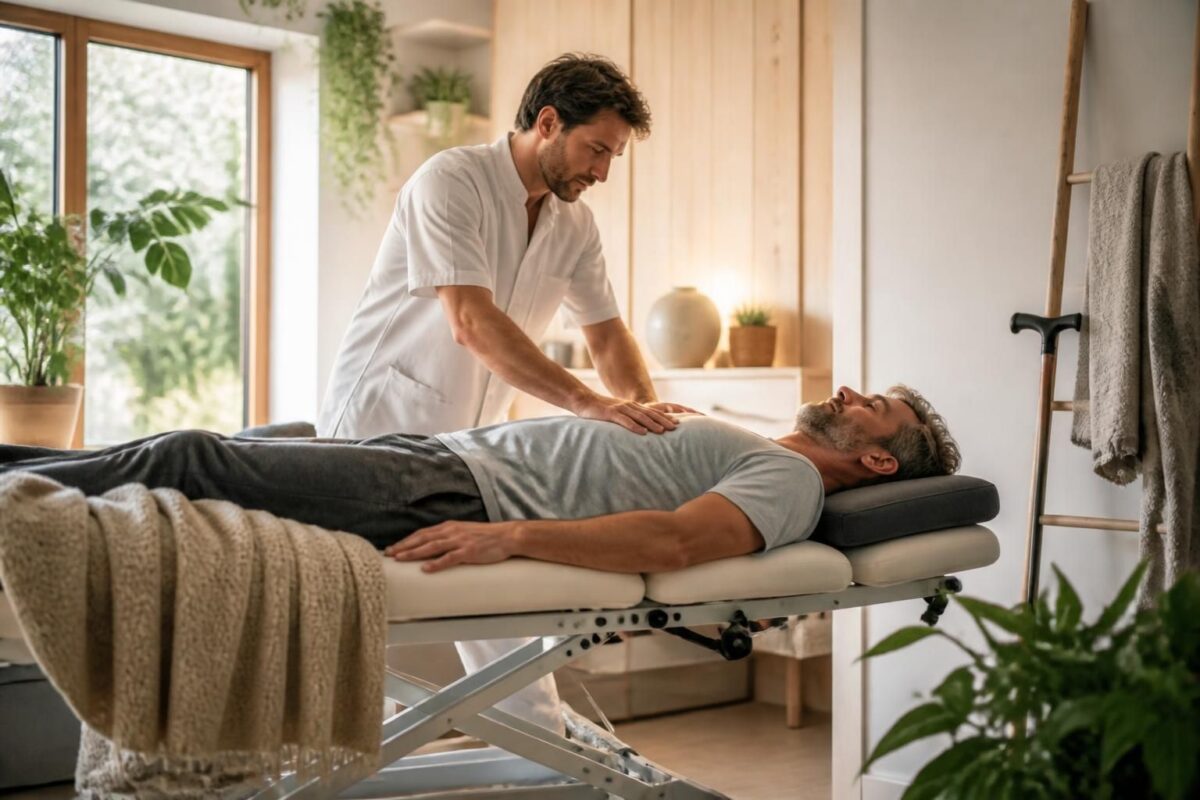
The joint flexibility Feeds on the ability of the musculoskeletal system to unlock, soft tissue relaxation and adjusted proprioception. The manipulations make it possible to reduce mechanical stress, restore joint amplitudes and improve the circulation of fluids and nutrients in the joint structures. The result is better fluidity of movement, less stiffness and faster recovery after exercise.
Why Osteopathy Is Essential For Recovery People
In short In short, Osteopathy in convalescence is an approach manual and holistic which helps to accelerate the recovery by restoring The balance, the mobility and a good circulation fabrics. it contributes to Reduce the pain, support the Back to…

Osteopathic manipulations to strengthen post-traumatic muscles
In short In short, Osteopathic manipulations for Strengthen post-traumatic muscles constitute a gentle manual approach aimed at restoring the mobility, reduce the pain and facilitate the Functional rehabilitation After a injury. What is Is it? A series of precise gestures…
Techniques and their progress
Structural techniques
Structural techniques target mobility blockages and restrictions. They are practiced with a precise approach: clear diagnosis, appropriate positioning of the patient and progressive tensioning. The goal is to achieve a measurable improvement in the range of motion, without pain or trauma.
Myotensive techniques
Myotensive techniques involve active muscle contractions of the patient against the practitioner’s resistance. This approach releases tension and restores flexibility by working on the relationship between muscle and joint. They promote patient engagement and strengthen movement awareness, often used when impulse manipulation is unsuitable.
Functional techniques
Functional techniques, often described as gentle, rely on held positions to reset neuromuscular circuits and release proprioceptive receptors. They are useful in fragile patients, in rehabilitation or in the recovery phase. The goal is to achieve a gradual and lasting improvement in mobility.

Osteopathy and prevention of work-related musculoskeletal disorders
In short theosteopathy is one Manual approach that restores body balance and prevents MSD related to work. Its advantages: reduction of tension, improvement of mobility and prevention of chronic pain. She is preventive and healing, suitable for office and trades…

The benefits of osteopathy to treat muscle imbalances
In short theosteopathy is a manual approach to restore themuscle harmony and postural considering the body as a whole. Its main benefits include the reduction of aches and tensions, the improvement of the mobility and from the posture, and prevention…
Security and recourse criteria
Each session begins with an evaluation and continues with patient-friendly gestures. Major contraindications include advanced degenerative decays, proven disc herniations and acute inflammation requiring medical advice. Manipulations should always remain painless and progressive, in order to protect the tissues and avoid aggravations.
Osteopathy and chronic leg pain: regaining an optimal quality of life
In short In short, Osteopathy is one Global manual approach aimed at reducing Chronic leg pain and improve the quality of life. What is it? Non-drug therapy using the hands to identify restrictions and treat lesional chains. How does it…
How osteopathy supports recovery after complex surgery
In short In short, Post-operative osteopathy is an approach fresh which supports the recovery After a Complex surgery. It helps to reduce the pain and the fatigue, improves the mobility and accelerates the healing thanks to a better vascularization and…
Practical tips for optimizing results
To maximize the benefits of Osteopathic manipulations Aiming for a better joint flexibility, Associate the sessions with guided stretching exercises and activities that promote mobility. Maintain sufficient hydration and pay special attention to posture throughout the day. Adopt a realistic progression: Start with gentle amplitudes and gradually increase according to your practitioner’s feedback and advice.
| analyzed aspect | Concise description |
|---|---|
| Structural technique | Restores joint mobility through quick and targeted painless adjustments. |
| Myotensive technique | Enables muscle contraction to release restrictions and restore extension. |
| Functional technique | Contributes to amplitude through maintained and repeated positions. |
| Proprioceptive rehabilitation | Resets proprioceptive afferents by holding in comfortable position. |
| Visceral technique | Improves mobility of adjacent organs and fascias, promoting overall flexibility. |
| Craniosacral osteopathy | Provides general relaxation and improves mobility with gentle gestures. |
| Indications and customization | Protocol adapted to each patient according to the evaluation, with appropriate precautions. |
| Frequency and efficiency | Improvements may appear from the first sessions as appropriate. |
Testimonials on osteopathic manipulations to improve joint flexibility
“Before starting the sessions, my movements were stiff and limited, especially in the shoulders and hips. After a few sessions focused on targeted manipulations, I found a flexibility and an mobility which allow me to perform my gestures with more fluidity. »
“As an athlete, I was looking for an effective method to increase the flexibility of my joints without pain. osteopathic manipulations released blockages and improved my mobility, favoring a faster and safer training resumption. »
“For me who spends long hours in front of the computer, the posture and the flexibility Shoulders and back have improved significantly thanks to appropriate techniques. I was able to resume my daily activities with more ease and less stiffness. »
“After a sports injury, the sessions targeted tensions around the joints and muscles. I now feel a release of the mobility joint and ma pain decreased, which encourages me to continue the training with more confidence. »
“The osteopathic approach also helped me to improve my proprioception and my coordination, two essential elements to maintain a flexibility lasting joints. The sessions bring constant and perceptible results from the first interventions. »
Professional biography of osteopathic manipulations for joint flexibility
This osteopath Expert combines osteopathy, naturopathy and manual medicine skills, and plays the role of Founding President of TagMed as well as the ACMA association. With a career dedicated to innovation in health care, he has made the progression of bodily possibilities and sustainable well-being his core business. His practice focuses on improving the Joint mobility and the joint flexibility, both in patients with chronic pain and in those wishing to optimize their physical performance. This approach is based on solid clinical bases and an integrative vision of the human body.
Its therapeutic approach is based on a global and personalized philosophy. He considers that the locomotor function Depends on a balance between musculoskeletal structures, fascias and the nervous system. Although the manipulations are at the heart of his intervention, he recalls that these techniques are part of a logic of correcting reversible dysfunctions, without claiming to cure established organic pathologies. As such, it carefully gauges the indications and contraindications before any session, in order to offer support secure and adapted the needs and abilities of each patient.
Regarding the techniques used, he favors structural manipulations as a reference to restore the mobility restrictions and joint blockages. The adjustments involve a brief controlled pulse and precise patient positioning, with an emphasis on a non-pain strict and rigorous diagnosis. The cracking sound that can sometimes occur illustrates the joint cavitation, a physiological phenomenon linked to the release of dissolved gases in the synovial fluid, and it is interpreted as a stage of recovery from regained mobility.
In addition, the interventions myotensive And tissue approaches occupy a central place in its practice. Myotensive techniques mobilize the patient’s active contractions against the practitioner’s resistance, targeted to the identified dysfunction to release stiffness without damaging the cartilage. This active patient participation strengthens his body awareness and sets the stage for further structural adjustments. Tissue approaches, for their part, work on soft tissues and myo-fascial structures to restore extensibility and reduce spasms that slow down mobility.
Atraumatic functional techniques, inspired by historical approaches, complete the therapeutic panel. They are based on the neurophysiological modification of the proprioceptive receptors and require precise maintenance for about 90 seconds to promote the relaxation and reset of the neuromuscular spindles. This soft and progressive dimension is particularly suitable for elderly patients, those with joint fragilities and athletes in the recovery phase.
In addition, it integrates various concepts such as visceral and cranio-sacral osteopathy when the indications justify it, remaining cautious about scientific evidence and ensuring patient safety. The overall goal is to offer a Personalized and efficient support which sustainably improves mobility and Joint flexibility, while promoting a better quality of life and optimized performance in effort.
In summary, osteopathic manipulations dedicated to joint flexibility are based on various approaches that aim to restore mobility, release tension and optimize neuromuscular coordination. Adapted to each individual, they are part of a logic of prevention and functional rehabilitation, without claiming to correct on their own established organic pathologies.
The mechanisms of action of osteopathic manipulations promote a Improved range of amplitude and a reduction in Muscle tensions, which directly contributes to a Better flexibility and a decrease in functional limitations related to movement. By favoring precise and progressive gestures, the practitioner aims for lasting results while ensuring the comfort and safety of the patient during the session.
the technical axes are mainly broken down into approaches structural, myotensive and functional. Structural techniques target blockages and mobility restrictions, myotensive techniques mobilize muscle chains and strengthen body awareness through active patient action, and functional approaches focus on rebalancing circuits Neuro-musculo-proprioceptives to prevent recurrences. At the heart of these methods, the aspects tissue and myofasciales play a key role, especially when tensions limit the extension and slipping of joints, while remaining complementary tools and not universal acts.
Leave room for a progressive and personalized approach, these approaches are particularly useful for athletes and active people with imbalances or postural compensation. Clinical results and patient feedback show that improvements in mobility can appear from the first sessions when the evaluation is fine and the treatment plan adapted. In this context, the techniques tissue constitute a significant proportion of care and represent approximately 60% Techniques used during a standard consultation.
Safety and continuity of care is based on a rigorous prior assessment and compliance with contraindications. The interventions must be adapted to the state of the musculoskeletal system and avoid manipulation in the event of advanced degenerative degenerative, confirmed herniated disc or inflammatory pathologies requiring a specific medical evaluation. In any case, the practice favors painless corrections and comfortable positions, with progression adapted to the patient’s tolerance and physical abilities.
To nurture these notions and discover concrete examples of mobility improvement, you can explore practical resources and additional information available online, including on topics related to improved mobility after prolonged immobilization, the effects of stress-related muscle tension and approaches preventive to avoid musculoskeletal disorders. Explanatory resources and practical guides are accessible via the following links: How osteopathy improves mobility after prolonged immobilization, Osteopathy manipulation, Techniques used in osteopathy, stress-related muscle tension, Prevention of musculoskeletal disorders, techniques, Benefits for lower limb pain, Osteopathic manipulations and joint flexibility, Recovery after a sprain, Osteopathy and body flexibility.

Dr Sylvain Desforges, B.Sc., D.O., N.D., osteopath, is the founding president of TAGMED and of the ACMA association. He dedicates his practice to chronic spinal pain, low back pain and symptoms compatible with sciatica, particularly when pain radiates toward the buttock, leg, calf, foot or toes.
Through SOS Sciatique, he publishes educational content on sciatica symptoms, possible causes such as disc herniation, disc narrowing, foraminal stenosis or irritation of a lumbar nerve root, as well as non-surgical approaches that may be considered according to the evaluation. At Clinique TAGMED, care may include, depending on the case, motorized neurovertebral decompression, specific osteopathic care or precision percussion.
For an evaluation related to sciatica treatment in Montreal / Mount Royal or sciatica treatment in Terrebonne, please consult the services available at Clinique TAGMED.
Medical disclaimer
The information published on SOS Sciatique is provided for educational purposes only and does not replace a consultation, diagnosis, opinion or treatment provided by a physician or another authorized healthcare professional. The author of this article is neither a medical doctor nor a specialist in a medical specialty recognized by the Collège des médecins du Québec. The osteopathic, manual medicine or functional support approaches described on this site do not constitute medical acts and are not intended to replace medical follow-up.
Consult a physician or emergency service in cases of loss of bladder or bowel control, anesthesia in the saddle area, significant or progressive weakness in the leg or foot, fever, recent trauma, severe pain or rapid worsening of symptoms. For more details, please read our Legal Notice.