



Sciatica in Terrebonne: understanding the signals sent by the leg
24/07/2026
Sciatica and retroverted pelvis: why the pain can descend
25/07/2026
IN BRIEF
| In brief, sciatic pain in Terrebonne results from nerve irritation or compression of a lumbar root. The approach allows for quick identification of the origin and aims to avoid surgery by favoring non-surgical solutions: osteopathy, physiotherapy, and when the assessment allows, neurovertebral decompression. Benefits: reduce irritation, restore mobility, and facilitate a return to activities, with a personalized plan and postural advice. Accessible in Terrebonne and its surroundings via the TAGMED Clinic, this program aims for a lasting functional recovery, without unnecessary pain. |
Sciatic pain in Terrebonne can result from nerve irritation without apparent herniation. To recognize it and act quickly, here are the key points:
- Path of pain that follows the sciatic nerve, from the buttock to the foot.
- Associated sensations: numbness, tingling, or weakness in the leg.
- Trigger signs: increased pain while walking or standing, sometimes relieved by sitting or bending forward.
- Origin without major herniation: can exist without perceptible ruptured disc; mechanical irritation can suffice.
- Evaluation: complete clinical assessment (path of pain, strength, and reflexes) and, if necessary, imaging to rule out other causes.
- Non-surgical care plan: osteopathy, targeted physiotherapy, and postural advice to reduce irritation and restore mobility.
- Next step: make an appointment at the TAGMED Clinic in Terrebonne for a personalized assessment.
This article, written by a health professional, explains how to recognize nerve irritation in the context of sciatic pain in Terrebonne. It distinguishes three common mechanisms: nerve irritation without major herniation, foraminal stenosis, and disc herniation. It describes the signs to watch for, the evaluation, and the non-surgical approaches offered by the TAGMED Clinic in Terrebonne and Montreal. The goal is to reduce nerve irritation, restore mobility, and facilitate a return to activities without routinely resorting to surgery when possible.
What is nerve irritation in the context of sciatica?
Nerve irritation involves inflammation or abnormal stimulation of the lumbar nerve roots L5 or S1, which can exit from the spinal column. This irritation can generate pain that follows the path of the sciatic nerve. It can occur without clear signs of disc herniation. The assessment aims to differentiate this irritation from other structural causes and to identify the precise painful path.
How to recognize the origin in Terrebonne
The diagnosis is based on the trace of pain, neurological examination, and imaging if necessary. The pain can follow the path of the nerve, from the buttock to the foot. The precise location depends on the affected root (L5 or S1). Signs such as tingling, numbness, or weakness may accompany the pain.
Clinical signs indicating nerve irritation
Typical signs include pain that follows the path of the nerve, tingling, or mild weakness in the lower limb. The assessment may include simple tests such as evaluations of strength and reflexes. Additional information can be found on dedicated pages: sciatica in Terrebonne — distinguish between lumbar pain and nerve pain.
Possible causes and associated mechanisms
Sciatic pain can result from nerve irritation without major herniation, foraminal stenosis, or other mechanisms. Resources explain the mechanisms and typical signs, including sciatica after injection and other general information available at sossciatique.com.
When to consult and what options to propose
For a complete evaluation, contact TAGMED Terrebonne. The team can propose non-surgical approaches such as neurovertebral decompression and osteopathy, combined with rehabilitation and postural advice. These treatments focus on reducing nerve irritation and improving mobility, while favoring non-invasive solutions when possible. To learn more about available options, visit Clinique TAGMED and neurovertebral decompression.
When and how to act in response to warning signs
Warning signs require prompt consultation: significant loss of strength in the leg, severe sensory disturbances, rapidly worsening pain, or urinary/sphincter disorders. These signs may indicate more severe nerve damage and require immediate medical assessment. For resources and advice, visit sosherniediscale.com.
Non-surgical approaches in Terrebonne and Montreal
The management is multimodal and personalized. It can combine precise evaluation, motorized neurovertebral decompression, and specific osteopathic care, complemented by functional rehabilitation and postural advice. The goal is to reduce irritation, restore mobility, and facilitate a gradual return to activities without invasive actions when the evaluation allows. For more information about the proposed care, please consult Clinique TAGMED and neurovertebral decompression.
Summary table of therapeutic options (comparative)
This section highlights a comparison of non-invasive approaches and physiotherapy, which is less favored in this context. The table is intended to illustrate the available options at the TAGMED Clinic in Montreal or Terrebonne and their relative effectiveness compared to extrinsic treatments. For a clear vision tailored to your case, contact TAGMED directly.
Prevention and follow-up
Prevention involves postural education and appropriate rehabilitation focused on core strengthening and pelvic stability. Follow-up allows for adjustments to the treatment plan based on the evolution of symptoms and any new signs.
Resources and useful links
To enrich your knowledge about sciatica and nerve mechanisms, you can consult resources available on the following sites: sciatica in Terrebonne — distinguish lumbar pain from nerve pain, Relieve Sciatica – TAGMED Clinic, Sciatica after infiltration. For general information about TAGMED and care options, visit TAGMED Clinic.
To learn more about the mechanisms and non-surgical options, you can also consult the following resources: Sos Herniated Disc, Sos Herniated Disc, and Sos Sciatica.
Medical disclaimer: The information and advice provided on this site do not replace the opinion, diagnosis, or treatment of a healthcare professional. Please note that Dr. Sylvain Desforges, osteopath, is neither a medical doctor nor a physician and is not a specialist in a medical specialty as defined by the Collège des médecins du Québec. Manual medicine, functional medicine, and sports medicine as described on this site exclude any medical treatment or diagnosis done by a doctor or specialist. Always consult your physician for any medical questions. For more details, please read our full Legal Notice.
- Pain route: follows the sciatic nerve, from the buttock to the foot.
- Origin: nerve irritation without major herniation.
- Sensory signs: paresthesias or numbness in the territory.
- Triggers: increased pain when walking or prolonged standing; relieved by resting or leaning forward.
- Initial strength: no significant motor deficit detected during the assessment.
- Examinations: Lasègue test sometimes positive; tenderness along the route; strength/reflexes sometimes normal.
- Imaging: often normal for pure nerve irritation, useful for ruling out a herniation.
- Differential diagnosis: allows differentiation from a disc herniation or foraminal stenosis.
- Approach in Terrebonne: specialized assessment at TAGMED Clinic and non-surgical management.
- Practical advice: regular walking, appropriate posture, and daily actions without twisting.
- Urgency: consult quickly if loss of strength, sphincter disorders, or rapidly worsening pain occurs.

Quick summary: in Terrebonne, recognizing nerve irritation without major herniation relies on identifying the pain route, neurological signs, and the absence of severe mechanical obstacles. Clinical assessment guides a tailored non-surgical plan, combining osteopathy, physiotherapy, and functional rehabilitation to restore mobility and prevent recurrences.
Identify the characteristic signs
Sciatica pain related to nerve irritation typically manifests as irradiation along the route of the sciatic nerve, from the buttock to the leg, and sometimes to the foot. You may feel numbness, tingling, or a burning sensation along this path. The pain may intensify when walking or standing and decrease when sitting or slightly leaning forward. It is important to distinguish these manifestations from simple muscle pain and to check for any possible weakness or altered sensitivity in the affected areas.

Sciatica in Terrebonne: L5 and difficulty lifting the foot
IN SHORT The L5 sciatica can cause pain or numbness on the side of the leg, the top of the foot, and the big toe, sometimes with difficulty lifting the foot. In Terrebonne, an evaluation compares strength, sensitivity, reflexes, and…
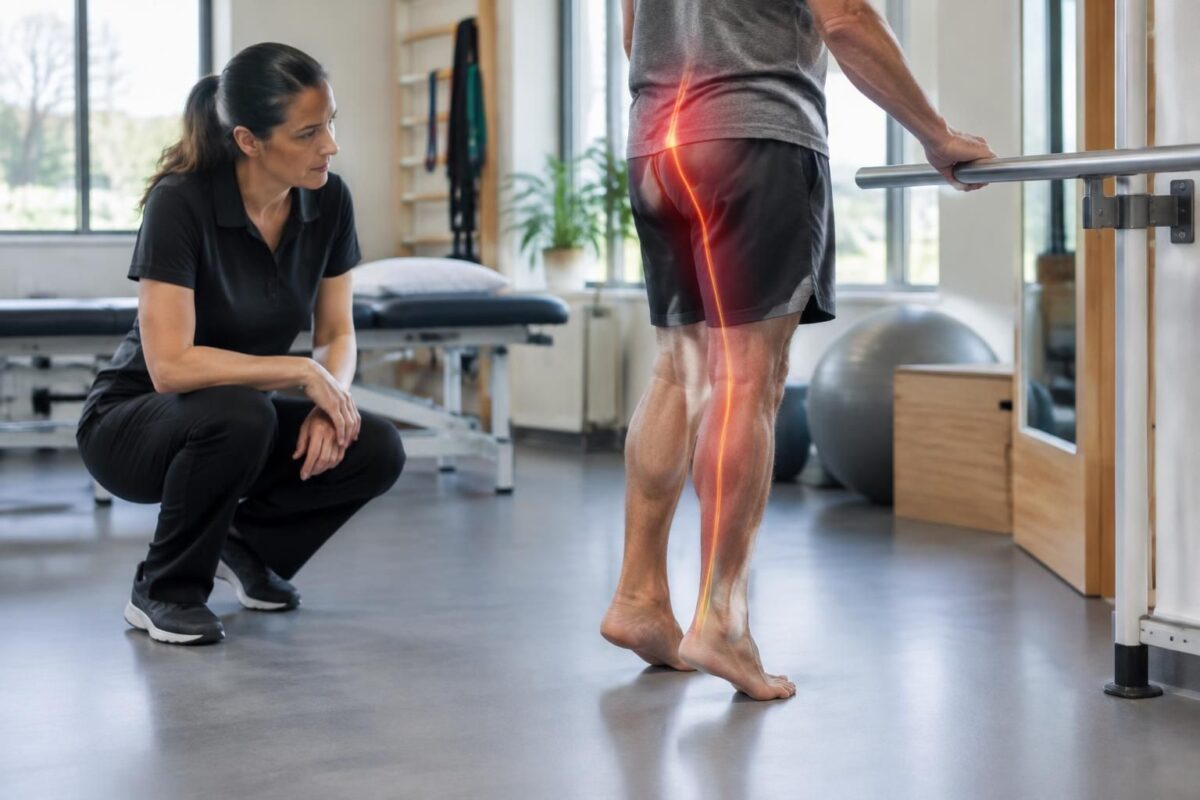
Sciatica in Terrebonne: S1 and difficulty standing on tiptoe
IN SHORT An S1 sciatica can irritate the nerve root associated with the calf and make it difficult to rise onto the balls of the feet. This sign should be evaluated with strength, sensitivity, reflexes, and walking: the pathway of…
Effective clinical assessment
To confirm nerve irritation and guide treatment, the assessment must precisely trace the painful route and test the strength, reflexes, and sensation of the lower limbs. The Lasègue test can be used to evaluate nerve tension. Clear neurological signs or unexplained pain when walking may require further examinations. The goal is to determine whether the origin is related to root irritation without major herniation or other mechanisms to avoid invasive procedures when possible.
Elements to check
Reflexes and strength of the leg muscles, sensitivity of the foot and ankle, and the precise location of pain following the path of the nerve. Pain that worsens with effort or significant neurological signs (marked weakness, loss of sensation, urinary disorders) require prompt and coordinated management with a professional.

Sciatica in Terrebonne: L4-L5 and pain towards the top of the foot
IN BRIEF A L4-L5 sciatica can radiate to the outer side of the leg and the top of the foot, sometimes reaching the big toe. This pathway can guide the assessment, though it does not suffice to confirm the cause:…

Sciatica in Terrebonne: L5-S1 and symptoms in the calf
IN BRIEF A L5-S1 sciatica can cause pain that radiates down the calf, sometimes accompanied by tingling, numbness, or weakness. At Terrebonne, an assessment at the TAGMED Clinic helps to examine the symptom pathways, strength, and sensitivity, and then discuss…
Non-surgical treatment options
In Terrebonne, the management prioritizes non-surgical approaches centered on mobility, posture, and reducing mechanical irritants. Osteopathy and physiotherapy form the core of care, complemented by appropriate rehabilitation and postural advice to limit aggravating factors. A neurovertebral decompression may be considered when clinical criteria allow, within a comprehensive and progressive plan.
Role of rehabilitation and daily actions
The program aims to reduce nerve irritation, restore mobility, and strengthen core stability to stabilize the spine. Targeted exercises, manual therapy techniques, and ergonomic recommendations (workplace, movements, driving) promote a gradual return to activities and prevent recurrences.

Sciatica in Terrebonne: pain in the big toe, L5 root or another cause?
IN BRIEF Pain in the big toe accompanied by pain in the buttock or leg may be compatible with irritation of the L5 root, but other causes are possible. In Terrebonne, the evaluation notably compares strength, sensitivity, and gait to…

Sciatica in Terrebonne: why the affected root changes the pain path
IN BRIEF Sciatica is a pain related to the irritation of a lumbar nerve root, the path of which varies depending on the affected root. Damage to L5 can radiate to the top of the foot, while damage to S1…
Preventing and managing daily
Adopting simple gestures can make a difference: regular walking on flat ground, avoiding prolonged sitting, bending the knees to pick up objects while keeping the back straight, sleeping in neutral positions, and supporting the pelvis. Postural education and trunk strengthening help limit tension on the nerve roots and promote sustainable recovery, while remaining in activities suited to your tolerance.

Sciatica in Terrebonne: L4-L5 disc, L5-S1 disc, and leg pain
IN BRIEF Sciatica is pain that travels down the leg when a nerve root is irritated. An injury to the L4-L5 disc often affects the L5 root; an L5-S1 injury affects the S1 root. The path of the pain and…

Sciatica in Terrebonne: understanding lumbar levels on an MRI
IN BRIEF Sciatica may be related to irritation of a lumbar nerve root. A lumbar MRI shows the disks and nerves at different levels, such as L4-L5 or L5-S1, to help identify an abnormality and compare it with symptoms. In…
When to Consult Quickly
Consult quickly in case of marked loss of strength in the leg, widespread sensory disturbances, rapid aggravation of pain, or sphincter disorders. These signs may indicate a more serious nerve injury requiring urgent medical assessment.
| Element | Concise Description |
|---|---|
| Pain Path | Pain that follows the sciatic nerve, from the lower back to the buttock, thigh, and sometimes the calf or foot. |
| Nature of the Pain | Neuropathic pain, electrical sensations, burning, or tingling along the path. |
| Motor Deficit | Little or no significant motor deficit observed during examination. |
| Aggrevating Factors | Walking and standing worsen; sitting or slight bending may relieve. |
| Useful Clinical Signs | The Lasègue test is useful, with a targeted neurological examination to specify the path and root. |
| Imaging | Imaging required based on clinical context to guide diagnosis and check possible causes. |
| Non-Surgical Approach | Osteopathy, physiotherapy, and targeted exercises with appropriate postural advice. |
| Warning Signs | Loss of strength, sphincter disorders, or rapid progression: medical emergency. |
| Care Plan | Personalized and progressive plan: relief, mobility, and rehabilitation with follow-up. |
Testimonials: Sciatic Pain in Terrebonne – How to Recognize Nerve Irritation
“In Terrebonne, I first thought my lower back pain was trivial. However, the pain quickly took the form of a irritation following the path of the sciatic nerve, starting from the buttock and descending into the leg down to the foot. Tingling and a sensation of numbness in my foot helped me recognize that it was not muscular pain but mild radiculopathy.”
“During my consultation at the TAGMED Clinic in Terrebonne, I was explained how to recognize nerve irritation without significant herniation: pain that follows the nerve, sometimes accompanied by weakness or tremors, but without significant loss of strength. The assessment confirmed the nerve path and guided me towards an effective non-surgical plan.”
“I was not walking much, and the pain increased after a long walk. I was shown that it was a nerve irritation rather than a hernia: pain that irritates the sciatic nerve, with sensations of burning and tingling along the leg. A program focused on movements and posture allowed me to gradually resume my activities.”
“I stayed vigilant about the signals: pain that intensifies when walking, numbness, and difficulty lifting my foot. In Terrebonne, the evaluation distinguished a nerve irritation and guided me towards osteopathic techniques and targeted rehabilitation, without surgery. Today, I feel my mobility returning and the pain decreasing.”
“The precise diagnosis and clear explanations reassured me: recognizing nerve irritation rather than a true hernia or stenosis changed the entire course, with postural advice and tailored rehabilitation. My return to my activities was gradual and risk-free.”
Dr. Sylvain Desforges, expert osteopath in osteopathy, naturopathy, and manual medicine, is the founding president of the TAGMED clinics and the ACMA association. With a career dedicated to innovation in healthcare, he focuses his practice on managing chronic low back pain and the precise evaluation of the mechanisms behind pain related to the sciatic nerve. His approach is based on evidence-based methods aimed at optimizing the health and well-being of each patient, with particular attention to sciatica and nerve irritation conditions.
In Terrebonne, his team offers a multidisciplinary and personalized approach, centered on a rigorous clinical assessment. The diagnosis relies on the tracing of the painful path, the neurological assessment, and, when necessary, the analysis of available imaging information. This approach allows for the precise differentiation of nerve irritation from other common causes of sciatica, such as disc herniation or foraminal stenosis. The doctor and his team use simple tests, such as the Lasègue, to evaluate nerve tension and guide treatment towards the most appropriate and least invasive solutions possible.
How to recognize nerve irritation without significant herniation? The sensation manifests as pain that follows the path of the sciatic nerve, often associated with paresthesias, tingling, or varying weakness in the leg. Unlike obvious disc pain, the signal primarily targets the nerve and may persist even in the absence of a major visible conflict on imaging. Dr. Desforges emphasizes the importance of listening to this painful path and distinguishing neurogenic signs from purely muscular or joint pain to avoid inappropriate actions and prioritize targeted care.
For patients presenting with nerve irritation in Terrebonne, the objective is clear: limit irritation, restore mobility, and allow a gradual return to daily activities. The care plan prioritizes non-surgical approaches when the situation allows. Specific osteopathic techniques, active rehabilitation, and postural advice may be considered, complemented by advanced physical options when necessary. The goal is to reduce inflammation and strengthen trunk muscles to stabilize the spine and prevent recurrences while ensuring a safe and tailored progression for each patient.
The TAGMED Terrebonne clinic offers an integrated strategy that may include, depending on the case,
advanced technologies combined with osteopathic and physiotherapy care, within a personalized framework. The practitioner ensures clear communication and attentive follow-up, with regular re-evaluation to adjust the plan based on the evolution of symptoms and individual goals. This approach aims to enable return to activities and sustainably reduce irritation of the sciatic nerve without systematically resorting to surgery.
For those suffering from pain radiating to the buttock, leg, or foot and who wish to understand if they have a nerve irritation, a specialized evaluation in Terrebonne can provide valuable insights and an appropriate therapeutic pathway. Contact the TAGMED Terrebonne Clinic for a targeted consultation on sciatica and its mechanisms, and benefit from a personalized and secure care plan.
This guide details how to recognize sciatic pain related to nerve irritation in Terrebonne, common mechanisms (herniated disc, foraminal stenosis, or nerve irritation without a major herniation), key clinical signs, and non-surgical options for lasting relief and functional recovery, emphasizing personalized evaluation and care planning.
Recognizing nerve irritation associated with sciatic pain
Nerve irritation typically manifests as pain following the path of the sciatic nerve, starting from the buttock and descending into the leg, sometimes down to the foot. The exact pattern of pain helps identify the affected root (L5 or S1) and guide treatment. Other sensations such as paresthesia, tingling, or targeted weakness may accompany this pain. For practical identification of typical signs of irritation, refer to dedicated resources on signs of irritation and their interpretation: signs of irritation in sciatica.
Simple clinical tests, such as evaluating muscle strength and sensitivity of the areas involved, supplemented if necessary by imaging, help distinguish nerve irritation from other causes. A well-conducted physiotherapy assessment allows for precise mapping of the painful pathway and evaluation of neurological signs, which informs the choice of therapeutic actions.
Possible origins and diagnosis
Three mechanisms frequently arise in the Terrebonne context: herniated disc, foraminal stenosis, and nerve irritation without major herniation. The history and the neurological examination guide the initial diagnosis, supplemented by imaging studies when necessary. To guide non-surgical treatment, refer to the resources on guidelines for sciatica treatment.
In the case of lumbar disc herniation, the root may be compressed at the foramen exit, causing radiation along the radicular pathway (e.g., L5-S1). In a foraminal stenosis, the narrowing of the opening around the root can also cause pain radiation while walking. A radicular irritation without herniation may occur when inflammation or a mechanical imbalance irritates the nerve. To better understand these mechanisms and their implications, explore dedicated resources such as nerve irritation and lumbar support.
Non-surgical approaches in Terrebonne
In Terrebonne, management favors non-surgical approaches focused on mobility, posture, and reducing mechanical irritants. A targeted assessment allows for the proposal of a personalized plan combining osteopathy, physiotherapy, and neurovertebral decompression, complemented by exercises and postural advice. For additional information on non-surgical options, refer to Non-surgical treatment and related resources.
Neurovertebral decompression may be considered when the clinical picture allows, and targeted osteopathic care helps relieve tensions, restore mobility, and strengthen the trunk. Complementary tools may be employed based on the assessment (e.g., instrument-assisted exercises, manual therapies, and postural education). For practical examples and details, see dedicated resources such as recognizing and relieving sciatic neuralgia.
Warning signs and when to seek emergency care
Certain signs require prompt medical consultation: significant loss of strength in the leg, widespread sensory disturbances, or pain that worsens rapidly despite treatment. Urinary or sphincter disturbances may indicate cauda equina syndrome, an absolute medical emergency requiring immediate attention. To quickly recognize concerning signals, you can consult dedicated resources such as how to recognize sciatica.
Assessment and care plan
The assessment process begins with the precise localization of the painful pathway, evaluation of strength and reflexes of the lower limbs, and sensitivity of the affected areas. The care plan is personalized, progressive, and oriented towards reducing nerve irritation and restoring mobility, with appropriate rehabilitation and postural advice to prevent recurrences. To learn more about the practical elements of the Terrebonne and Montreal approach, consult dedicated resources on non-surgical options and the mechanisms of sciatica, especially the pages related to treatment in Terrebonne and professional guides.
Resources and useful links
To deepen your understanding of recognition, management, and treatment of sciatica and nerve irritation, you can consult the following resources: signs of irritation, lumbar cushion and caution, recognizing and relieving neuralgia, guidelines for sciatica treatment, useful or aggravating lumbar support, medical committee authors, treatment in Terrebonne – herniation, stenosis, or nerve irritation, nerve irritation sciatic, recognizing sciatica, accessibility.

Dr Sylvain Desforges, B.Sc., D.O., N.D., osteopath, is the founding president of TAGMED and of the ACMA association. He dedicates his practice to chronic spinal pain, low back pain and symptoms compatible with sciatica, particularly when pain radiates toward the buttock, leg, calf, foot or toes.
Through SOS Sciatique, he publishes educational content on sciatica symptoms, possible causes such as disc herniation, disc narrowing, foraminal stenosis or irritation of a lumbar nerve root, as well as non-surgical approaches that may be considered according to the evaluation. At Clinique TAGMED, care may include, depending on the case, motorized neurovertebral decompression, specific osteopathic care or precision percussion.
For an evaluation related to sciatica treatment in Montreal / Mount Royal or sciatica treatment in Terrebonne, please consult the services available at Clinique TAGMED.
Medical disclaimer
The information published on SOS Sciatique is provided for educational purposes only and does not replace a consultation, diagnosis, opinion or treatment provided by a physician or another authorized healthcare professional. The author of this article is neither a medical doctor nor a specialist in a medical specialty recognized by the Collège des médecins du Québec. The osteopathic, manual medicine or functional support approaches described on this site do not constitute medical acts and are not intended to replace medical follow-up.
Consult a physician or emergency service in cases of loss of bladder or bowel control, anesthesia in the saddle area, significant or progressive weakness in the leg or foot, fever, recent trauma, severe pain or rapid worsening of symptoms. For more details, please read our Legal Notice.


