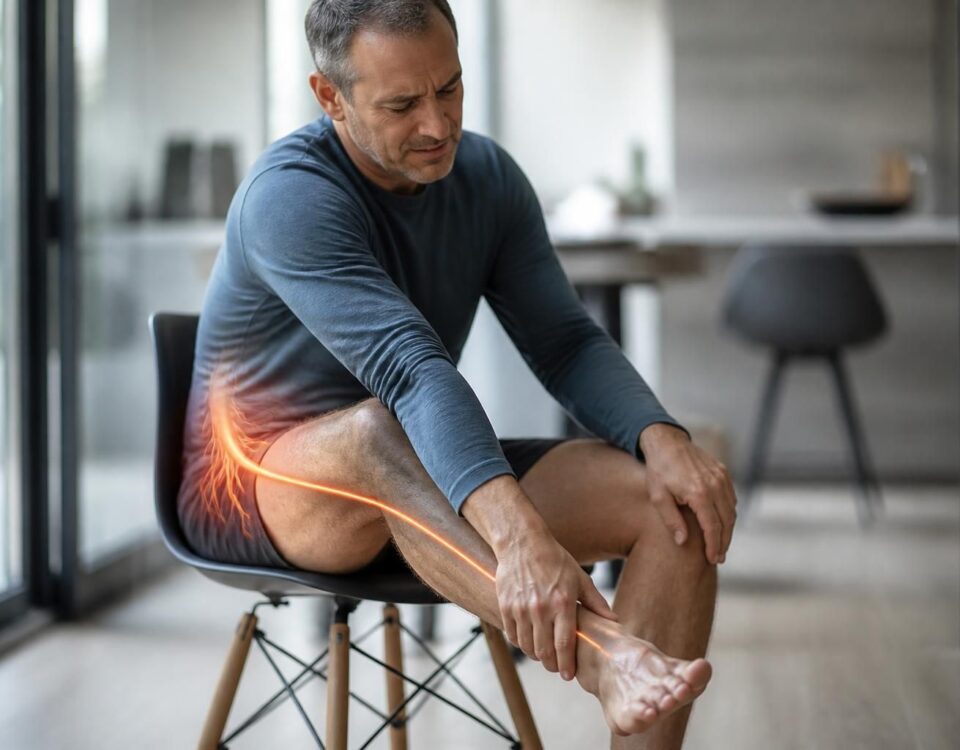
Sciatica: pain alleviated when sitting and narrow lumbar canal
16/07/2026
IN BRIEF
| In short, sciatica accompanied by a heavy leg may involve nerve pain that follows the path of the sciatic nerve, but it may also be due to other causes. The assessment helps distinguish a nerve-related origin from non-neurological causes and guides the patient toward a medical evaluation and effective conservative approaches. Benefits include greater diagnostic accuracy, improved mobility, and pain reduction, while favouring non-surgical solutions whenever possible. Available in Montreal and the surrounding area, this process aims to quickly provide a personalized plan and tangible results. |
Sciatica is pain that follows the path of the sciatic nerve. When accompanied by a sensation of a heavy leg, it is important to distinguish between nerve pain and other possible causes of the heaviness.
- Nerve pain: irritation or compression of the sciatic nerve, most often linked to a herniated disc, lumbar stenosis, or piriformis syndrome.
- Other causes of heaviness: venous disorders, such as edema or venous insufficiency; muscle inflammation or fatigue; and joint disorders affecting the hip or knee.
- How to identify the cause: clinical examination, tests such as the Lasègue test, and sometimes MRI or EMG to clarify the cause and guide treatment.
- Typical management: adapted physical activity, physiotherapy, and symptomatic treatments. Surgery remains uncommon and is considered only when conservative treatment fails or significant neurological signs are present.
Seek prompt professional care if the pain is accompanied by progressive weakness, significant numbness, or urinary problems. These signs require urgent medical evaluation.
Brief summary: sciatica with a heavy leg may be nerve pain related to the sciatic nerve, but other conditions can also cause a feeling of heaviness in the leg. This article describes the signs that help distinguish these causes, the useful examinations, and the management options available at TAGMED Clinic, with references for further reading. The goal is to guide an accurate, appropriate assessment without suggesting unsuitable exercises for non-neurological causes.
Signs suggesting nerve pain
Sciatic pain follows the path of the sciatic nerve. It often begins in the lower back or buttock and travels down the leg to the foot. It may be described as burning, stabbing, or electric. Paresthesia, tingling, or muscle weakness may accompany the pain. Symptoms may worsen with prolonged sitting or movements that place strain on the nerve.
Non-neurological causes of a heavy leg
Heaviness in the leg may originate from other body systems. Circulatory, venous, or arterial disorders, fluid retention, or muscular problems can create a feeling of heaviness without primary nerve involvement. Peripheral vascular disorders, edema, or neuropathies unrelated to nerve-root compression are also possible causes. In some cases, the pain may feel generalized or diffuse, without a clear nerve pathway.
How the diagnosis is established
The assessment begins with a focused medical history and physical examination, including checks of muscle strength, reflexes, and sensation in the lower limbs. The professional may perform specific tests to confirm or rule out irritation of the sciatic nerve. Imaging examinations such as magnetic resonance imaging can reveal a possible herniated disc, foraminal stenosis, or other compressive factors. Electromyography (EMG) may be used to evaluate nerve activity and the degree of denervation. For more information on general clinical considerations, consult the dedicated resources available on sossciatique.com and sosherniediscale.com.
In some cases, further investigations ordered by a physician may be necessary. A thorough neurological assessment may be indicated if particular motor or sensory signs appear. Useful information is available on pain in the buttock without back pain and interpreting pain that travels below the knee.
Management options
Management depends on the identified cause. When pain results from nerve compression, non-surgical options may be considered following a complete assessment. At TAGMED Clinic, the assessment can help determine whether an intervention such as neurovertebral decompression is appropriate or whether other osteopathic and precision approaches may be useful. To learn more about the available approaches, consult the resources on neurovertebral decompression.
Additional information about disc-related causes and management alternatives is available on herniated discs and herniated discs.
For general information and practical advice, consult MSD Manuals—Sciatica and related public resources on pain on the top of the foot.
Important: In articles about neurovertebral decompression, herniated discs, disc protrusions, bulging discs, foraminal stenosis, spinal stenosis, disc-space narrowing, or disc degeneration, avoid suggesting specific exercises or stretches.
When to seek professional care and which signs require prompt assessment
Seek prompt professional care for progressive muscle weakness, loss of bladder or bowel control, very severe pain, or the sudden onset of neurological impairment. If pain persists or worsens despite initial measures, a specialized assessment is recommended. For information on situations requiring professional care, consult the resources on neurological assessment.
Preventing and living with a heavy leg of non-inflammatory or non-neurological origin
Maintain proper posture and a healthy weight. Adapted physical activity may help improve circulation and endurance without prescribing specific exercises for neurological causes. Practical measures include regularly checking gait and posture and consulting a specialist for a personalized program. For additional explanations of causes and treatment choices, consult specialized resources on sciatica and symptom interpretation and foot weakness and a possible neurological cause.
Useful information on the clinical framework and available treatments can be found on pain in the buttock and TAGMED Clinic.
For additional information on therapeutic considerations and options in Montreal or Terrebonne, prepare your care plan through an appropriate assessment and patient-centred choices.
Useful links and additional resources: sossciatique.com, cliniquetagmed.com, decompressionneurovertebrale.com, sosherniediscale.com, sosherniateddisc.com, sostunnelcarpien.com.
Medical disclaimer: The information and advice provided on this website are not a substitute for the advice, diagnosis, or treatment of a healthcare professional. Please note that Dr. Sylvain Desforges, osteopath, is neither a Doctor of Medicine nor a physician, and is not a specialist in any medical specialty as defined by the Collège des médecins du Québec. Manual medicine, functional medicine, and sports medicine, as described on this website, exclude any medical treatment or diagnosis provided by a physician or medical specialist. Always consult your physician with any medical questions. For more details, please read our full Legal Disclaimer.
References and sources available online: MSD Manual, Sciatica and symptom interpretation.
- Nerve origin
- Pain that follows the path of the sciatic nerve
- Typical causes: herniated disc, lumbar stenosis, piriformis syndrome, trauma, or tumour
- Associated signs: paresthesia and possible weakness; pain worsened by exertion, coughing, or sneezing
- Warning signs: progressive weakness, sphincter dysfunction, and very severe pain
- Other causes of heaviness
- Vascular causes: venous insufficiency, intermittent claudication
- Edema and fluid retention: heaviness that increases at the end of the day
- Musculoskeletal causes: osteoarthritis, tendinopathies, and muscle fatigue
- When to seek professional care: obtain an assessment and targeted tests based on the suspected cause

A heavy leg may be related to nerve pain, such as sciatica, or to other causes requiring different approaches. This article helps you distinguish typical signs, understand what should be checked, and identify the priority actions needed to optimize your care.
Different causes of a heavy leg
A feeling of a heavy leg may accompany nerve pain or result from a vascular, muscular, or metabolic problem. Understanding the context helps direct the patient toward the appropriate treatment. Factors to monitor include the location and radiation of the pain, sensory disturbances, and vascular signs such as changes in colour or temperature or the presence of edema.
Nerve pain and sciatica
Pain of neurological origin often follows the path of a nerve and may be accompanied by paresthesia (tingling), muscle weakness, and increased discomfort during certain movements. The pain may begin in the lower back or buttock and travel down the thigh and leg, sometimes reaching the foot. It may be sensitive to prolonged sitting or exertion and may sometimes feel like an electric shock or burning sensation.
Common non-neurological causes
Vascular causes, such as intermittent arterial ischemia or venous insufficiency, may cause a feeling of heaviness that increases while walking and improves with rest. Muscular or joint disorders, fluid retention, or inflammation can also cause a heavy leg without directly involving the sciatic nerve.

Sciatic pain and loss of sensation: why consult?
IN BRIEF In brief, sciatica pain and loss of sensation describe pain that follows the path of the sciatic nerve and may be accompanied by paresthesia and numbness. Quick consultation has key benefits: obtaining a clear diagnosis, assessing the risks…
Sciatica and pain on the top of the foot: possible L5 root
IN BRIEF Sciatica associated with pain on the top of the foot is often linked to compression or irritation of the L5 root of the sciatic nerve, leading to pain that starts in the lower back and radiates to the…
How to distinguish the signs
To assist with the assessment, note whether the heaviness is more pronounced during exertion—such as walking or climbing stairs—or at rest, and whether it is accompanied by:
– Paresthesia or numbness,
– pain radiating down the leg,
– weakness that interferes with walking or lifting the foot,
– vascular signs, such as paleness, coldness, absent peripheral pulses, or significant edema.

Sciatica and pain on the outer edge of the foot: possible S1 root
IN BRIEF What is this theme? The sciatic pain radiating towards the outer edge of the foot may reflect involvement of the S1 root of the sciatic nerve. This radiation can also affect the calf and heel depending on the…

Sciatica pain that radiates down to the foot: understanding the pathway
IN BRIEF The sciatic pain that travels down to the foot is a projected pain following the path of the sciatic nerve, originating from the lower back and potentially radiating towards the buttock, thigh, calf, and foot. Understanding this pathway…
Recommended assessment and investigations
If the heavy-leg sensation persists, a physician may perform a clinical examination focused on muscle strength, reflexes, and sensation, as well as simple tests to assess pain and nerve irritation. Useful complementary examinations may include:
– MRI or spinal imaging to identify a possible herniated disc or stenosis,
– electromyography (EMG) to assess nerve activity and denervation,
– vascular tests such as the ABI, which screens for arterial insufficiency, and an assessment of blood flow.

Sciatica with numbness in the toes: what should you watch out for?
IN BRIEF In brief, sciatica with numbness of the toes is an impairment of the sciatic nerve that can cause pain, paresthesia, and loss of sensation along the leg and foot. The evaluation may begin with a teleconsultation to screen…

Foot pain without back pain: should we think about the back?
IN BRIEF In brief, foot pain without low back pain refers to foot discomfort occurring independently of back pain, often caused by mechanical, nerve, or joint factors. This pain may result from plantar fasciitis, Morton’s neuroma, or a biomechanical imbalance,…
Action plan and recommended treatments
Depending on the identified cause, approaches may include:
– maintaining adapted activity and performing strengthening exercises,
– physiotherapy and manual therapies focused on the spine, pelvis, and lower limb,
– pain management with anti-inflammatory drugs or other analgesics suited to the patient’s profile,
– targeted therapies for nerve pain, such as gentle neurostimulation, neurodynamic exercises, and functional rehabilitation,
– vascular measures or specific medications if arterial or venous involvement is confirmed,
– advice on posture, lifting loads, and lifestyle, including weight management, smoking cessation, and regular activity.

Pain in the buttock without back pain: could it be sciatica?
IN BRIEF In brief, buttock pain without back pain can be sciatica when the pain follows the path of the sciatic nerve down to the leg. What is it? a nerve-origin pain; the benefits of an accurate diagnosis: appropriate management,…

Sciatica radiating into the calf: possible lumbar cause
IN BRIEF In brief, sciatica that radiates down to the calf may have a lumbar cause and present as radicular pain radiating to the calf and foot. The diagnosis relies on a clinical evaluation that seeks the precise pain pathway…
When to seek prompt professional care
Seek emergency care if you experience very severe pain accompanied by progressive weakness, loss of bladder or bowel control, sudden pain accompanied by another concerning symptom, or an abrupt change in peripheral vascular signs, such as an absent or markedly diminished pulse. Outside of emergencies, arrange a prompt appointment if the heaviness persists for more than a few weeks despite initial measures or if vascular signs appear.
| Element | Concise interpretation |
|---|---|
| Location and irradiation | Pain following the path of the sciatic nerve to the buttock, thigh, leg, or foot. |
| Type of pain | Electrical, burning pain with paresthesia; the heaviness may be of muscular or vascular origin. |
| Associated symptoms | Numbness and potential weakness; weakness or loss of strength may indicate nerve compression. |
| Triggers and aggravating factors | Generally worsened by sitting and exertion and improved when the leg moves. |
| Motor signs | Difficulty lifting the foot or walking; strength assessment to determine the degree of impairment. |
| Sensory signs | Paresthesia or tingling in the foot and toes. |
| Useful examinations | Neurological examination and Lasègue test; lumbar MRI and EMG, depending on the clinical findings. |
| Complementary diagnostic tests | MRI and EMG to confirm the cause; X-rays may be useful for ruling out other disorders. |
| Emergencies and warning signs | Progressive weakness, sphincter dysfunction, very severe pain, or signs of cauda equina syndrome require prompt management. |
Testimonials about sciatica with a heavy leg: nerve pain or another cause?
Sophie, age 38: I felt a heavy leg with every step and pain that began in my lower back and radiated into my thigh. I thought it was muscular, but the examinations revealed nerve pain related to irritation of the sciatic nerve. With adapted exercises and postural education, the heaviness decreased and the pain became more manageable.
Marc, age 54: My heavy leg would not improve. At first, fatigue was suspected, but an assessment revealed nerve compression involving the sciatic nerve and possible lumbar stenosis. Through multidisciplinary care, I regained sensation and improved my walking.
Claire, age 62: I had the sensation of nerve pain spreading through me and forcing me to remain seated. I also had signs that could have originated from other body systems. After the assessment, a plan of gentle exercises and postural advice was implemented. The heavy-leg sensation subsided, and I was able to resume my activities.
Léo, age 29: I woke up with a heavy leg and electric-shock sensations and feared nerve pain. The assessment also investigated other possible causes, such as muscle pain and lumbar tension. The osteopathic approach and recommended movements quickly helped me.
Nathalie, age 41: After several weeks, my heavy leg was still present. The team investigated whether it resulted from an irritated nerve or another cause and concluded that it was nerve pain associated with a mild herniated disc. The osteopathy and exercise program allowed me to move again with less heaviness.
This biography describes the career of a specialist clinician committed to clarifying the mechanisms of sciatica when a heavy leg accompanies the pain. In his work, he carefully distinguishes potential nerve pain from other painful conditions that may mimic this symptom, such as muscle tension, vascular problems, or referred pain. His approach is based on a rigorous assessment, clinical evidence, and appropriate care intended to restore mobility and quality of life.
Trained in osteopathy, naturopathy, and manual medicine, this clinician holds leadership positions in organizations dedicated to healthcare innovation. As the head of TAGMED clinics and a professional association, he focuses on managing chronic lower-back pain and integrating advanced technologies to optimize patient outcomes. His work emphasizes evidence-based care and interdisciplinary collaboration to address symptoms and their underlying causes, particularly when a heavy leg may indicate nerve involvement.
For patients with a heavy leg, he promptly identifies the signs that distinguish nerve pain from pain of non-neurological origin. Common causes include a herniated disc, foraminal stenosis, and piriformis syndrome, but other factors such as vascular disorders, inflammation, or trauma may also play a role. This approach avoids generalizations and guides patients toward targeted treatments suited to their profile and stage of pain.
In his practice, diagnosis is based on a thorough clinical examination, an assessment of muscle strength and reflexes, and structured tests. Advanced imaging and, when indicated, neurophysiological assessments complete the clinical picture to confirm or rule out nerve compression. This methodology supports informed decision-making and prevents treatment delays that could worsen pain of possible neurological significance.
For management, this clinician first favours non-surgical, multidisciplinary approaches. Options include rehabilitation exercises, targeted manual techniques, strengthening and stretching programs, and non-invasive interventions such as motorized neurovertebral decompression, postural work, and mobility optimization. When necessary, injections or targeted therapies may be proposed to reduce inflammation and pain. Surgery remains uncommon and is reserved for specific cases after conservative treatments have failed.
This career illustrates an approach that places the patient at the centre of decision-making and seeks to transform uncertainty into practical, effective actions. To learn more about his approach and the available services, contact TAGMED Clinic and schedule a personalized assessment to determine whether the sciatica is truly nerve pain or whether other causes require a different approach.
This article provides a clear overview of sciatica with a heavy leg, distinguishing pain of neurological origin from other possible causes and presenting appropriate assessment and management options. It highlights signs suggesting nerve pain, signs pointing to alternative causes, common therapeutic options, and situations requiring emergency care.
Nerve pain associated with a heavy leg may result from irritation or compression of the sciatic nerve, but this is not the only mechanism that can cause a sensation of heaviness. Vascular causes, such as venous or arterial insufficiency, as well as muscular or metabolic causes, may also produce heaviness in the leg, independently of or alongside pain radiating along the sciatic nerve. A comprehensive assessment must examine all relevant body systems to identify the main cause and tailor treatment accordingly.
From a diagnostic perspective, useful examinations and tests focus on identifying nerve compression or irritation while investigating other possible causes. The clinical examination, movement and reflex testing, the Lasègue test, and an understanding of the radicular pathway help assess radiculopathy or sciatic neuropathy. Complementary investigations such as MRI and electromyography (EMG) clarify the level and severity of nerve involvement and guide therapeutic decisions. When a heavy leg is accompanied by other signs, such as pain while walking, marked weakness, or impaired sphincter control, this may indicate an emergency or a more complex disorder requiring prompt care.
The treatment plan is based on a multimodal approach. For pain of neurological origin, conservative treatments play a central role: adapted physical activity, physiotherapy focused on stretching and strengthening, pain management with appropriate medication, and sometimes targeted anti-inflammatory injections. In some cases, when compression is severe or neurological symptoms worsen, interventional or surgical options may be discussed following a thorough assessment. Potential non-neurological factors contributing to heaviness, such as vascular disorders, a sedentary lifestyle, or diabetes, must also be treated to prevent recurrence and improve quality of life.
To learn more about the mechanisms and available options, consult dedicated resources describing the mechanical causes of sciatica and therapeutic approaches: Understanding the possible mechanical causes. Other sources provide additional explanations about difficulties associated with sitting and management strategies, including Sciatica and difficulty remaining seated for long periods and practical advice for radiating pain in the buttock and lower back: pain in the buttock and a possible lumbar cause. For an overview of causes and treatments, resources such as Medecindirect and Le Médecin provide additional information.
If there is any doubt about the nature of the pain and heaviness—particularly in the presence of symptoms such as loss of sensation, progressive weakness, rapidly worsening pain, or urinary or bowel dysfunction—promptly consult a physician or seek emergency care. A specialized assessment may require complementary examinations, such as MRI or EMG, and multidisciplinary consultation to determine the most appropriate treatment plan for your situation.
For additional perspectives and practical advice on sciatica and management approaches, you may also consult specialized resources presenting clinical perspectives and practical recommendations, including guides and treatment plans offered by professionals in the field.

Dr Sylvain Desforges
Dr Sylvain Desforges, B.Sc., D.O., N.D., osteopath, is the founding president of TAGMED and of the ACMA association. He dedicates his practice to chronic spinal pain, low back pain and symptoms compatible with sciatica, particularly when pain radiates toward the buttock, leg, calf, foot or toes.
Through SOS Sciatique, he publishes educational content on sciatica symptoms, possible causes such as disc herniation, disc narrowing, foraminal stenosis or irritation of a lumbar nerve root, as well as non-surgical approaches that may be considered according to the evaluation. At Clinique TAGMED, care may include, depending on the case, motorized neurovertebral decompression, specific osteopathic care or precision percussion.
For an evaluation related to sciatica treatment in Montreal / Mount Royal or sciatica treatment in Terrebonne, please consult the services available at Clinique TAGMED.
Medical disclaimer
The information published on SOS Sciatique is provided for educational purposes only and does not replace a consultation, diagnosis, opinion or treatment provided by a physician or another authorized healthcare professional. The author of this article is neither a medical doctor nor a specialist in a medical specialty recognized by the Collège des médecins du Québec. The osteopathic, manual medicine or functional support approaches described on this site do not constitute medical acts and are not intended to replace medical follow-up.
Consult a physician or emergency service in cases of loss of bladder or bowel control, anesthesia in the saddle area, significant or progressive weakness in the leg or foot, fever, recent trauma, severe pain or rapid worsening of symptoms. For more details, please read our Legal Notice.