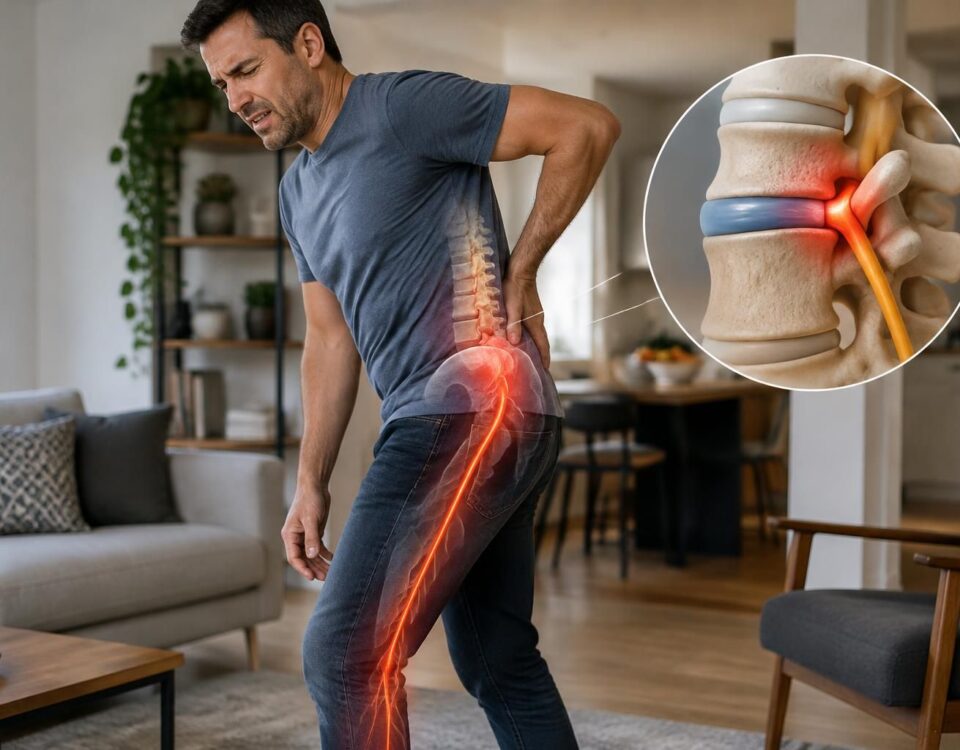
Sciatica and recurring pain episodes
02/11/2026
Sciatica and poorly tolerated activity: how to recognize it
02/11/2026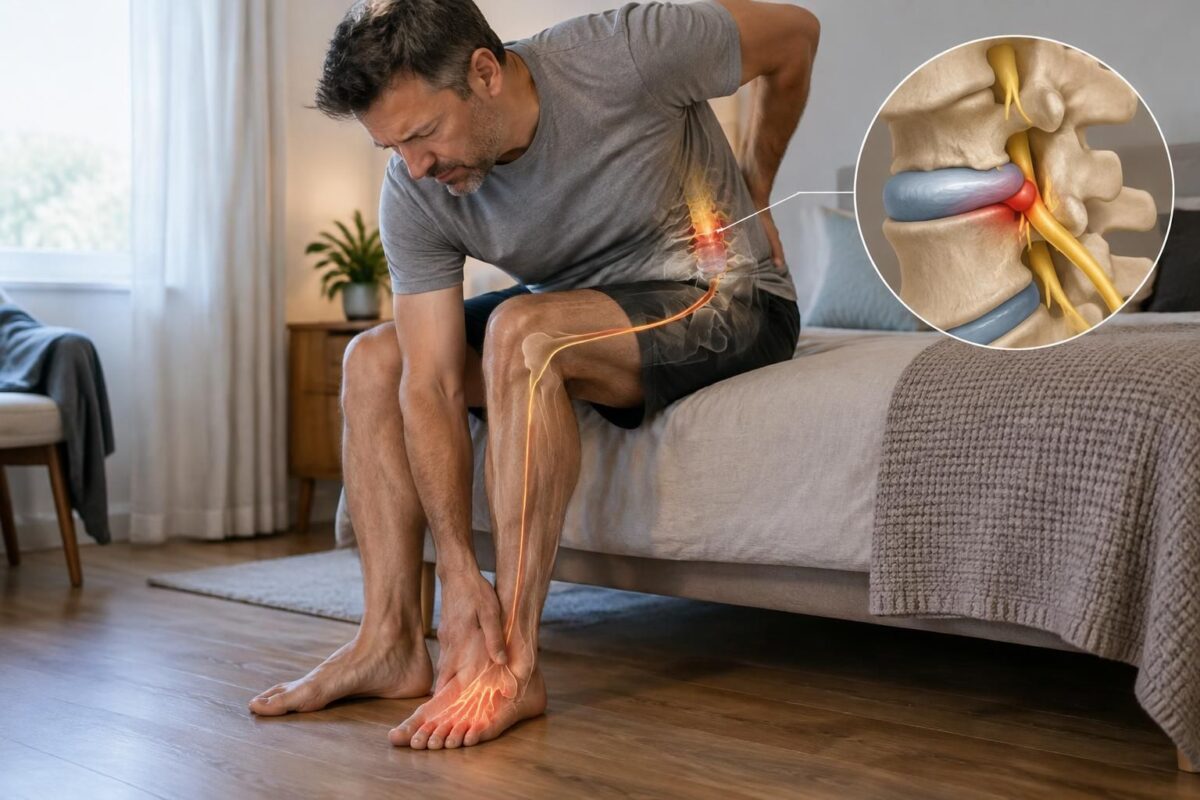
IN BRIEF
| A disc protrusion is an intervertebral disc that bulges without necessarily rupturing. Pain on the top of the foot may sometimes be related to irritation of a lumbar nerve, but it does not alone confirm disc involvement. An evaluation helps to investigate the cause and guide appropriate care. Consult quickly if significant or progressive weakness appears. |
A lumbar disc protrusion can sometimes irritate a nerve root and cause pain that radiates down the leg to the top of the foot, sometimes accompanied by tingling or numbness. However, a protrusion visible on imaging does not always cause symptoms, and foot pain can have other origins.
A healthcare professional can assess strength, sensitivity, and the origin of the pain to guide management. Consult quickly if weakness in the leg or foot appears or worsens. Loss of bladder or bowel control or numbness in the saddle region requires urgent evaluation.
A lumbar disc protrusion can sometimes irritate a nerve root and cause pain that radiates down the leg to the top of the foot. However, this pain alone does not prove that a disc is involved: a clinical examination is necessary to distinguish nerve irritation from a local foot problem. This article explains the possible links, signs to watch for, and assessment and management options.
How a disc protrusion can irritate a nerve
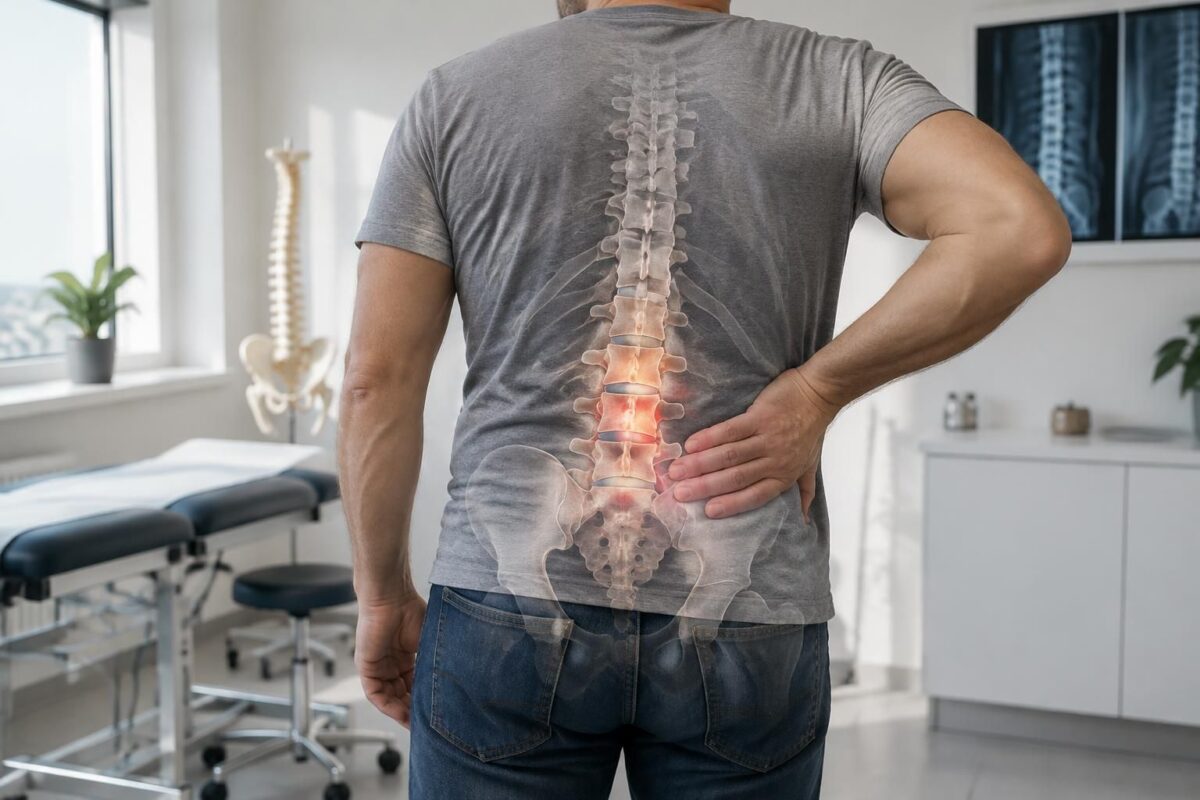
The intervertebral discs separate the vertebrae and help cushion strains. Over time, a disc can lose height and bulge. This deformation, called disc protrusion, does not automatically mean that a nerve is compressed or that it causes pain.
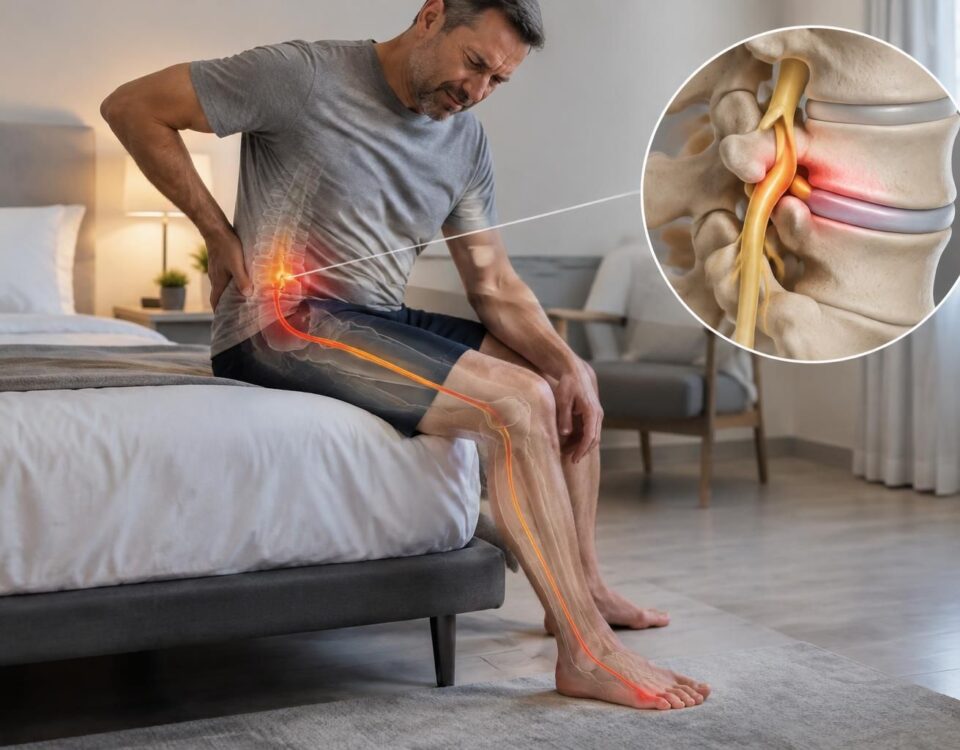
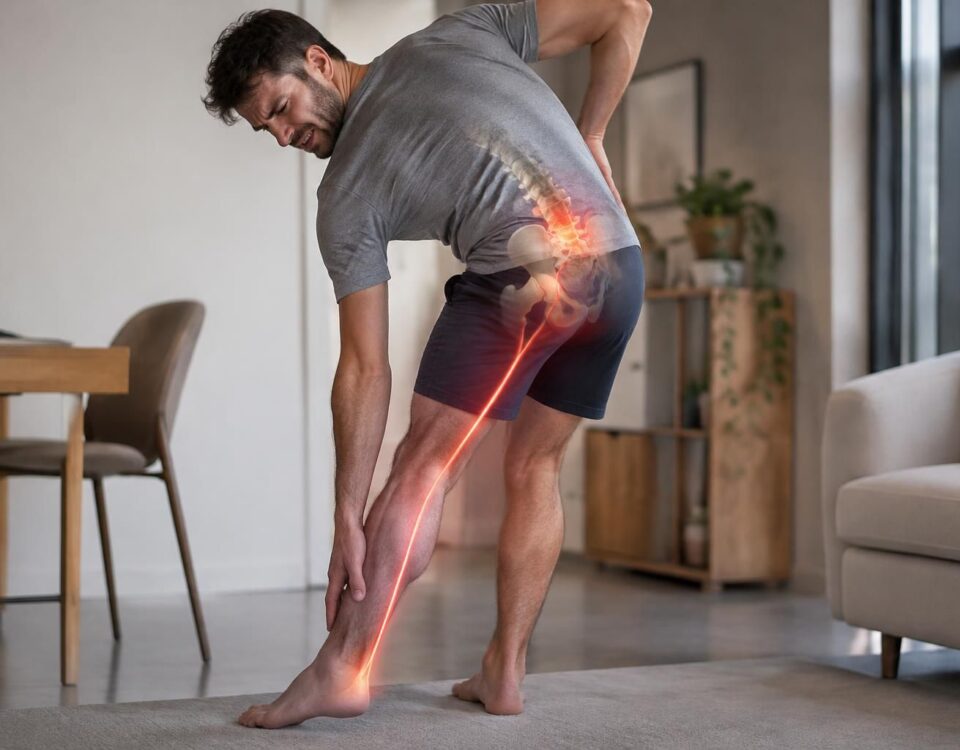
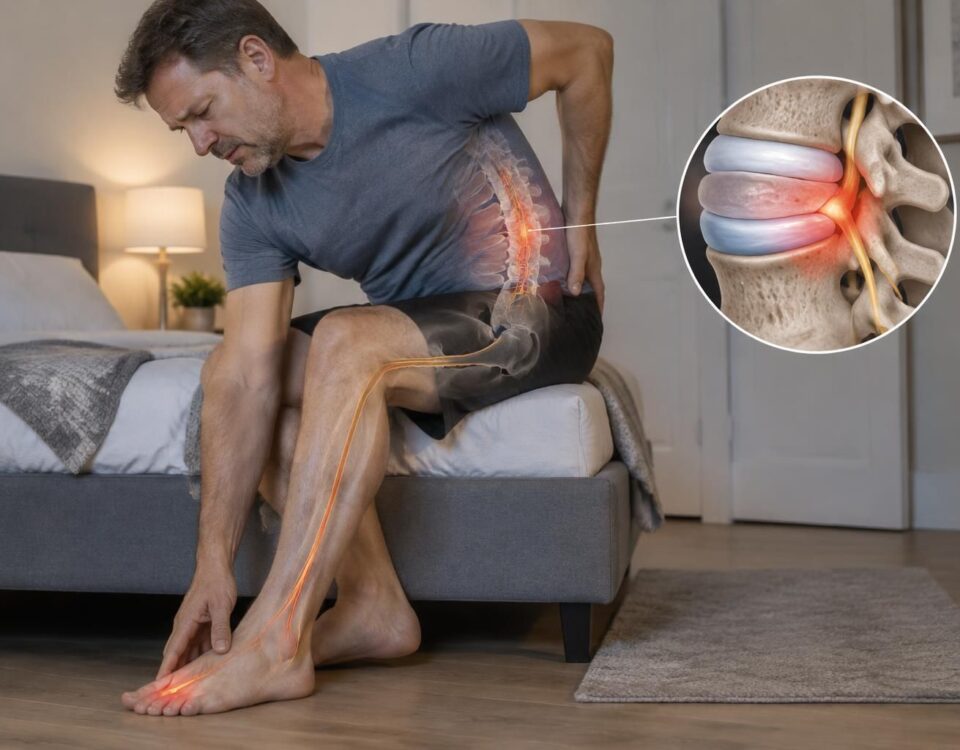
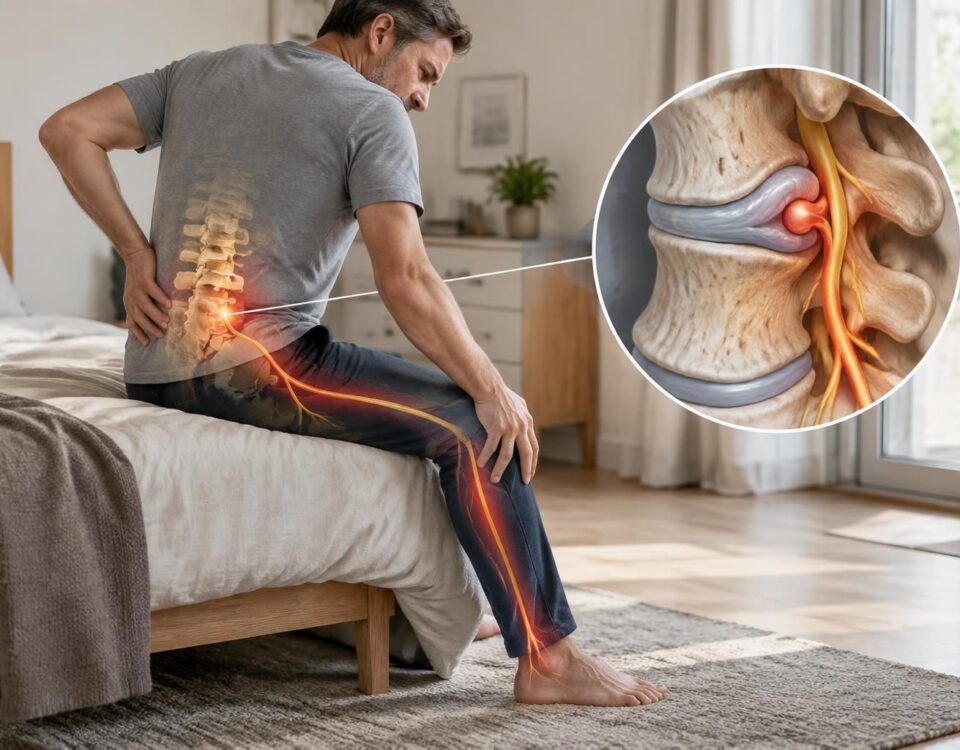
A protrusion located in the lower back can irritate a nerve root if it encroaches on the space where that root passes. Depending on the nerve affected, pain can radiate from the lumbar region or buttock down the leg, reaching the top of the foot. Irritation associated with the L4-L5 region can particularly accompany pain, numbness, or weakness in the leg. To learn more, visit the page on L4-L5 sciatica.
The top of the foot alone is not sufficient to identify the cause
Pain on the top of the foot may be related to nerve irritation but can also be due to a local cause. A shoe that is too tight, repeated pressure, an injury, or a problem affecting the tendons or joints in the foot can also cause pain in this area. Therefore, the location alone does not allow for a diagnosis.
Nerve-originated pain is sometimes accompanied by tingling, a burning sensation, or numbness. It may also follow a path from the lower back or the buttock. To compare possible causes of local pain, refer to this page on pain that improves when walking, keeping in mind that symptoms vary from person to person.
What symptoms may accompany the pain?
Signs consistent with nerve irritation
A lumbar nerve injury can cause pain in the lower back or buttock, followed by irradiation into the thigh, calf, or foot. Some people experience tingling or a decrease in sensitivity. Others notice weakness, for example, when lifting the foot or toes. These signs warrant evaluation, especially if they persist or progress.
Pain can vary depending on posture and movements. Some people feel it more when seated or upon rising. Others notice an increase during certain movements of the lower back. You can find information on pain upon getting out of bed and pain worsened in lumbar extension.
When foot pain may have another origin
Pain limited to the top of the foot, with no pain in the leg or lumbar symptoms, may suggest a local cause. Pain triggered by a shoe, walking, or pressure on a specific area also provides useful clues. The healthcare professional considers these elements, as well as sensitivity, strength, and mobility.
It is important not to conclude that a protrusion visible on imaging necessarily explains the pain. Disc changes may be present without symptoms. An MRI result must be interpreted alongside clinical signs and the person’s progression. The page dedicated to pain that radiates down the leg upon waking describes an example of radiating symptoms.
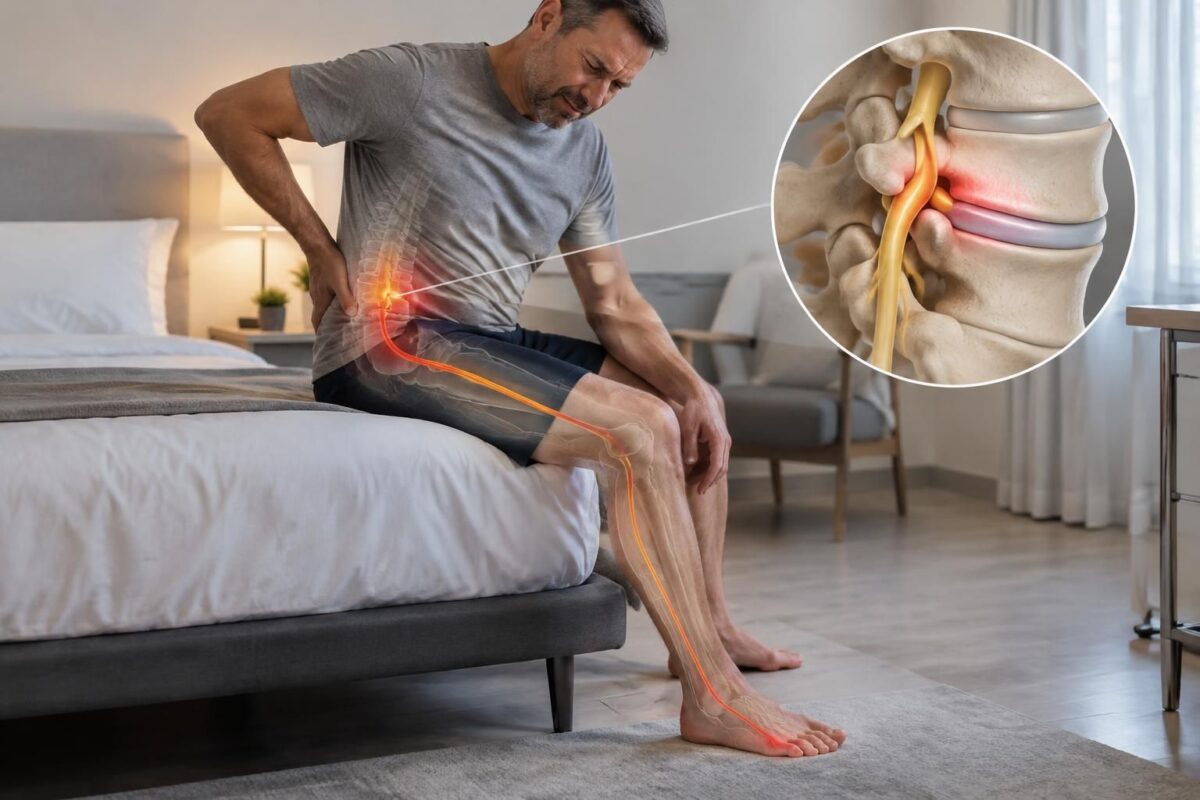
Disc protrusion and pain on the outer edge of the foot
IN BRIEF A disc bulge is a bulging of the disc that can sometimes irritate a nerve root and cause pain down to the outer edge of the foot. However, this pain is not always related to the disc: a…
Disc protrusion and disc herniation: what is the difference?
The protrusion refers to a bulging of the disc. A disc herniation generally refers to a condition where part of the disc extends beyond its usual limits. These terms describe aspects observed through imaging; they do not, on their own, determine the intensity of pain or the need for treatment.
A protrusion or a herniation can remain asymptomatic. Symptoms may sometimes appear when a nerve structure is irritated, but other factors can also contribute to pain. For an additional explanation, refer to the page on disc protrusion and herniation.
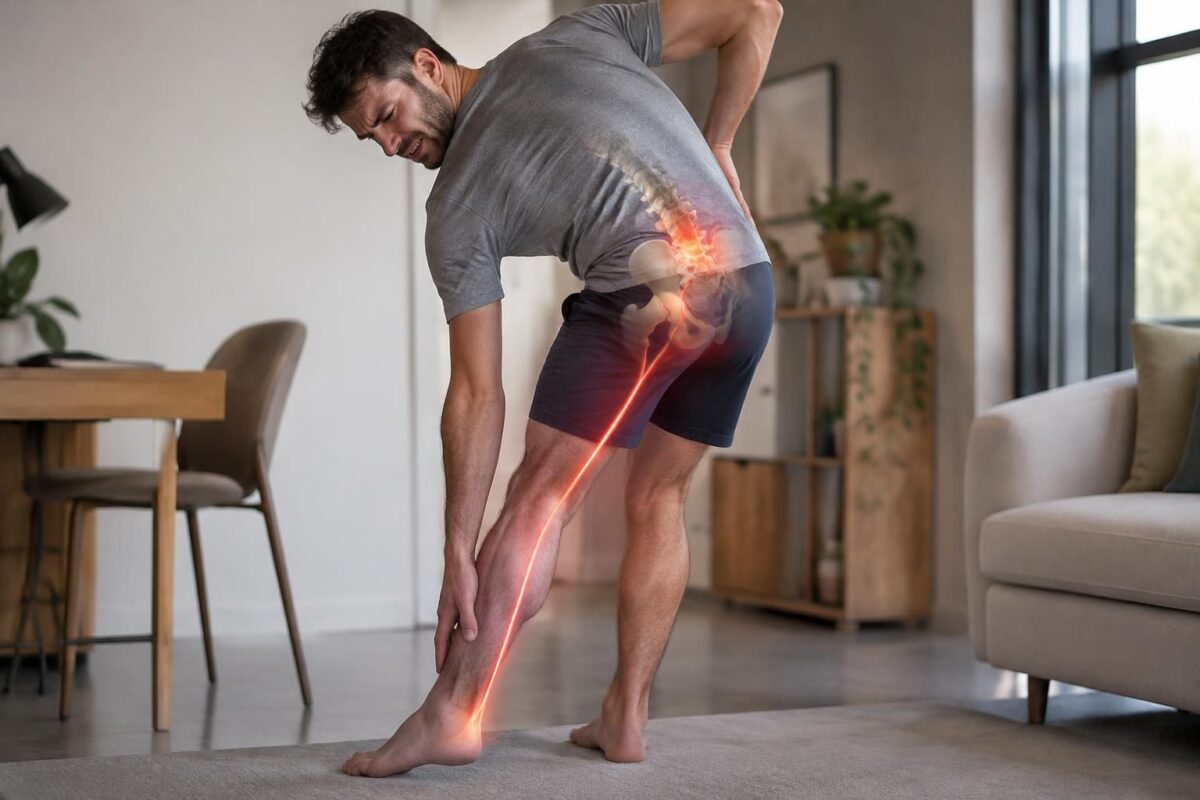
IN BRIEF A disc herniation is a bulging of a disc in the spine, often without symptoms. If it irritates a lumbar nerve root, the pain may radiate down the leg to the foot and sometimes be felt in the…
How to assess pain on the top of the foot?
Clinical examination
The healthcare professional will ask you about the onset of the pain, its path, positions that modify it, and associated symptoms. They may examine sensitivity, muscle strength, reflexes, and some movements of the back and leg. Examination of the foot can also help identify a local cause.
Imaging and results
An X-ray, a CT scan, or an MRI are not necessary for every pain. The healthcare professional decides whether imaging is useful based on the symptoms, their duration, and the results of the examination. An MRI may show a protrusion, but this image must be correlated with the observed signs. It does not automatically confirm that the protrusion is causing pain in the foot.

Intervertebral disc protrusion and pain in the big toe
IN BRIEF A disc protrusion is a bulging of the disc that can irritate a lumbar nerve root, particularly L5, and cause pain, tingling, or numbness down to the big toe. This symptom alone does not confirm a disc origin:…
Care Options
Care depends on the likely cause, the intensity of the symptoms, and their evolution. A doctor or another licensed healthcare professional can assess the situation and discuss appropriate options. Medications or injections require a medical evaluation and a prescription when indicated.
At TAGMED Clinic, an assessment can help clarify the functional factors associated with lower back pain and radiating symptoms. Depending on the case, the care may include specific osteopathy or a motorized neurovertebral decompression. These approaches may not be suitable for everyone and do not replace a medical diagnosis. To learn about available services, consult the TAGMED Clinic in Montreal or Terrebonne.
The choice of an approach should take into account the examination, the individual’s history, and tolerance. Carefully managing aims to monitor the evolution of symptoms and reassess the situation if the pain changes or if weakness appears.
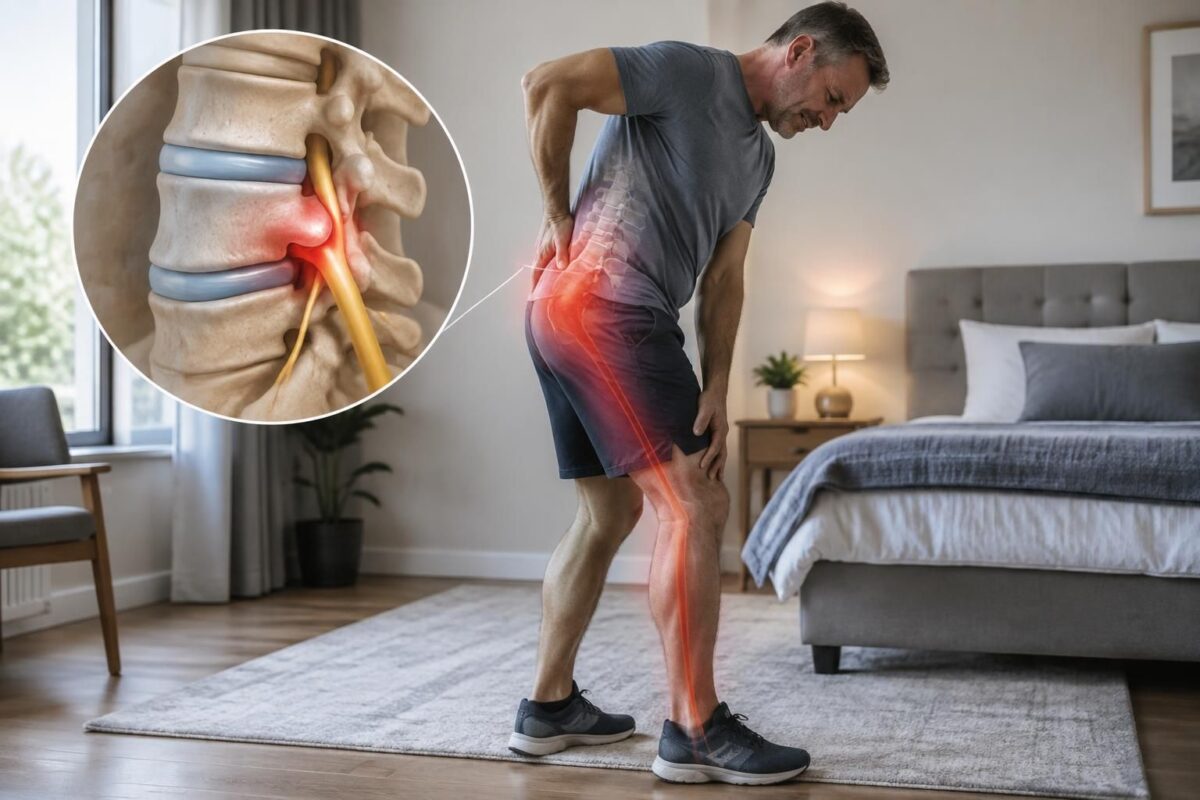
Disc herniation and pain radiating below the knee
IN BRIEF A disc protrusion is a deformation of a disc in the spine that can irritate a nerve root. If the pain extends below the knee, with tingling or weakness, this may suggest sciatica, although this alone does not…
When to Consult Quickly?
Consult a healthcare professional if the pain persists, radiates down the leg, is accompanied by numbness, or limits your activities. New or worsening weakness in the leg or foot requires prompt evaluation.
Go to the emergency room in case of loss of control of the bladder or bowels, numbness in the saddle area, significant or progressive weakness, fever with back pain, or severe pain that worsens rapidly. These signs may require immediate attention.
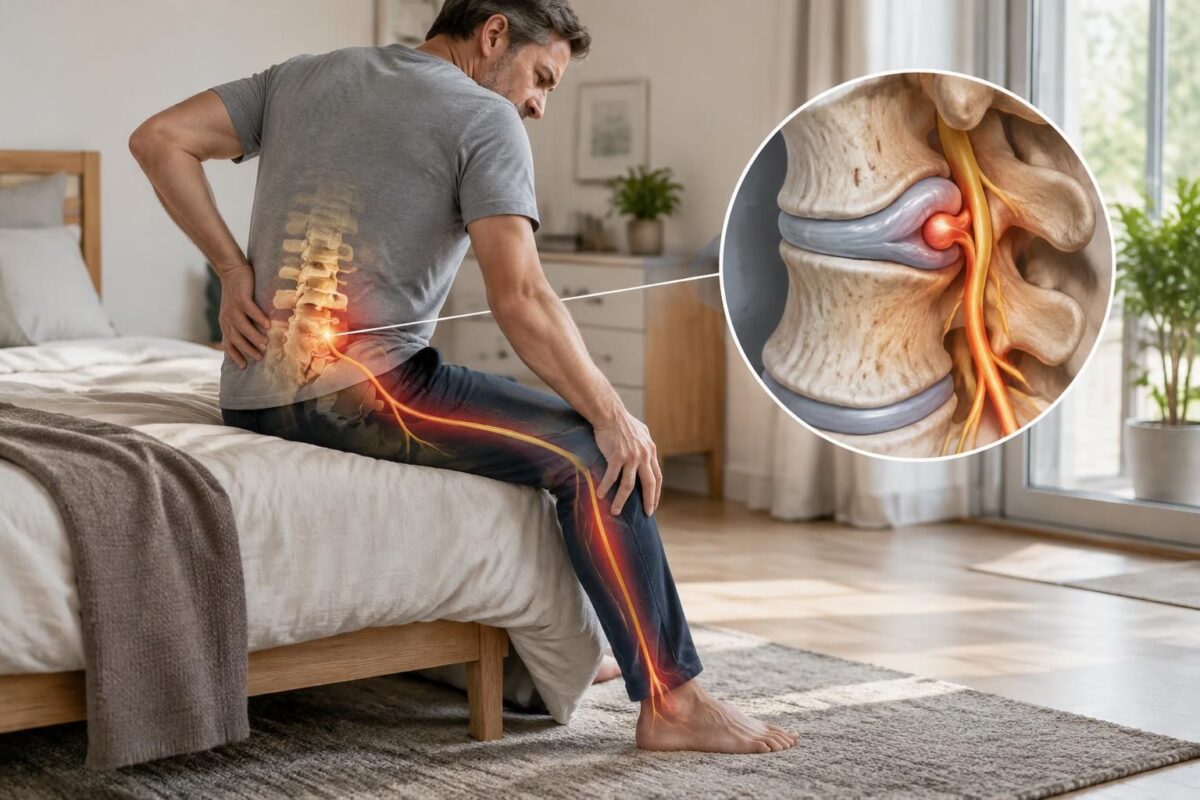
Intervertebral disc protrusion and neurological symptoms
IN BRIEF A disc protrusion is an intervertebral disc that bulges and can irritate a nerve root. It can cause pain, tingling, numbness, or weakness in an arm or leg, depending on its location. Clinical examination and, if necessary, imaging…
Daily Precautions
Avoid drawing conclusions from a medical image alone or trying to treat new weakness without professional advice. Note the evolution of the pain, its path, and associated symptoms. This information can help the healthcare professional guide the assessment.
If the pain changes location, extends further down the leg, or is accompanied by new sensory or strength disturbances, request a reevaluation. Pain on the top of the foot deserves particular attention when it occurs with lumbar symptoms or irradiation along the leg.
Medical Disclaimer: The information and advice provided on this site do not replace the opinion, diagnosis, or treatment of a healthcare professional. Please note that Sylvain Desforges, B.Sc., D.O., N.D., doctor in osteopathy, is neither a medical doctor nor a physician, and is not a specialist in a medical specialty as defined by the Collège des médecins du Québec. Manual medicine, functional medicine, and sports medicine as described on this site exclude any medical diagnosis or treatment provided by a physician or medical specialist. Always consult your physician for any medical questions. For more details, please read our Complete Legal Disclaimer.
What Pain May Indicate
- A lumbar protrusion may irritate a nerve root, sometimes associated with pain on the top of the foot.
- Tingling, numbness, or pain descending down the leg may accompany this irritation.
- Imaging alone is not sufficient to establish the link: clinical examination matters.
Guidelines for Action
- Consult a professional if the pain persists, worsens, or is accompanied by foot weakness.
- Stay active as much as possible, adapting painful activities.
- Emergency if significant or progressive weakness, loss of bladder or bowel control, or numbness in the saddle area.

A disc protrusion can sometimes irritate a lumbar nerve root and contribute to pain that radiates down the leg to the top of the foot. However, this pain can also have other causes, and an abnormality seen on imaging is not sufficient to establish its origin. The following recommendations can help to act cautiously, preserve your activities, and know when to seek professional evaluation.
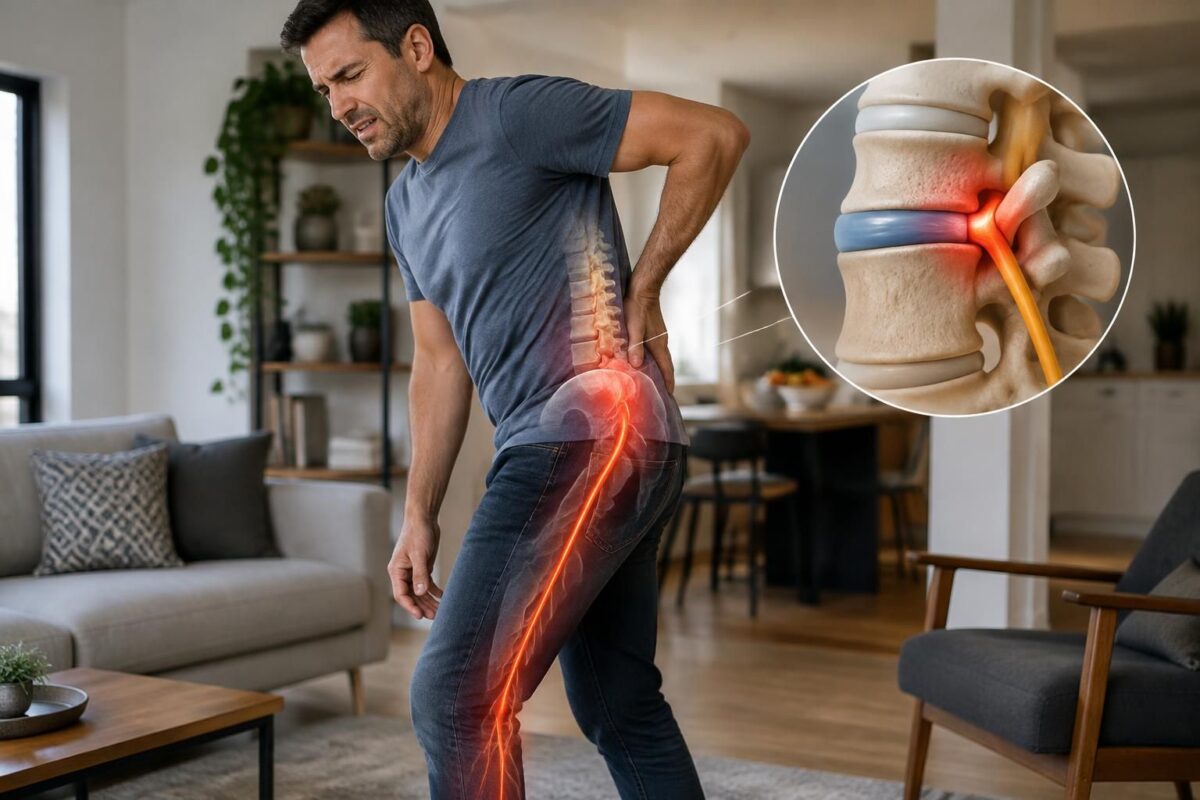
Disc herniation and recurrent sciatica
IN BRIEF A disc protrusion is a bulging of the disc that may be associated with recurring sciatica, without necessarily being the cause. The evaluation correlates symptoms, neurological examination, and imaging, if relevant. An appropriate plan can help improve function…
Understanding the Link Between the Back and the Top of the Foot
A protrusion corresponds to a bulging of the disc between two vertebrae, without necessarily causing symptoms. If a nerve root is irritated or compressed, pain may spread from the lumbar region to the buttock, leg, and sometimes the top of the foot. Involvement of certain lumbar roots, particularly in the L5 region, may be compatible with this path, but only an evaluation can assess this possibility.
Pain in the foot may also be related to a local problem, such as tendon irritation or a shoe that is too tight. Note where the pain begins, its path, activities that exacerbate it, and the potential presence of tingling or weakness. This information will help the healthcare professional guide the examination.
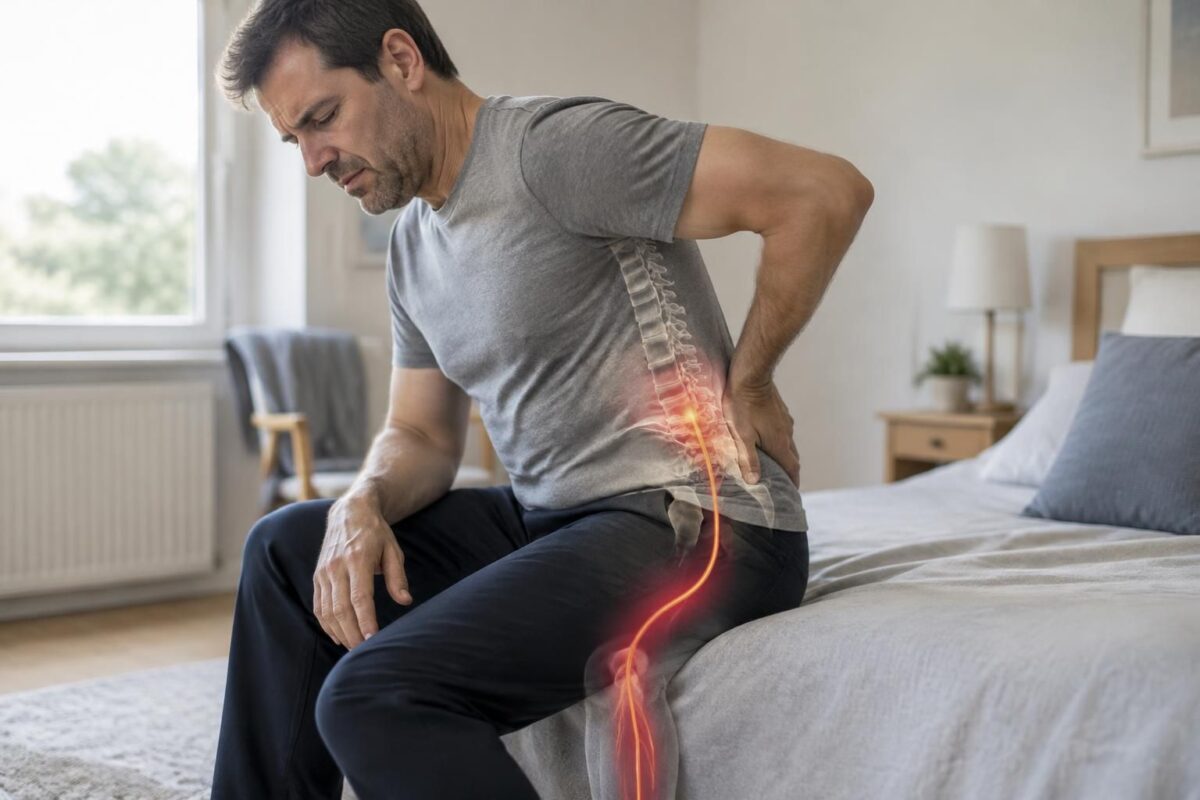
Disc herniation and persistent pain in the leg
IN BRIEF A disc protrusion is a bulging of a disc that can irritate a nerve and cause persistent pain in the leg, sometimes accompanied by tingling or numbness. Imaging alone does not confirm the origin of the symptoms: clinical…
What to Do Daily?
Stay Active Without Straining
In the absence of urgent signs, prioritize appropriate activity rather than strict prolonged rest. Short walks or gentle movements can be tried if the symptoms do not intensify. Temporarily reduce movements that clearly trigger the pain, such as lifting a load while bending or staying in an uncomfortable position for long periods, then gradually resume your activities according to your tolerance.
Adapt Positions and Loads
Alternate between sitting and standing positions, take regular breaks, and bring objects closer to your body before lifting them. Avoid sudden movements and exercises that exacerbate radiating pain in the leg. There is no universal exercise suitable for all protrusions: a doctor, physiotherapist, or another qualified professional can guide you towards appropriate movements.
Disc herniation and lumbar degeneration
IN BRIEF A lumbar disc protrusion is a bulging of a disc often related to disc degeneration. It does not always cause symptoms but can contribute to lower back pain or pain radiating down the leg if a nerve is…
When to seek an evaluation?
Consult a professional if the pain persists, frequently recurs, limits your activities, or is accompanied by numbness. A new or progressive weakness, such as difficulty lifting the foot or toes, requires prompt evaluation. A clinical examination precedes any imaging choices; an MRI is not routine and is decided based on symptoms and context.
Call emergency services in case of loss of bladder or bowel control, numbness in the area between the legs, or significant weakness that worsens. These signs may indicate serious nerve damage and should not wait for a routine appointment.
What management options to consider?
Based on the evaluation, management may combine activity advice, progressive rehabilitation, and relief strategies. Medications or other interventions should be discussed with a professional, taking into account your health condition. Manual therapies can sometimes accompany a functional approach but do not replace a diagnosis or medical follow-up. Surgery is only considered in certain situations, particularly in the presence of complications or persistent severe symptoms.
About the author
Sylvain Desforges, B.Sc., D.O., N.D., is an osteopath and naturopath, founder and president of TAGMED and the ACMA association. His educational content particularly focuses on spinal pain and symptoms compatible with sciatica.
Medical Disclaimer
This information is educational and does not replace a consultation, diagnosis, or treatment by a licensed health professional. The author is neither a physician nor a specialist in any medical field recognized by the College of Physicians of Quebec. Osteopathy, manual medicine, or functional support approaches do not replace medical follow-up.
| Point to check | Possible link to a disc protrusion |
|---|---|
| Pain on the top of the foot | Can sometimes be related to irritation of a lumbar nerve root, particularly L5. |
| Associated signs | A low back pain or radiation in the leg may guide the evaluation, without confirming the cause. |
| Other explanations | Tight shoes, local irritation of a nerve, or foot problems can also cause this pain. |
| Diagnosis | A clinical examination is necessary; imaging is considered based on symptoms and their progression. |
| When to consult | Consult if the pain persists, worsens, or is accompanied by numbness or weakness. |
| Emergency | Significant or progressive weakness, saddle anesthesia, or loss of bladder or bowel control: consult urgently. |
Illustrative testimonies: disc protrusion and pain on the top of the foot
Note: the stories below are fictional examples written for educational purposes. They do not correspond to verified testimonials and should not be used to diagnose. Pain on the top of the foot can have various origins; it may sometimes accompany nerve root irritation related to the lower back, but a visible disc protrusion on imaging is not necessarily the cause.
“My pain did not stay in my lower back” — In this scenario, a person describes low back pain that radiates down the leg and extends to the top of the foot. The sensation varies with movements and time spent sitting. Clinical evaluation is important to determine if the symptoms follow a nerve pathway and to check the strength and sensitivity of the leg and foot.
“The MRI showed a protrusion, but I wanted to know if it explained my symptoms” — Here, the person learns that a disc protrusion is visible on imaging and wonders about the link to their foot pain. The professional explains that an image must be interpreted in conjunction with symptoms and physical examination: some protrusions do not cause any pain, while nerve irritation can sometimes produce pain radiating to the foot.
“I also had tingling on the top of my foot” — In this example, the pain is accompanied by intermittent tingling. The person consults to have their sensitivity, reflexes, and muscle strength checked. These signs deserve evaluation, especially if they persist, spread, or are accompanied by difficulty lifting the foot.
“I adapted my activities without staying completely still” — This fictional narrative describes a gradual return to activities while temporarily avoiding movements that significantly exacerbate symptoms. The plan is adjusted with a healthcare professional, who can propose appropriate exercises and refer for medical evaluation if necessary. The response to care varies from person to person; no exercise is suitable for all cases.
Pain on the top of the foot alone does not allow for a conclusion of a disc protrusion or sciatica. Consult a healthcare professional if the pain persists, worsens, or is accompanied by numbness or weakness. Significant or progressive weakness, loss of bladder or bowel control, or numbness in the saddle area requires urgent medical evaluation.
Disc protrusion and pain on the top of the foot: understanding the link
A pain on the top of the foot can sometimes be related to nerve irritation originating from the lower back. When a lumbar disc protrusion is located near a nerve root, it may contribute to pain that radiates into the buttock, leg, and then to the foot. This possibility deserves evaluation, but it does not automatically mean that a disc is involved: several disorders of the back, leg, or foot can produce similar symptoms.
Intervertebral discs are located between the vertebrae. They help absorb stress and allow movements of the spine. Over time, they may lose water and flexibility. A disc protrusion refers to a bulging of the disc that extends beyond its usual contour, without necessarily rupturing its outer layer. This condition is common and may be visible on imaging even in the absence of pain.
Pain primarily occurs when a sensitive structure, such as a nerve root, is irritated or compressed. Certain lumbar impairments can affect the nerves associated with sensitivity and strength in the leg and foot. Irritation of the L5 root, for example, may sometimes accompany pain or tingling on the top of the foot and near the big toe. However, the distribution of symptoms varies from person to person and is not sufficient by itself to establish a diagnosis.
Symptoms may include lower back pain, a burning sensation or electric shock feeling in the leg, numbness, tingling, or weakness. They may be more pronounced after prolonged sitting, certain movements, or exertion, but this is not systematic. Pain strictly localized to the foot may also arise from a joint, tendon, local nerve irritation, ill-fitting shoes, or another cause. Therefore, it is important to examine the entire picture rather than relying solely on an MRI image.
The evaluation generally relies on the history of symptoms and an examination of mobility, sensitivity, reflexes, and strength. Imaging is not always necessary initially; a healthcare professional can determine if it is indicated based on the duration of the troubles, their evolution, and observed signs. Management depends on the cause and intensity of the symptoms. It may include a temporary adaptation of activities, maintaining a tolerated activity level, and supervised progressive exercises. Medications or other treatments should be discussed with a licensed professional.
Avoiding prolonged immobility and gradually resuming movements that remain comfortable can be helpful, without trying to force through significant pain. Strengthening and improving effort tolerance can then be tailored to the situation. A manual or functional approach may be considered as a complement, after evaluation, but it does not replace a medical diagnosis or the required care.
Consult quickly if the pain is accompanied by new or progressive weakness, especially if the foot becomes difficult to lift. Loss of bladder or bowel control, numbness in the saddle area, fever, recent trauma, or rapid worsening require urgent evaluation. These signs do not allow identification of a cause from a distance, but they justify not waiting.
About the author
Sylvain Desforges, B.Sc., D.O., N.D., Doctor of Osteopathy and naturopath, is the founding president of TAGMED and the ACMA association. He dedicates his practice to chronic pain of the spine, lower back pain, and pain compatible with sciatica, especially when the pain radiates down toward the buttock, leg, calf, foot, or toes.
Through SOS Sciatique, he publishes educational content on the symptoms of sciatica, possible causes such as herniated discs, disc compression, foraminal stenosis, or irritation of a lumbar nerve root, as well as on non-surgical approaches that may be considered based on the evaluation. At the TAGMED Clinic, care may include, depending on the case, motorized neurovertebral decompression, specific osteopathy, or precision percussion.
Medical disclaimer
The information published on SOS Sciatique is provided for educational purposes and does not replace a consultation, diagnosis, opinion, or treatment performed by a physician or another licensed healthcare professional. The author of this article is neither a physician nor a specialist in a medical specialty recognized by the Collège des médecins du Québec. The approaches of osteopathy, manual therapy, or functional support described on this site do not constitute medical acts and are not intended to replace medical follow-up.
A disc protrusion can sometimes irritate a nerve root and cause pain radiating down into the leg up to the top of the foot. However, this pain is not sufficient to establish a diagnosis: examination of the symptoms and, if necessary, medical exams are required to search for the cause.
When pain on the top of the foot is accompanied by radiation into the leg, tingling, or numbness, lumbar nerve irritation, particularly at the L4-L5 or L5-S1 level, may be considered. Information about pain in the leg associated with the L4-L5 and L5-S1 discs may help to better understand this possibility. However, pain on the top of the foot can have other origins; also consult resources on pain on the top of the foot and pain on the top of the foot.
A protrusion observed on imaging is not necessarily the cause of the symptoms: it must be interpreted considering the clinical examination and their evolution. Professional evaluation is particularly indicated if the pain persists, intensifies, or is accompanied by weakness. In the meantime, adjust activities that worsen symptoms without completely immobilizing yourself, and seek advice from a healthcare professional before undertaking exercises or treatment.
Consult quickly in case of significant or progressive weakness in the leg or foot. Loss of urinary or bowel control, or numbness in the saddle area, requires urgent care.

Sylvain Desforges, B.Sc., D.O., N.D., docteur en ostéopathie
Dr Sylvain Desforges, B.Sc., D.O., N.D., osteopath, is the founding president of TAGMED and of the ACMA association. He dedicates his practice to chronic spinal pain, low back pain and symptoms compatible with sciatica, particularly when pain radiates toward the buttock, leg, calf, foot or toes.
Through SOS Sciatique, he publishes educational content on sciatica symptoms, possible causes such as disc herniation, disc narrowing, foraminal stenosis or irritation of a lumbar nerve root, as well as non-surgical approaches that may be considered according to the evaluation. At Clinique TAGMED, care may include, depending on the case, motorized neurovertebral decompression, specific osteopathic care or precision percussion.
For an evaluation related to sciatica treatment in Montreal / Mount Royal or sciatica treatment in Terrebonne, please consult the services available at Clinique TAGMED.
Medical disclaimer
The information published on SOS Sciatique is provided for educational purposes only and does not replace a consultation, diagnosis, opinion or treatment provided by a physician or another authorized healthcare professional. The author of this article is neither a medical doctor nor a specialist in a medical specialty recognized by the Collège des médecins du Québec. The osteopathic, manual medicine or functional support approaches described on this site do not constitute medical acts and are not intended to replace medical follow-up.
Consult a physician or emergency service in cases of loss of bladder or bowel control, anesthesia in the saddle area, significant or progressive weakness in the leg or foot, fever, recent trauma, severe pain or rapid worsening of symptoms. For more details, please read our Legal Notice.