Sciatica and pain worsened in lumbar flexion
29/10/2026
Sciatica and exercises found on the Internet: caution depending on the cause
29/10/2026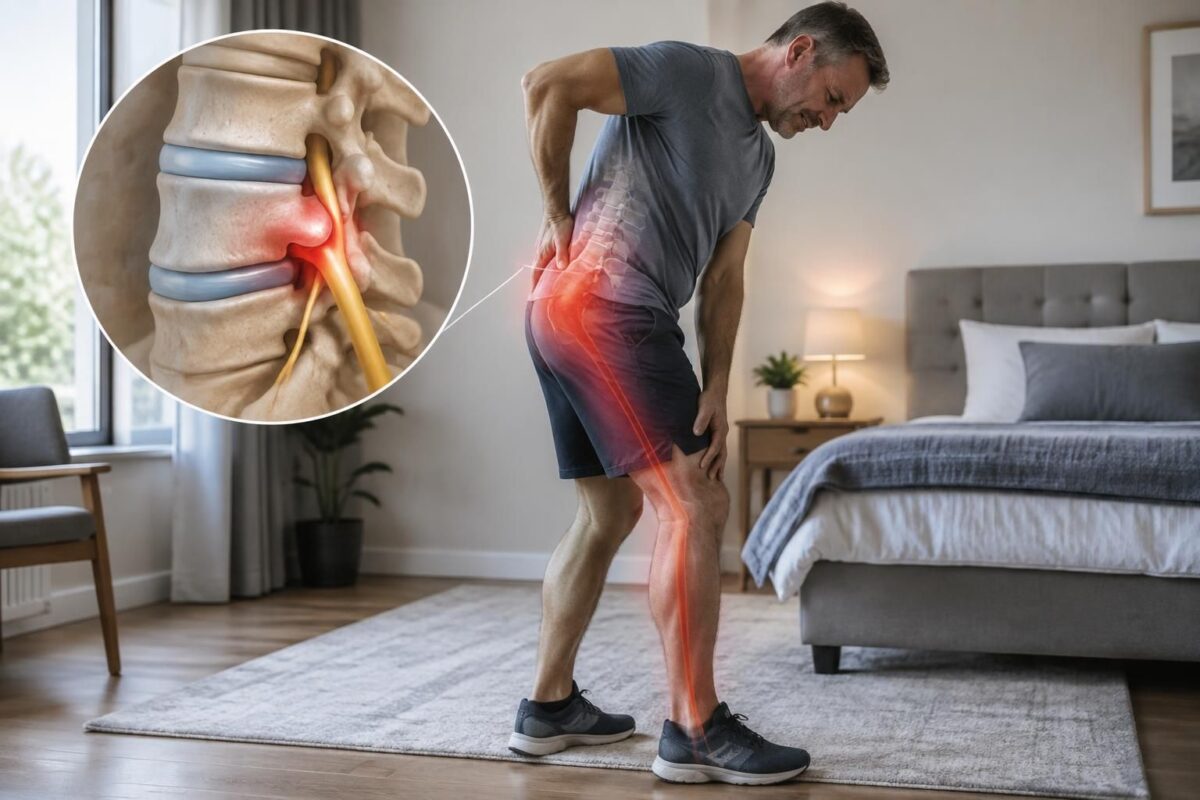
IN BRIEF
| A disc protrusion is a deformation of a disc in the spine that can irritate a nerve root. If the pain extends below the knee, with tingling or weakness, this may suggest sciatica, although this alone does not confirm the cause. A professional examination helps guide management and choose appropriate measures to relieve symptoms and maintain mobility. |
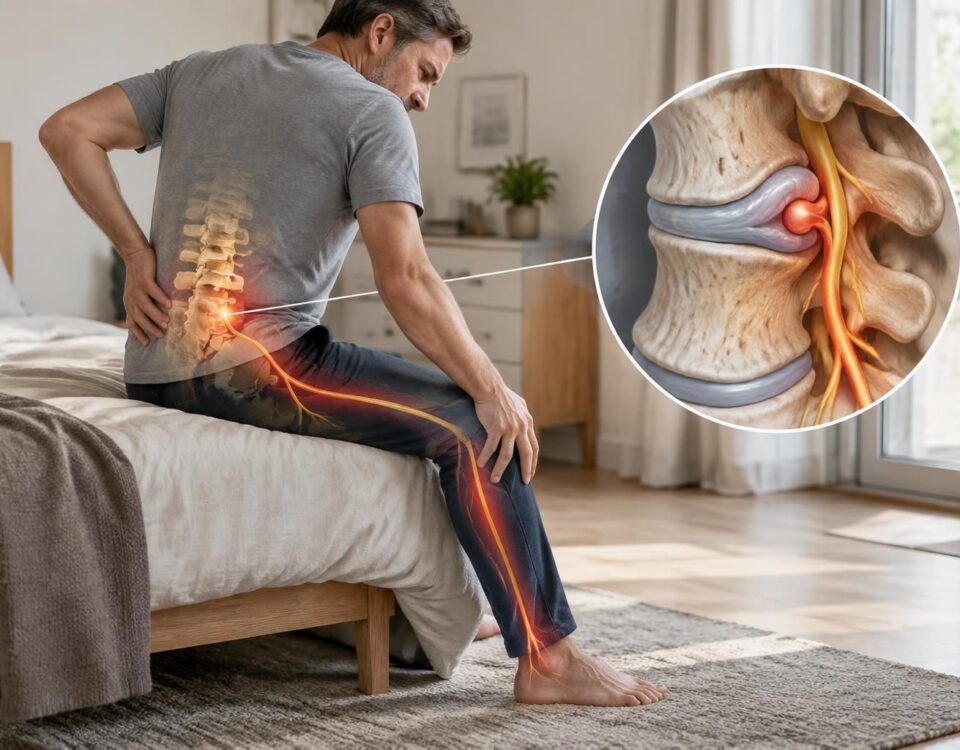
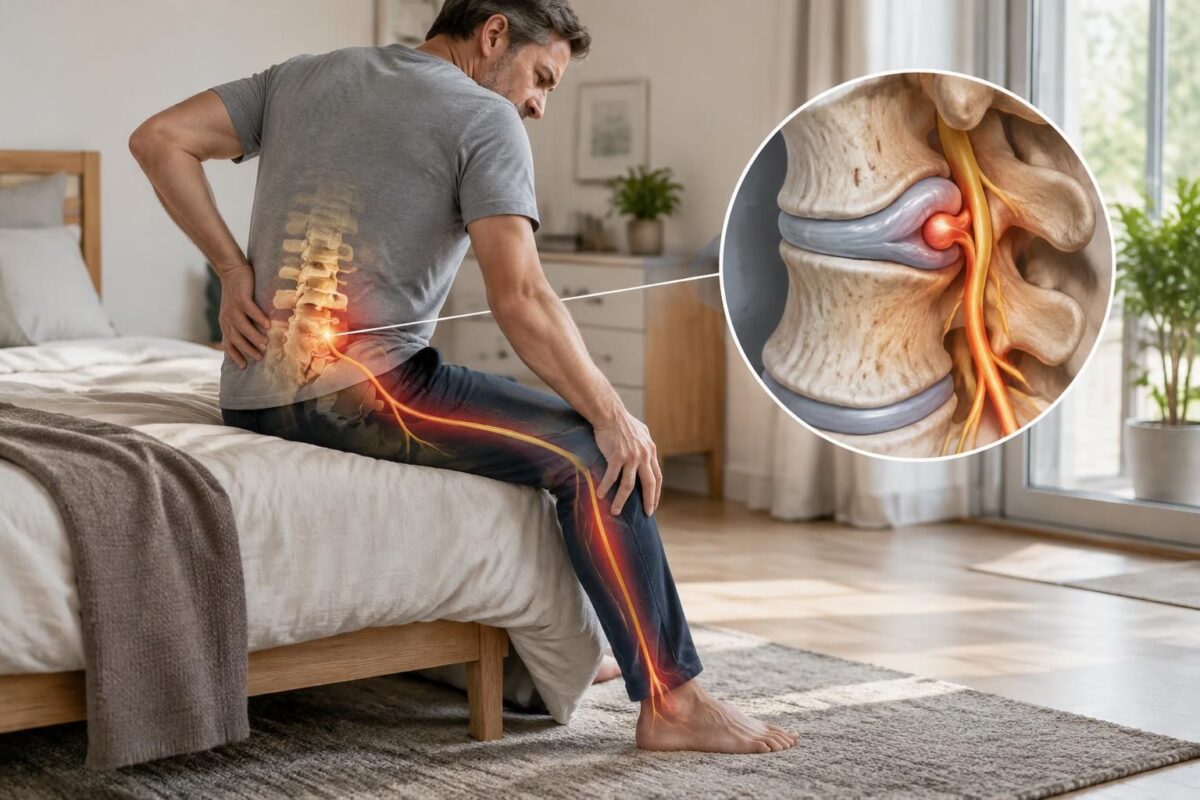
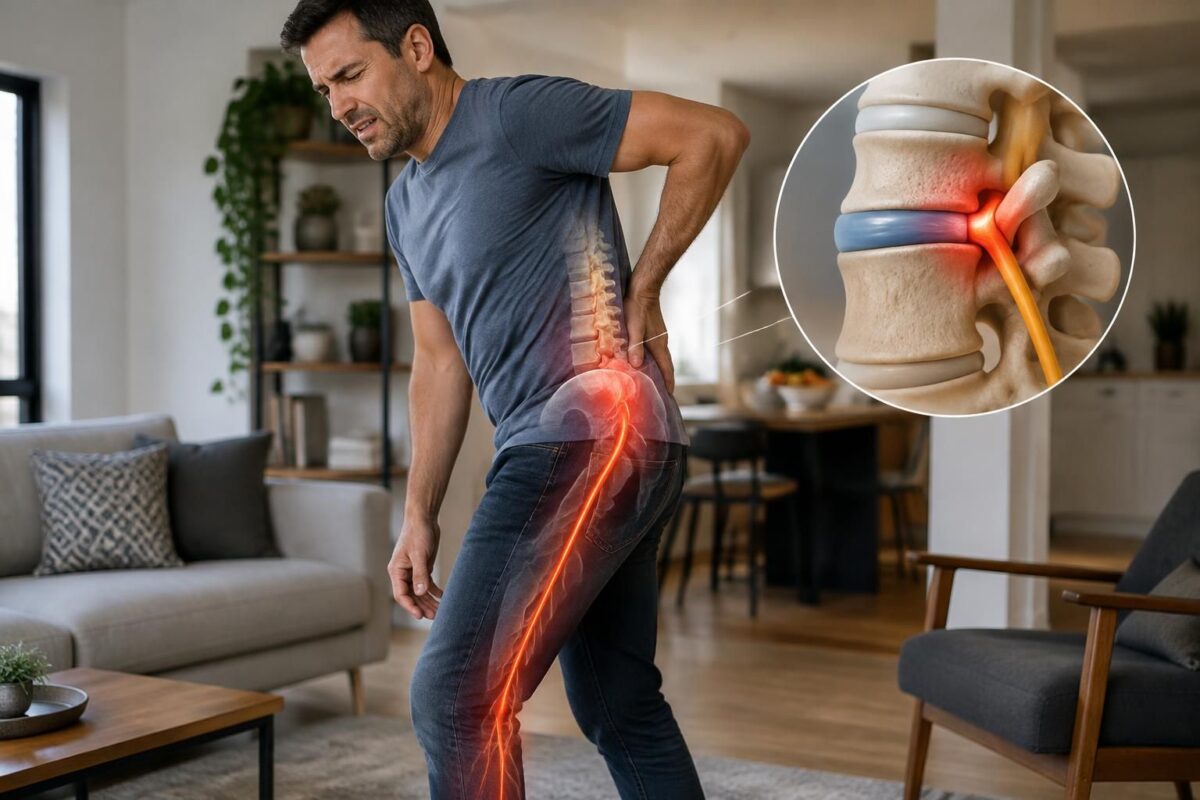
A disc protrusion can irritate a nerve root and cause pain that radiates from the back or buttock and goes below the knee, sometimes down to the foot. Numbness, tingling, or weakness may also occur. These symptoms alone do not confirm the cause: an evaluation by a healthcare professional helps guide management. Seek prompt medical attention in cases of significant or progressive weakness, or loss of bowel or bladder control.
A disc protrusion can irritate a nerve root and cause pain that extends below the knee, sometimes down to the calf or foot. This pain may suggest sciatica, but imaging alone cannot confirm the cause: evaluation of symptoms and a clinical exam help guide management. This article explains possible signs, examinations, and options to discuss with a healthcare professional.
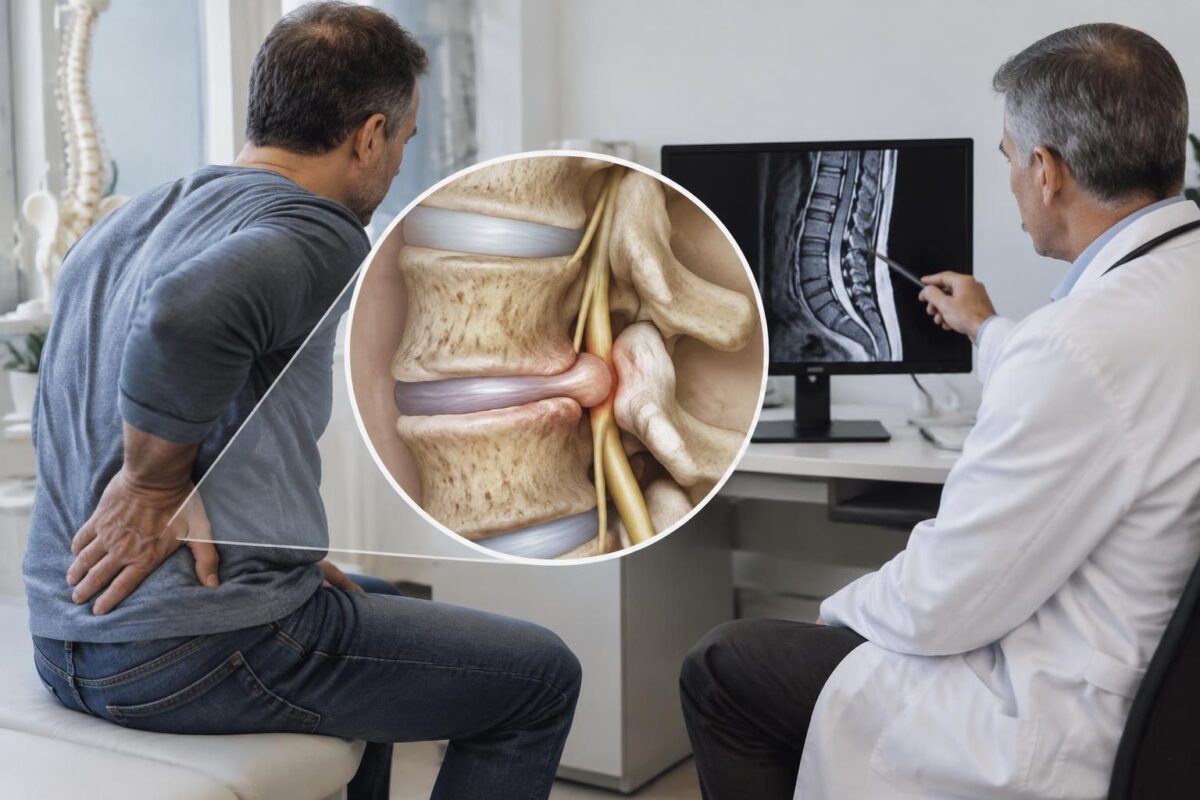
A disc protrusion corresponds to a deformation of the disc located between two vertebrae. The disc bulges, but its outer casing remains intact. The protrusion can sometimes reduce the space available around a nerve root and irritate it.
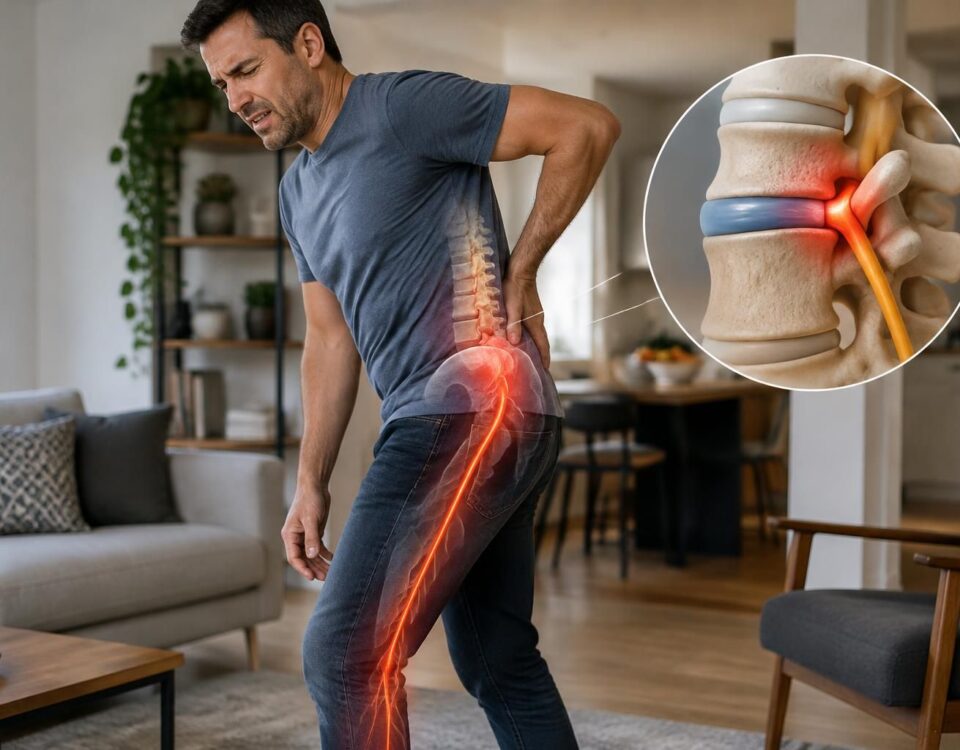
Pain that radiates down below the knee can follow the path of a nerve. It may be accompanied by tingling, numbness, or a sensation of weakness in the leg or foot. However, a protrusion visible on MRI does not always cause symptoms. Therefore, it is necessary to compare imaging results with present signs and the clinical examination.
How to recognize nerve-related pain
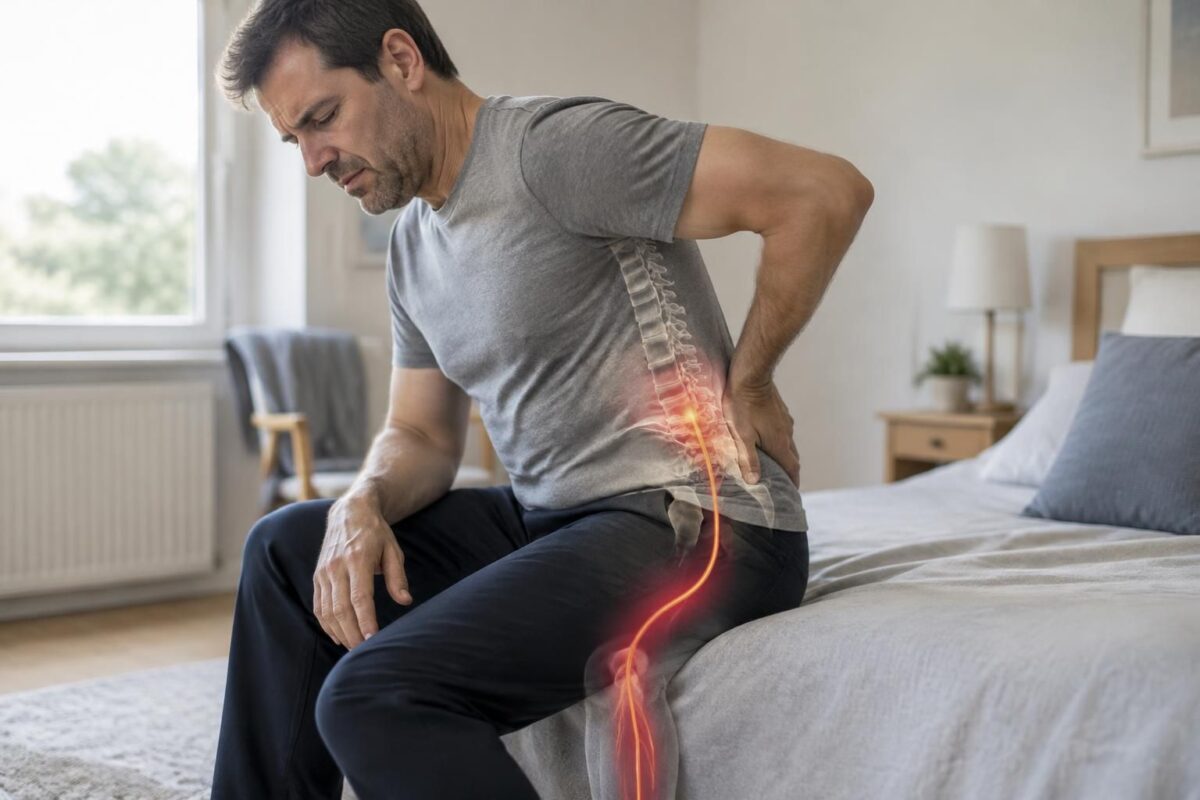
Nerve pain can start in the lower back or buttock, then radiate down the thigh and below the knee. Some people also experience burning sensations, shocks, or tingling. The affected area depends on the irritated nerve root.
Pain that extends to the calf or foot deserves evaluation if it persists, worsens, or limits daily activities. Symptoms can vary depending on posture and movements. However, the trajectory alone is not sufficient to identify the cause with certainty.
Disc protrusion, hernia, and other possible causes
Disc protrusion and herniation refer to different forms of disc deformation. The term used in an MRI report does not alone predict the intensity of pain or its progression. To better understand these differences, consult this page on the L5-S1 region and sciatica.
Other problems can also cause pain in the leg, such as foraminal stenosis or other nerve irritation. Pain relieved in a sitting position may sometimes lead the professional to consider the possibility of stenosis, although this sign alone is not sufficient to establish a diagnosis. Learn more about pain relieved in a sitting position and stenosis.
Causes and symptoms to watch for
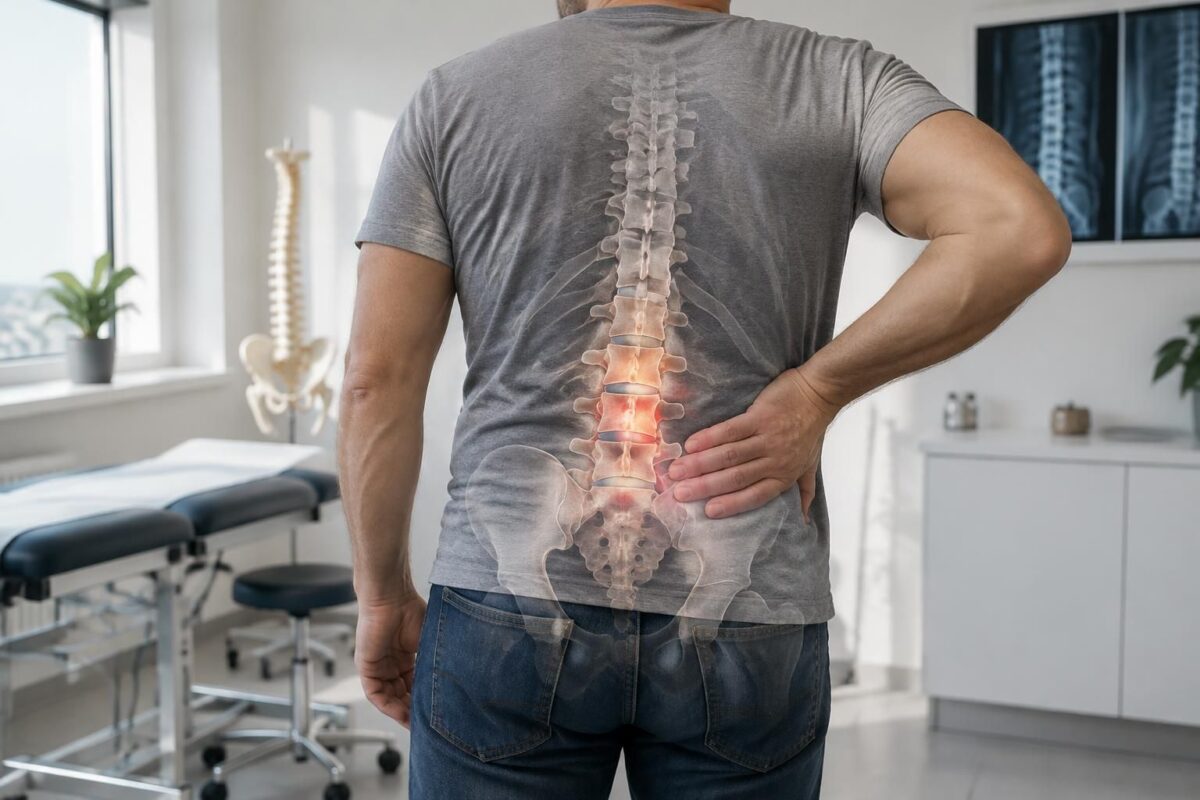
Discs change with age. Some factors, such as repeated strains on the spine or a history of back problems, can also contribute to symptoms. However, it is not always possible to identify a single cause. A protrusion may be present without causing pain.
Depending on the affected area, symptoms may include lower back or neck pain, radiation into a limb, tingling, or weakness. Pain radiating below the knee may correspond to irritation of a lumbar nerve root, but other causes must sometimes be considered.
If pain increases after stretching or extends further down the leg, stop the movement that triggers the symptoms and seek advice from a professional. You can check these articles on pain that radiates lower after stretching and on calf pain that increases after stretching. This information does not replace a clinical evaluation.
Intervertebral disc protrusion and neurological symptoms
IN BRIEF A disc protrusion is an intervertebral disc that bulges and can irritate a nerve root. It can cause pain, tingling, numbness, or weakness in an arm or leg, depending on its location. Clinical examination and, if necessary, imaging…
Assessment and diagnosis
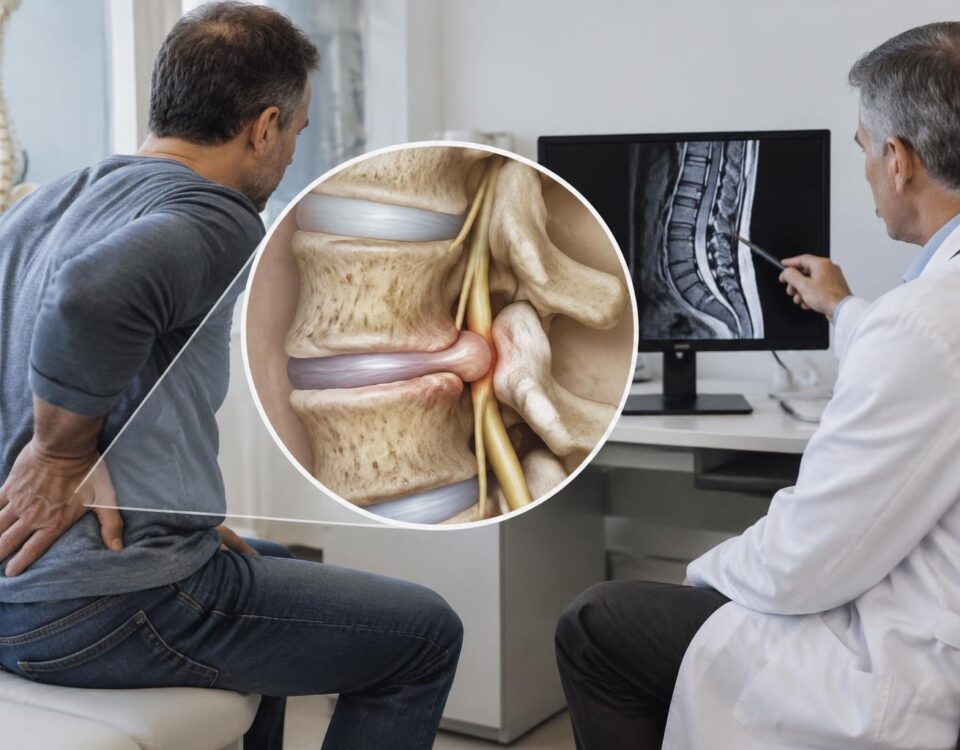
The healthcare professional asks about the onset of the pain, its trajectory, and associated signs. They may check sensitivity, strength, and reflexes, and assess movements that modify symptoms. These elements help determine if a nerve root may be affected.
An MRI is not necessary in all cases. The doctor may request it based on the symptoms, their duration, and the results of the examination. Imaging helps visualize the discs and surrounding structures, but must be interpreted alongside clinical signs. To learn more, visit our page on foraminal compression at L5-S1.
Disc herniation and recurrent sciatica
IN BRIEF A disc protrusion is a bulging of the disc that may be associated with recurring sciatica, without necessarily being the cause. The evaluation correlates symptoms, neurological examination, and imaging, if relevant. An appropriate plan can help improve function…
Management options
Management depends on the likely cause, the intensity of symptoms, and their progression. A doctor can discuss appropriate medications, necessary examinations, and care options. Do not start or modify any medication without seeking advice from a qualified professional.
A manual approach or functional support may be considered after evaluation and based on the situation. At the TAGMED Clinic, services may include specific osteopathy and motorized neurovertebral decompression. These approaches do not replace a medical diagnosis and are not suitable for everyone. Expected benefits, limitations, and risks should be discussed in advance.
For information on available services, visit the TAGMED Clinic in Montreal or Terrebonne. An assessment will determine if these services are appropriate for your symptoms and health condition.
Disc herniation and persistent pain in the leg
IN BRIEF A disc protrusion is a bulging of a disc that can irritate a nerve and cause persistent pain in the leg, sometimes accompanied by tingling or numbness. Imaging alone does not confirm the origin of the symptoms: clinical…
When to seek medical help quickly
Quickly consult a doctor if you notice new or progressive weakness in the leg or foot, significant loss of sensation, or marked worsening of pain. Loss of control over the bladder or bowels, or numbness in the saddle area, requires urgent evaluation.
Also seek medical advice in cases of fever, recent trauma, severe pain, or rapid worsening. These signs may require immediate assessment.
Disc herniation and lumbar degeneration
IN BRIEF A lumbar disc protrusion is a bulging of a disc often related to disc degeneration. It does not always cause symptoms but can contribute to lower back pain or pain radiating down the leg if a nerve is…
Frequently asked questions about disc protrusion and pain under the knee
Does a disc protrusion always cause sciatica?
No. A protrusion can be present without pain. Sciatica occurs when a nerve root is irritated or compressed, but other causes can produce similar symptoms. Clinical examination helps to differentiate.
Does pain under the knee mean the nerve is compressed?
Not necessarily. Pain under the knee may follow a nerve pathway, but this sign alone does not confirm compression. The professional considers pain, sensitivity, strength, reflexes, and, if necessary, imaging results.
How long can symptoms last?
The duration varies from person to person. It depends on the cause, the intensity of irritation, and the progression of symptoms. Follow-up helps reassess the situation and adapt management if the pain persists or worsens.
About the author
Sylvain Desforges, B.Sc., D.O., N.D., Doctor of Osteopathy and Naturopath, is the founding president of TAGMED and the ACMA association. His practice focuses on chronic pain of the spine, lower back pain, and pain associated with sciatica, especially when it radiates down to the buttock, leg, calf, foot, or toes.
Through SOS Sciatique, he publishes educational content on sciatica symptoms, their possible causes, and non-surgical approaches that may be considered after evaluation. At TAGMED Clinic, care may include, as appropriate, motorized neurovertebral decompression, specific osteopathy, or precision percussion.
For evaluation, consult the information on sciatica treatment in Montreal and Mont-Royal or sciatica treatment in Terrebonne.
Medical disclaimer: The information published on SOS Sciatique is provided for educational purposes. It does not replace a consultation, diagnosis, opinion, or treatment performed by a doctor or other licensed health professional. The author of this article is neither a physician nor a specialist in a medical specialty recognized by the Collège des médecins du Québec. The approaches to osteopathy, manual medicine, or functional support described on this site do not constitute medical acts and are not intended to replace medical follow-up. For more details, please read our Legal notice.
Medical disclaimer: The information and advice provided on this site do not replace the opinion, diagnosis, or treatment of a health professional. Please note that Sylvain Desforges, B.Sc., D.O., N.D., Doctor of osteopathy, is neither a medical doctor nor a physician and is not a specialist in a medical specialty as defined by the Collège des médecins du Québec. Manual medicine, functional medicine, and sports medicine as described on this site exclude any treatment or medical diagnosis made by a doctor or specialist. Always consult your physician for any medical questions. For more details, please read our complete Legal Notice.
Disc protrusion and pain under the knee: useful guidelines
What it may indicate
Good reflexes

A disc protrusion can sometimes irritate a nerve root and cause pain that radiates below the knee, particularly toward the calf or foot. This irradiation merits clinical evaluation: it does not, by itself, prove that the disc is the cause of the symptoms. While waiting for professional advice, favor tolerated movements, adjust your activities, and monitor any weakness or worsening.
Disc protrusion and disc pinching: combined mechanisms
IN BRIEF A disc protrusion is a bulging of the disc, while a disc narrowing refers to a decrease in its height. These changes can coexist and sometimes irritate a nerve root, leading to pain or radiation, but they can…
Understanding pain that radiates below the knee
A symptom to evaluate, not a diagnosis
Pain that starts from the lower back or buttock and extends below the knee may indicate nerve irritation, sometimes referred to as radicular pain or sciatica. Tingling, numbness, or a sense of weakness may also be present. However, multiple structures can contribute to these symptoms. The presence of a protrusion on imaging is therefore insufficient to establish it as the cause of the pain: results must be interpreted in conjunction with symptoms and clinical examination.
Note where the pain starts, how far it radiates, what aggravates or alleviates it, as well as the appearance of unusual sensations. This information will help the healthcare professional assess your situation and determine if further examinations are necessary.

Disc herniation and associated foraminal stenosis
IN BRIEF A disc protrusion associated with foraminal stenosis occurs when a bulging disc coexists with a narrowing of the opening through which a nerve root passes. This association can lead to lower back pain radiating into the leg, tingling,…
What to do daily in case of symptoms
Stay active without straining
A short period of rest can be helpful when pain is very acute, but staying immobile for too long can maintain stiffness and loss of capacity. Try to keep engaging in light activities, such as small movements, while staying within an acceptable tolerance zone. Temporarily reduce gestures that trigger significant radiation, then gradually resume them as your symptoms evolve.
Avoid intense stretching, self-manipulations, and exercises that significantly aggravate pain in the leg. There is no one movement suitable for everyone. A physiotherapist or another qualified professional can suggest progressive exercises and help you modify your movements at work or at home.
Adjusting Posture and Efforts
Regularly alternate positions instead of sitting or standing for too long. To lift an object, bring it close to your body and avoid combining a heavy load with twisting your trunk. These adjustments do not directly heal a protrusion, but they can make activities more comfortable during recovery.

Spinal disc protrusion and nerve inflammation
IN BRIEF A disc protrusion is a bulging of the disc that can irritate or compress a nerve, without necessarily causing symptoms. When it leads to nerve inflammation, it can cause pain in the back or neck, sometimes accompanied by…
When to Seek Medical Evaluation
Consult a professional if pain below the knee persists, returns frequently, intensifies, or limits your activities. An evaluation checks strength, sensitivity, and reflexes, then decides on the appropriate treatment. Depending on the situation, management may include activity advice, supervised exercises, or medications prescribed by a licensed professional. Manual care and decompression approaches can be discussed with the care team, but their relevance varies by individual and they do not replace a medical evaluation.
Surgery is generally not the first option. It may be considered by a specialist when significant symptoms persist despite non-surgical management, or when neurological impairment warrants it. The decision depends on the examination, imaging, and progression and should include a discussion of potential benefits and risks.

Disc protrusion and irritation of L5
IN SHORT A disc protrusion is a bulging of the disc that can irritate the L5 root and cause lower back pain radiating to the buttock, leg, or foot, sometimes with tingling or weakness. MRI alone is not sufficient to…
Recognizing Emergency Signs
Quickly consult a medical service if you experience significant or progressive weakness in the leg or foot. Loss of bladder or bowel control, numbness in the saddle area, fever, recent trauma, or rapid deterioration also require urgent assessment. These recommendations are educational and do not replace a diagnosis or a personalized opinion from a healthcare professional.
| Marker | To Remember |
|---|---|
| Pain below the knee | May indicate nerve irritation, without confirming a disc protrusion. |
| Path to the foot | Pain radiating down the calf or foot warrants clinical evaluation. |
| Associated signs | Tingling, numbness, or weakness may accompany irritation of a nerve root. |
| Diagnosis | Symptoms and examination guide the evaluation; imaging is considered based on the context. |
| Progression | Consult if pain persists, worsens, or limits your activities. |
| Emergency | Progressive weakness, loss of urinary or bowel control: consult urgently. |
Illustrative Testimonials: Disc Protrusion and Pain Below the Knee
Note: The following accounts are fictional examples written for educational purposes. They do not represent actual patient testimonials and should not be used to predict the evolution of your situation. Pain that radiates below the knee may be related to nerve root irritation, but it can also have other causes.
“The pain started in my lower back and went down to my calf”
After several weeks of lower back pain, Marc’s discomfort extended into his buttock, and then down the back of his leg to his calf. He sometimes felt tingling after sitting for a long time. Imaging showed a disc protrusion, but his healthcare professional explained that the images needed to be interpreted with his symptoms and clinical examination. An appropriate management plan was established and reevaluated based on his progress.
“I thought the pain was only coming from my knee”
Elise initially consulted for pain located below the knee, accompanied by burning sensations in her leg. The evaluation also took into account her back, sensitivity, and muscle strength. She understood that pain felt in the leg does not necessarily mean the problem lies in the knee, and that a protrusion visible on imaging alone is not sufficient to establish the cause of the symptoms.
“The symptoms varied with my posture”
Alexandre noticed that his pain increased in certain positions and decreased when he changed activities regularly. It sometimes radiated below the knee, with tingling in the foot. With support from healthcare professionals, he learned to monitor his symptoms and gradually resume movements suitable for his situation. The exercises were adjusted based on his tolerance rather than followed as a uniform routine for everyone.
“I needed to know when to ask for help”
Sophie’s pain radiated down her leg and made her anxious. Her evaluation allowed her to discuss possible options, the importance of follow-up, and signs to monitor. She particularly noted that new or progressive weakness warrants quick attention, as does loss of bladder or bowel control or numbness in the saddle area.
These situations illustrate why pain below the knee deserves individualized evaluation, especially if accompanied by numbness, tingling, or weakness. The presence of a disc protrusion on imaging alone does not determine if it explains the pain or what treatment is suitable. A doctor or another licensed healthcare professional can examine the symptoms and guide the management.
Disc Protrusion and Pain Radiating Below the Knee: Understanding the Symptoms
A disc protrusion corresponds to a deformation of the disc located between two vertebrae. The disc bulges beyond its usual contour, without necessarily breaking. This feature distinguishes it from a disc herniation with extrusion, although both issues can sometimes irritate or compress a nerve root. However, a protrusion visible on imaging does not automatically explain pain: it must be interpreted alongside symptoms and clinical examination.
When the pain radiates below the knee, particularly toward the calf, foot, or toes, lumbar nerve irritation may be considered. The pain may be accompanied by tingling, numbness, or a feeling of weakness. It sometimes manifests on one side only and can vary with certain positions, walking, coughing, or back movements. These signs may correspond to sciatic pain, but other causes are possible. Only a healthcare professional can assess their origin.
The location of the protrusion, its extent, and the sensitivity of the tissues influence the symptoms. Age, repetitive activities, unusual exertion, and history of lumbar pain can also contribute to the clinical picture. Therefore, it is best not to draw conclusions from an isolated imaging report. A doctor can conduct an examination, check strength, sensitivity, and reflexes, and then determine whether further imaging is relevant.
Management depends on the situation and generally aims to relieve symptoms while progressively maintaining activities. Depending on the evaluation, it may include medical advice, medications prescribed or recommended by a professional, as well as appropriate rehabilitation. Gradual mobility and strengthening exercises can help regain confidence in movement. Avoid starting exercises that significantly exacerbate the pain radiating down the leg without professional advice.
In some cases, a professional may discuss complementary approaches, such as specific osteopathy or motorized neurovertebral decompression. These do not suit everyone and do not replace medical diagnosis or indicated treatments. Surgery is considered in certain situations, particularly when significant symptoms persist despite non-surgical management or when concerning neurological impairment is observed. This decision rests with the medical team after discussing the benefits and risks.
The duration of improvement varies by individual, the cause of symptoms, and their evolution. Regular follow-up allows for re-evaluating pain, adapting activities, and spotting any changes. Breaks during prolonged positions, a gradual return to movement, and ergonomic work habits can support daily life, though they alone do not guarantee healing.
Consult a doctor promptly if weakness in the leg or foot appears or worsens. A loss of bladder or bowel control, numbness in the saddle region, fever, recent trauma, or severe pain requires urgent evaluation.
About the author: Sylvain Desforges, B.Sc., D.O., N.D., Doctor of Osteopathy and naturopath, is the founding president of TAGMED and the ACMA association. His practice focuses on chronic spinal pain and lumbar pain that may radiate into the leg. His approach is based on evaluating the individual and may involve, as needed, specific osteopathy or technologies such as motorized neurovertebral decompression.
Medical warning: This information is educational and does not replace a consultation, diagnosis, or treatment by a licensed healthcare professional. The author is neither a doctor nor a specialist in a medical field recognized by the Collège des médecins du Québec. The care described does not replace medical follow-up.
A disc protrusion can sometimes irritate a nerve root and cause pain that starts from the back or buttock and then radiates down the thigh and below the knee. This radiation may be accompanied by tingling, numbness, or weakness, but it alone does not confirm the cause: evaluating the symptoms and, if needed, a medical examination are essential for guiding management.
Pain below the knee: a clue to interpret
The pain that descends below the knee may be consistent with radicular pain, particularly when a lumbar nerve root is irritated. It can extend toward the calf, foot, or toes and vary with movements, postures, or exertion. However, pain in the leg can also have other origins: its location alone is not sufficient to establish a diagnosis. To better distinguish nerve radiation from referred pain, consult these pointers on radicular pain and referred pain.
An L4-L5 protrusion may be associated with low back pain that radiates into the leg, but imaging results must always be interpreted concerning symptoms and clinical examination. Examples of leg pain associated with an L4-L5 protrusion are presented for Montreal and for Terrebonne. A visible anomaly on MRI does not automatically mean it explains every pain felt.
Evaluation and management options
When pain persists, descends below the knee, or limits activities, a healthcare professional can assess strength, sensitivity, reflexes, and movements that exacerbate or relieve symptoms. Depending on the situation, they may determine whether further examinations are relevant. Management is generally tailored to the individual case and may include advice to maintain a tolerated activity, progressive exercises, and physiotherapy. Medication treatments or other interventions should be discussed with a licensed professional. For an overview of possible approaches, consult this information on healing time and treatments for disc protrusion, as well as on rehabilitation after a disc protrusion.
Prolonged complete rest is generally not a strategy to adopt without professional advice. It is often preferable to modulate activities according to tolerance and to temporarily avoid movements that significantly exacerbate the radiation. Squats, for example, are not necessarily to be prohibited for everyone, but their range, load, and technique can matter when sciatic symptoms are present: these precautions are addressed in this guide on sciatica and squats. If finding a comfortable posture becomes difficult, these tips on finding a tolerable position may also help you better understand the problem.
When to seek medical help promptly
Consult a doctor or an emergency service without delay in case of significant or worsening weakness in the leg or foot, loss of control of the bladder or bowels, or numbness in the saddle area. Pain accompanied by fever, occurring after recent trauma, very intense, or rapidly worsening also requires medical evaluation. These signs should not be automatically attributed to a disc protrusion.
To delve deeper into the possible causes, symptoms, and management steps, you can consult resources on disc protrusion, its symptoms, and its solutions, as well as this general presentation of disc protrusion. This information is educational and does not replace an individual consultation or diagnosis.

Sylvain Desforges, B.Sc., D.O., N.D., docteur en ostéopathie
Dr Sylvain Desforges, B.Sc., D.O., N.D., osteopath, is the founding president of TAGMED and of the ACMA association. He dedicates his practice to chronic spinal pain, low back pain and symptoms compatible with sciatica, particularly when pain radiates toward the buttock, leg, calf, foot or toes.
Through SOS Sciatique, he publishes educational content on sciatica symptoms, possible causes such as disc herniation, disc narrowing, foraminal stenosis or irritation of a lumbar nerve root, as well as non-surgical approaches that may be considered according to the evaluation. At Clinique TAGMED, care may include, depending on the case, motorized neurovertebral decompression, specific osteopathic care or precision percussion.
For an evaluation related to sciatica treatment in Montreal / Mount Royal or sciatica treatment in Terrebonne, please consult the services available at Clinique TAGMED.
Medical disclaimer
The information published on SOS Sciatique is provided for educational purposes only and does not replace a consultation, diagnosis, opinion or treatment provided by a physician or another authorized healthcare professional. The author of this article is neither a medical doctor nor a specialist in a medical specialty recognized by the Collège des médecins du Québec. The osteopathic, manual medicine or functional support approaches described on this site do not constitute medical acts and are not intended to replace medical follow-up.
Consult a physician or emergency service in cases of loss of bladder or bowel control, anesthesia in the saddle area, significant or progressive weakness in the leg or foot, fever, recent trauma, severe pain or rapid worsening of symptoms. For more details, please read our Legal Notice.