
Disc bulge L5-S1 and pain toward the foot
06/11/2026
IN SHORT Sciatica is pain related to irritation of the sciatic nerve, which can recur when returning to activities too quickly. To limit recurrences, gradually resume movement and exertion, taking into account pain and hip and pelvic mobility. The goal: regain strength without overloading the back or awakening symptoms. |
After sciatica, returning too quickly or suddenly increasing exertion can awaken the pain, especially if the cause of the irritation persists. Conversely, avoiding all movement for a long time can weaken the body and make it less ready to resume activities. The most cautious approach is to gradually resume, without exceeding a pain level of 3 out of 10, and to adjust effort if symptoms worsen or persist the next day.
A too-quick return after sciatic pain can awaken symptoms, especially if activity increases before the back and leg have regained their ability to tolerate it. Complete rest can also weaken the body. To limit relapses, one must gradually resume, monitor symptom evolution, and have the cause of the pain evaluated when it persists or returns.
The term sciatica describes pain that follows the path of the sciatic nerve. It can originate from the lower back or the buttock and descend into the leg. A burning sensation, tingling, or numbness may also occur. The term does not specify the cause of the irritation on its own.
Pain in the leg does not always indicate the location where the nerve is irritated. An origin may be located in the lower back or near the pelvis. An evaluation helps better understand the symptoms and determine the course of action. To learn more about possible causes, consult this article on herniated discs and recurrent sciatic pain.
A temporary well-being does not mean complete recovery
Pain may decrease before the leg has regained its strength and tolerance to activities. If you suddenly resume long walks, lifting weights, or prolonged sitting, symptoms may return. This reaction does not necessarily indicate that a new injury has occurred. It sometimes indicates that the load has exceeded what the body could still tolerate.
Relapses can also be related to persistent factors: staying seated for a long time without changing position, avoiding any movement for several days, or resuming efforts without progress. Some people notice more pronounced pain after an active day or when getting up from a chair. These situations are addressed in resources on sciatic pain that returns and symptoms that worsen at the end of the day.
Why prolonged rest can perpetuate pain
Resting can provide relief during a painful flare-up. However, lying down or avoiding almost all movement for long periods can reduce strength and mobility. Returning to usual activities then becomes more difficult, and ordinary loads may seem excessive.
When pain allows, short frequent movements may be easier to tolerate than a long isolated activity. There is no need to force or try to ignore symptoms. Severe pain that intensifies or is accompanied by new signs requires professional advice. For general guidelines, consult the advice on chronic sciatica and preventing recurrences.
Sciatica and pain during exercise: sign to watch out for
IN BRIEF Sciatica causes pain that radiates from the lower back or buttock down the leg. During exercise, stop the movement if it worsens the pain or causes discomfort: gentle, adapted activities can help you stay active without guaranteeing recovery.…
Habits that can bring back symptoms
Resuming efforts as before, without intermediate steps
After a few days of rest, immediately returning to the usual pace can exceed the body’s current capacity. Work, household tasks, travel, and sports all represent a load. Increase one activity at a time and observe the reaction during exertion, then in the hours that follow.
A simple guideline is to reduce effort if pain significantly increases or does not return to its usual level after activity. The advice on recurrent sciatica and how to prevent its return can help better understand the factors that maintain symptoms.
Sitting for long periods in the same position
A prolonged seated position can worsen discomfort for some people, especially if the pelvis sags and the back remains rounded. There is no perfect posture for everyone. However, regularly changing position and standing briefly can reduce the time spent immobile.
If pain arises when you stand up, note the circumstances in which it occurs and how long it lasts. The article on sciatic pain when getting up from a chair discusses this type of situation.
Stretching the painful leg despite worsening
An intense stretch of the back of the thigh may increase tension felt in the leg for some people. If a movement triggers a burning sensation, tingling, or pain that travels lower, stop and seek advice from a healthcare professional. The goal is not to push the nerve into a painful position.
Strengthening the back without considering the hip and pelvis
A strengthening program is not automatically suitable for everyone. Hip mobility, symptoms, strength, and history must be taken into account. If an activity awakens pain, its intensity or choice should be reviewed with a professional rather than pushing through at all costs.

Sciatica and pain after exercise: muscle soreness or nerve irritation?
IN BRIEF Pain after exercise can be muscle soreness or the sign of sciatic nerve irritation. Soreness primarily affects the muscles used and usually subsides within a few days; sciatica can radiate from the buttocks down the leg, sometimes with…
How to gradually resume after sciatica
Start with common activities that you can do without significant aggravation. Spread tasks throughout the day and avoid compensating for a quiet day with intense exertion the next day. Gradually increase the duration or intensity, but not both at once.
Observe your body’s response during the activity and the following day. A mild and temporary discomfort may sometimes appear, but any pain that worsens, extends lower down the leg, or is accompanied by a loss of strength should be evaluated. Resources on recurring sciatica and factors that may help prevent the return of pain offer additional insights.
A persistent pain can have several causes. A herniated disc or disc protrusion may be among the possibilities, but symptoms alone cannot confirm a diagnosis. To better understand certain associated signs, consult the information on L4-L5 protrusion and sciatic pain.
Sciatica and poorly tolerated activity: how to recognize it
IN BRIEF An activity poorly tolerated with sciatica significantly worsens the pain that radiates down the buttock and leg, or causes more tingling and discomfort. Reduce or adapt effort, without remaining bedridden, and gradually resume based on your symptoms. A…
When to seek medical advice
Consult a healthcare professional if the pain occurs frequently, limits your activities, worsens, or does not improve. An assessment helps to identify the cause, check the strength and sensitivity of the leg, and then choose an appropriate management plan. Avoid resuming an exercise that triggers or worsens your symptoms on your own.
Seek urgent medical help in case of significant or recent loss of strength in the leg, dragging of the foot, numbness around the genitals or anus, or new difficulty in urinating or controlling bowel movements. These signs require prompt evaluation.
Medical disclaimer: The information and advice provided on this site do not replace the opinion, diagnosis, or treatment of a healthcare professional. Please note that Sylvain Desforges, B.Sc., D.O., N.D., doctor in osteopathy, is neither a medical doctor nor a physician, and is not a specialist in a medical specialty as defined by the Collège des médecins du Québec. Manual medicine, functional medicine, and sports medicine as described on this site exclude any treatment or medical diagnosis made by a physician or specialist. Always consult your doctor for any medical questions. For more details, please read our full Legal Notice.
Too rapid resumption
- Increasing effort suddenly after a period of rest.
- Resuming with stretches or exercises that strain the leg.
- Avoiding walking, lifting, or bending for long periods.
- Strengthening the back without regaining hip mobility.
Why the pain returns
- The area irritating the nerve has not been identified.
- The nerve, already sensitive, is further stressed.
- Prolonged rest reduces strength and mobility.
- The back compensates if the hip remains stiff.
- The load exceeds the body’s capabilities at that moment.
Resume gradually, without exceeding 3/10 pain during exertion, and ensure that symptoms return to their usual level the next day.

After a sciatica episode, resuming efforts too quickly can bring back the pain, even if the leg seemed to improve. The nerve may remain irritable, and the body may not yet be ready to handle the same stresses as before. To limit relapses, the goal is to stay active, identify what maintains the discomfort, and gradually reintroduce efforts.

Sciatica and exercises to avoid according to the symptoms
IN BRIEF Sciatica is pain related to irritation or compression of the sciatic nerve. Exercises can help maintain mobility and reduce tension, but avoid those that intensify leg pain, as well as sudden twists, forced bends, and carrying heavy loads.…
Why does the pain return after a rapid resumption?
Sciatica describes pain related to irritation of the sciatic nerve along its path, from the lower back to the foot. It does not reveal, by itself, the exact location where the nerve is being irritated. The source may be found in the lower back, around the pelvis, or in the deep muscles of the buttock. If this constraint persists, resuming usual activities without adjustment may awaken the symptoms.
An improvement in pain does not always mean that the leg and back have regained their capacity to bear weight, walk for long periods, or remain seated. After several days of inactivity or avoidance, muscles can be less enduring and movements stiffer. Resuming sports, physical tasks, or a long day of sitting all at once imposes a heavy load on a body that is still deconditioned.
Sciatica and movement that worsens: why stop it
IN BRIEF Sciatica is a pain related to the irritation of a nerve, which can extend from the lower back to the leg. If a movement or exercise increases the radiation, tingling, or weakness, stop it: this helps to avoid…
Avoiding actions that maintain irritation
Do not strain a pulling leg
Strongly extending the back of the thigh can enhance the tension felt if the nerve is already sensitive. Rather than trying to pull more, favor gentle movements and adjust them according to your sensations. A pain that significantly increases during exercise or remains aggravated the next day indicates that intensity should be reduced and advice sought from a healthcare professional.
Break long periods of immobility
Rest can provide temporary relief during a flare-up, but staying in bed for long periods can reduce strength and mobility. If possible, try short walks, repeated throughout the day, rather than a long outing that triggers pain. At the office or in the car, change positions regularly and stand up about every 30 minutes. An appropriate sitting position and hips slightly higher than the knees can also make posture more comfortable.
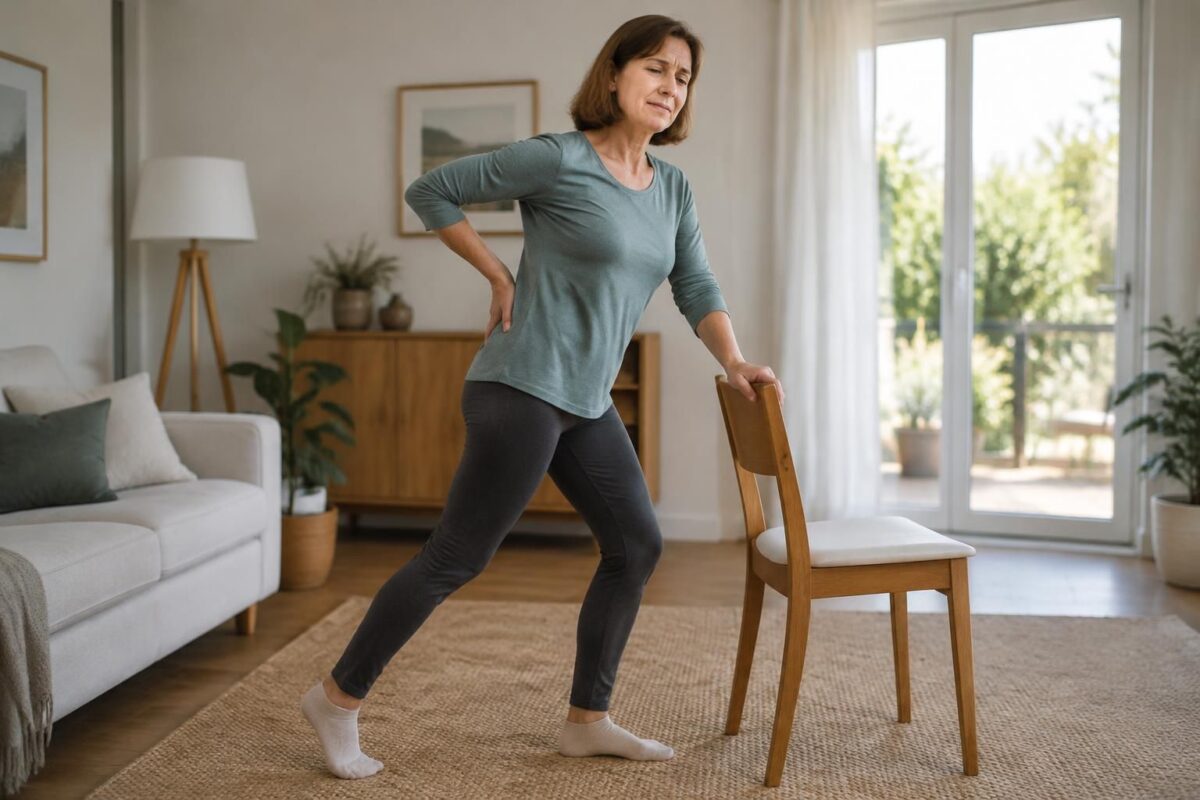
Sciatica and movement that provides temporary relief: is it enough?
IN BRIEF Sciatica is pain related to the irritation of the sciatic nerve, often felt from the lower back down to the leg. Gentle movement, walking for a few minutes, and changing positions regularly can provide temporary relief and limit…
Gradually resuming efforts
Gradually increasing load does not mean forcing through pain. Start with an easy version of the activity: walking for a few minutes, carrying a light load, or standing up from a chair. Then increase only one element at a time, such as duration, frequency, or weight. A practical guideline is to not exceed 3 out of 10 pain during exertion and to check that symptoms have returned to their usual level the next day. If this is not the case, reduce the load.
Strengthening may be helpful, but it is not about multiplying core exercises without considering the hips and pelvis. Their mobility contributes to distributing movements and preventing the lower back from compensating for everything. Walking or swimming may be suitable for some people, provided they are resumed gently and adapted to their tolerance.

Sciatica and exercises found on the Internet: caution depending on the cause
IN BRIEF Sciatica is pain that radiates from the lower back to the buttock and leg. Gentle exercises can promote mobility and relieve symptoms, but their effectiveness depends on the cause: a movement suitable for piriformis irritation may worsen a…
When to seek medical advice?
If the pain returns regularly, spreads further, or limits your activities, a healthcare professional can assess possible causes and guide you to resume without rushing. In case of loss of strength in the leg, dragging foot, or urinary issues, do not start exercising: consult a doctor without delay.
| Too quick resumption | Gradual resumption |
|---|---|
| Resuming usual efforts as soon as the pain decreases | Increasing activity step by step |
| Pushing through despite intensifying pain | Adapting effort to sensations, without exceeding 3/10 |
| Going for a long walk after several days of inactivity | Favoring short regular walks |
| Sustainably avoiding movement out of fear of pain | Reintroducing movement without staying still for long |
| Resuming without checking progress the next day | Reducing effort if symptoms do not return to their usual level |
Illustrative testimonials inspired by frequently encountered situations. Pain that reappears upon resumption is not necessarily a sign that you have “started all over again.” It may indicate that the body has not yet regained enough mobility, strength, or tolerance to effort.
“After a few days of rest, I felt better. I resumed my long walks all at once and the pain returned even to my leg. I understood that relief did not mean my body was ready to resume as before.” — Marc, 47 years old
A resumption of activity that is too intense can awaken symptoms, especially after a period of inactivity. Conversely, staying in bed too long can reduce strength and stiffen joints. When it is bearable, it is often better to resume with short regular walks, then gradually increase the duration.
“I was stretching hard as soon as I felt a pull behind my thigh. At the moment, I thought I was doing the right thing, but the burning increased afterward. With support, I learned not to pull harder on my leg and to adapt movements according to my sensations.” — Élodie, 39 years old
Pain that travels down the leg does not solely indicate where the nerve is irritated. Intense stretching can sometimes increase the tension felt. The goal is rather to identify movements that worsen symptoms and gradually regain ease around the lower back, pelvis, and hips.
“I was doing core exercises every day to strengthen my back, but my hip remained stiff. I felt like my lower back was working for everything else. By resuming more gradually and also working on my hip mobility, I was able to better gauge my efforts.” — Samira, 52 years old
Strengthening can be useful, but it is not about forcing at all costs. An adapted resumption takes into account mobility, strength, and daily activities. During effort, keep a moderate intensity: if the pain exceeds 3 out of 10 or remains significantly worsened the next day, reduce the load and seek advice from a healthcare professional.
“After the crisis, I avoided lifting, bending, and even going out. When I started again, I wanted to make up for lost time in a few days: the pain returned. This time, I resumed one task at a time, gradually increasing.” — Thomas, 44 years old
Sustainably avoiding all movements can also make the return to activities more difficult. A step-by-step progression — getting up, walking, lifting a light object, then gradually increasing — helps to rebuild the body’s capacity without rushing it. Regular breaks and changing position are also useful if you remain seated for long periods.
“I thought my sciatica was returning for no reason. By observing my days, I noticed that several hours sitting and an intense return to sports often triggered the symptoms. I changed position regularly and resumed training more gently.” — Claire, 36 years old
If you notice a loss of strength in the leg, a dragging foot, or urinary issues, do not resume exercises: consult a doctor promptly.

Sciatica and generic exercises: why they are not suitable for everyone
IN BRIEF Sciatica is pain related to irritation or compression of the sciatic nerve. Generic exercises are not suitable for everyone: their effectiveness depends on the cause, intensity of symptoms, and recovery phase. Adapted movements can help maintain mobility without…
Sylvain Desforges: Sciatica and Too Quick Resumption, Why the Pain Returns
Dr. Sylvain Desforges specializes in osteopathy, naturopathy, and manual medicine. Founder and president of TAGMED clinics and the ACMA association, he has dedicated his career to innovation in health and the management of persistent pain. His approach notably focuses on situations where sciatica returns after a period of rest or following a too rapid resumption of activity.
Sciatica refers to pain related to irritation of the sciatic nerve, which runs from the lower back to the buttock and leg. The painful area does not necessarily reveal where the nerve is irritated: the origin may be located in the lower back, around the pelvis, or in the deep tissues of the buttock. For Dr. Desforges, understanding this difference is essential in order to not only address the symptom but also to seek the factors that may contribute to its onset or persistence.
After a crisis, relief may entice one to immediately resume previous habits: long periods of sitting, commuting, household tasks, or sports activities. Conversely, some people wait until they are completely free of pain before starting to move again. Both reactions can complicate the return to activity. A resumption that is too intense abruptly stresses tissues that are still sensitive, while prolonged inactivity can reduce the strength and mobility needed to support ordinary movements.
The pain may then reappear without any spectacular effort being the cause. A day spent sitting, a repeated bending motion, or a longer walk than usual can be enough to exceed the body’s capacity at that moment. The irritated nerve may also become more reactive: movements that were previously well tolerated may now seem to cause significant discomfort. This does not automatically mean a new injury has occurred, but persistent or worsening pain deserves an appropriate evaluation.
In a progressive approach, Dr. Desforges emphasizes observing daily movements and constraints. Sitting posture, how one bends, carrying a load always on the same side, and hip mobility can be taken into account. Regularly modifying posture, getting up at reasonable intervals, and distributing loads are simple adjustments that can help manage demands better, without replacing professional advice.
The resumption of activity must then be adjusted to everyone’s capabilities. Gentle walking, controlled movements, and adapted exercises can help gradually regain mobility and strength. The goal is not to push through significant pain or to remain immobile until all sensation has completely disappeared. Instead, it is about increasing efforts in stages, monitoring the body’s response during and after activity. Strength training alone is not always sufficient if certain joints, particularly the hips, remain stiff and the lower back compensates.
Dr. Desforges is also interested in the technologies used in the management of chronic pain, including spinal decompression, laser, and shockwaves. Their relevance depends on the patient and their clinical evaluation; they do not constitute a universal answer to sciatica. His mission is to provide care based on available data to optimize the health and well-being of his patients.
If there is new weakness in the leg, dragging foot, or urinary issues, urgent medical consultation is necessary. These signs should not be managed by exercises done alone.
A sciatica that returns after a too rapid resumption does not necessarily mean that you have worsened your back. Often, pain reappears because the leg, hip, and back have not yet regained their ability to sustain normal activities. Gradually resuming, observing the body’s reactions, and avoiding pushing through pain help manage this phase better.
Why can pain return?
Sciatica describes pain related to the irritation of the nerve along its path, from the lower back to the leg. The painful area does not always precisely indicate the source of the problem: discomfort felt in the buttock or behind the thigh may be linked to the lower back, pelvis, or hip. This is why temporarily calming pain without identifying the constraints that provoke it is not always enough to prevent its return.
After a period of rest or reduced activity, muscles and joints may be less accustomed to exertion. Resuming long walks, carrying loads, or sports sessions all at once places significant demand on a body that has not yet regained its tolerance. Pain can also vary from day to day: this fluctuation is discussed in this article on variations in sciatic pain.
Resuming without testing your limits
An effective resumption does not involve waiting for the complete disappearance of any sensation before moving, nor resuming immediately at the same pace as before. The goal is to gradually reintroduce activity: short walks, regular breaks, and efforts tailored to your current level. If a long walk triggers symptoms, temporarily reduce the duration or pace rather than abandoning all movement; advice on sciatica after a long walk can help better understand this reaction.
Discomfort may appear during exertion without automatically indicating a new injury. However, it should remain moderate and return to its usual level at the latest by the next day. A common rule of thumb is not to exceed 3 out of 10 during activity. If pain increases significantly, persists, or is accompanied by new symptoms, adjust the effort and seek advice from a healthcare professional.
Reintroducing movement and gradually strengthening
Rest can provide relief during a flare-up, but remaining still for extended periods can decrease strength and mobility. When bearable, small repeated movements throughout the day are often easier to tolerate than a single prolonged activity. If the leg goes numb or experiences tingling, note when these sensations appear and their progression; this article discusses a leg that goes numb in cases of sciatica.
Strengthening should also follow a progression. Gentle exercises may be considered based on symptoms, but strengthening only the back without considering the mobility of the hips and pelvis may fail to meet individual needs. A physiotherapist or doctor can help you choose the appropriate movements, especially if a herniated disc is mentioned: its progression depends on several factors, as explained in this resource on factors influencing the progression of a herniated disc and sciatica.
Identifying habits that maintain symptoms
Resuming activity is not limited to sports or exercises. Long periods of sitting, a maintained posture without breaks, or a sudden increase in daily tasks can also put strain on the back and leg. Try to regularly change positions, stand up for a few moments, and distribute loads evenly. If sitting triggers symptoms, this page describes sciatic pain that hinders sitting.
A pain that reappears does not always have a single cause. Symptoms can be influenced by activity load, sleep, posture, and nerve sensitivity. To better understand recurring episodes, also consult these resources on sciatica that returns, on reasons why sciatica persists despite treatments, and on the recurrence of chronic sciatic pain.
A burning sensation behind the thigh can be part of the symptoms felt along the nerve path, without pinpointing the cause. To learn more, you can read this article on burning behind the thigh. If a herniated disc has been diagnosed, the factors associated with a recurrence are also presented in this resource on recurrence of sciatica and herniated disc.
When to seek medical advice
If pain recurs frequently, limits your activities, or does not improve despite appropriate resumption, a healthcare professional can evaluate your situation and assist you in choosing activities. Consult promptly in case of loss of strength in the leg, dragging foot, or urinary problems: these signs require urgent medical evaluation.

Sylvain Desforges, B.Sc., D.O., N.D., docteur en ostéopathie
Dr Sylvain Desforges, B.Sc., D.O., N.D., osteopath, is the founding president of TAGMED and of the ACMA association. He dedicates his practice to chronic spinal pain, low back pain and symptoms compatible with sciatica, particularly when pain radiates toward the buttock, leg, calf, foot or toes.
Through SOS Sciatique, he publishes educational content on sciatica symptoms, possible causes such as disc herniation, disc narrowing, foraminal stenosis or irritation of a lumbar nerve root, as well as non-surgical approaches that may be considered according to the evaluation. At Clinique TAGMED, care may include, depending on the case, motorized neurovertebral decompression, specific osteopathic care or precision percussion.
For an evaluation related to sciatica treatment in Montreal / Mount Royal or sciatica treatment in Terrebonne, please consult the services available at Clinique TAGMED.
Medical disclaimer
The information published on SOS Sciatique is provided for educational purposes only and does not replace a consultation, diagnosis, opinion or treatment provided by a physician or another authorized healthcare professional. The author of this article is neither a medical doctor nor a specialist in a medical specialty recognized by the Collège des médecins du Québec. The osteopathic, manual medicine or functional support approaches described on this site do not constitute medical acts and are not intended to replace medical follow-up.
Consult a physician or emergency service in cases of loss of bladder or bowel control, anesthesia in the saddle area, significant or progressive weakness in the leg or foot, fever, recent trauma, severe pain or rapid worsening of symptoms. For more details, please read our Legal Notice.