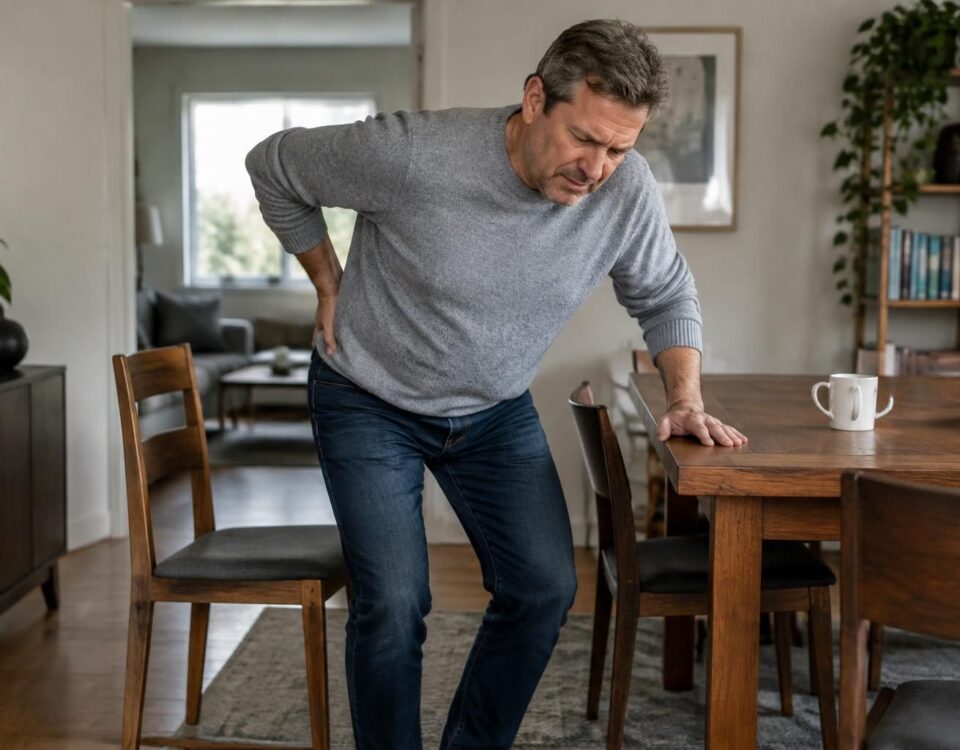
Sciatica S1 in Terrebonne: pain towards the calf and the outer edge of the foot
08/10/2026
Disc herniation and pain in the buttock
08/10/2026
IN BRIEF
| Sciatica after a day of sitting refers to pain that starts in the lower back or buttock and may radiate down the leg. Prolonged posture can accentuate discomfort. Regular breaks, a few minutes of walking, and an adequately adjusted workspace can help relieve tension and move more comfortably. If the pain persists, worsens, or is accompanied by weakness, consult a healthcare professional. |
After a day of sitting, sciatica may present as pain in the lower back that radiates to the buttock and leg. Prolonged static posture and poorly adjusted workstations can increase discomfort, though they are not necessarily the cause.
To limit strain, stand up and briefly walk every 30 to 45 minutes, keep your feet flat, support the lower back, and position the screen at eye level. Avoid movements or stretches that increase pain. If pain persists or is accompanied by tingling or weakness, seek advice from a healthcare professional. In cases of significant or progressive weakness, or loss of bladder or bowel control, consult emergency care.
A sciatica-type pain after a day of sitting can occur in the lower back, buttock, or leg. Fixed position, a poorly adjusted workspace, and lack of breaks can increase discomfort for some individuals. Simple adjustments and regular position changes can help better tolerate the day. However, intense, persistent pain or pain accompanied by weakness requires medical evaluation. Prolonged sitting keeps the back and pelvis in the same posture. If you slouch or lean too long towards the screen, the back muscles may tire, and the lumbar region can become sensitive. Some individuals then experience pain that starts in the lower back or buttock and radiates down the thigh, calf, or foot. Pain that radiates down the leg does not solely identify its cause. It may be consistent with irritation of a nerve root, but other issues can produce similar symptoms. To better understand pain that arises after a sitting period, refer to information on sciatica and sitting posture. Pain can also occur when you leave your chair or stand up. Resources explain pain when standing up from a chair and pain when straightening up. Pain consistent with sciatica often follows a path from the buttock to part of the leg. It may take the form of burning, shock-like sensations, numbness, or tingling. The path and intensity vary from person to person. A burning sensation behind the thigh or a persistent pain in the heel may warrant evaluation, especially if these symptoms persist or worsen. Note when the pain starts, where it spreads, and if it changes with position. These details help the healthcare professional understand your situation. Worsening pain by the end of the day is also a useful point to report during a consultation; see information on sciatica that worsens at the end of the day. Adjust the chair to keep your feet flat on the floor or on a footrest. Position the knees at roughly a right angle, without forcing. The backrest should support the lower back without pushing you into a rigid posture. Position the screen directly in front of you at a height that allows you to keep your head straight. Keep the keyboard and mouse close to your body to avoid reaching with your arms. An appropriate chair can help, but it does not replace position changes. A comfortable sitting arrangement is a starting point; alternating postures remains important. For guidelines on setting up a sitting workspace, refer to this guide on back pain with sitting work. Avoid sitting for several hours without interruption. Stand up regularly, walk for a few moments, or do a task standing if your work allows. You can set a reminder every 30 to 45 minutes. The goal is to vary positions, not to remain perfectly still in a so-called ideal posture. When working from home, avoid working all day on a couch or with a laptop positioned too low. If you don’t yet have a complete desk, temporarily set the computer on a stable support and use a separate keyboard if possible. Other practical tips are presented in this guide on solutions to relieve pain at work. For recommendations dedicated to maintaining professional activities despite sciatica-type pain, you can also check this guide on sciatica at work. If the pain increases, change positions and interrupt the sitting task for a moment. Walk gently if it does not worsen the symptoms. Do not force a movement that causes sharp pain or worsens in the leg. Note what improves or intensifies the symptoms and share this information with a healthcare professional. Avoid thinking of a stretch or exercise as a universal solution. An appropriate movement depends on the cause of the symptoms and your condition. If an activity triggers stronger pain, numbness, or weakness, stop it and seek advice from a qualified professional. Consult a doctor if the pain persists, recurs frequently, radiates down the leg, or limits your activities. An evaluation is also indicated in the presence of persistent tingling or decreased strength. The professional can examine the symptoms and determine if tests or medical follow-up are necessary. Seek emergency care quickly in the event of loss of bladder or bowel control, numbness in the saddle area, significant or progressive weakness in a leg or foot, fever, recent trauma, or rapid worsening. The choice of an approach depends on the evaluation, symptoms, and history. At the TAGMED Clinic, information is available on sciatica in office work. Clinic services in Montreal or Terrebonne can be discussed based on the situation. The care offered does not replace a diagnosis or medical follow-up, and no method guarantees the same result for every individual. For pain that seems related to the hours spent sitting, start by observing your positions, adjusting your workstation, and integrating regular breaks. If the pain persists or is accompanied by neurological signs, seek an evaluation rather than relying solely on general advice. Sylvain Desforges, B.Sc., D.O., N.D., Doctor of Osteopathy, is the founding president of TAGMED and the ACMA association. He dedicates his practice to chronic pain of the spine, lower back pain, and pain compatible with sciatica, particularly when the pain radiates down to the buttock, leg, calf, foot, or toes. Through SOS Sciatique, he publishes educational content about the symptoms of sciatica, possible causes such as disc herniation, disc pinching, foraminal stenosis, or irritation of a lumbar nerve root, as well as non-surgical approaches that may be considered based on the evaluation. At the TAGMED Clinic, care may include, depending on the case, motorized neurovertebral decompression, specific osteopathy, or precision percussion. For an assessment related to sciatica treatment in Montreal / Mont-Royal or sciatica treatment in Terrebonne, check the services available at the TAGMED Clinic. The information published on SOS Sciatique is provided for educational purposes and does not replace a consultation, diagnosis, opinion, or treatment by a physician or other licensed healthcare professional. The author of this article is neither a physician nor a specialist in a medical specialty recognized by the Collège des médecins du Québec. The approaches of osteopathy, manual medicine, or functional support described on this site are not medical acts and are not intended to replace medical follow-up. Consult a doctor or emergency service in case of urinary or bowel incontinence, saddle area numbness, significant or progressive weakness in the leg or foot, fever, recent trauma, severe pain, or rapid deterioration. For more details, please read our Legal Notice. Medical disclaimer: The information and advice provided on this site do not replace the opinion, diagnosis, or treatment of a healthcare professional. Please note that Sylvain Desforges, B.Sc., D.O., N.D., Doctor of Osteopathy, is neither a doctor of medicine nor a physician, and is not a specialist in a medical specialty as defined by the Collège des médecins du Québec. Manual medicine, functional medicine, and sports medicine as described on this site exclude any treatment or medical diagnosis made by a physician or medical specialist. Always consult your doctor for any medical questions. For more details, please read our full Legal Notice.Why pain may increase after several hours of sitting
Identifying signs accompanying sciatica
Adjusting the workspace to reduce discomfort
Adjusting the chair and screen
Interruption of long sitting periods
What to do if pain arises during the day
When to seek an evaluation
Evaluate support options
About the Author
Medical Disclaimer
In case of significant or progressive weakness, numbness in the saddle area, or urinary or bowel issues, seek medical attention without delay.Sciatica after a day of sitting: take action in the office
To limit
To try

After a day of sitting, pain that starts from the lower back or buttock and radiates down the leg may suggest sciatica. To limit discomfort at work, focus on frequent position changes, a better-adjusted workstation, and gentle movements rather than a rigid posture. If the pain is intense, worsens, or is accompanied by neurological signs, seek medical advice promptly.
Why can pain increase after sitting for a while?
The position of sitting maintained for long periods can increase strain on the lower back and tire the muscles. A seat that is too low, a poorly placed screen, or slouching can also promote tension. For some individuals, these factors exacerbate an already existing pain, sometimes felt in the buttock, thigh, or lower leg. However, pain radiating down the leg does not, by itself, identify its cause.
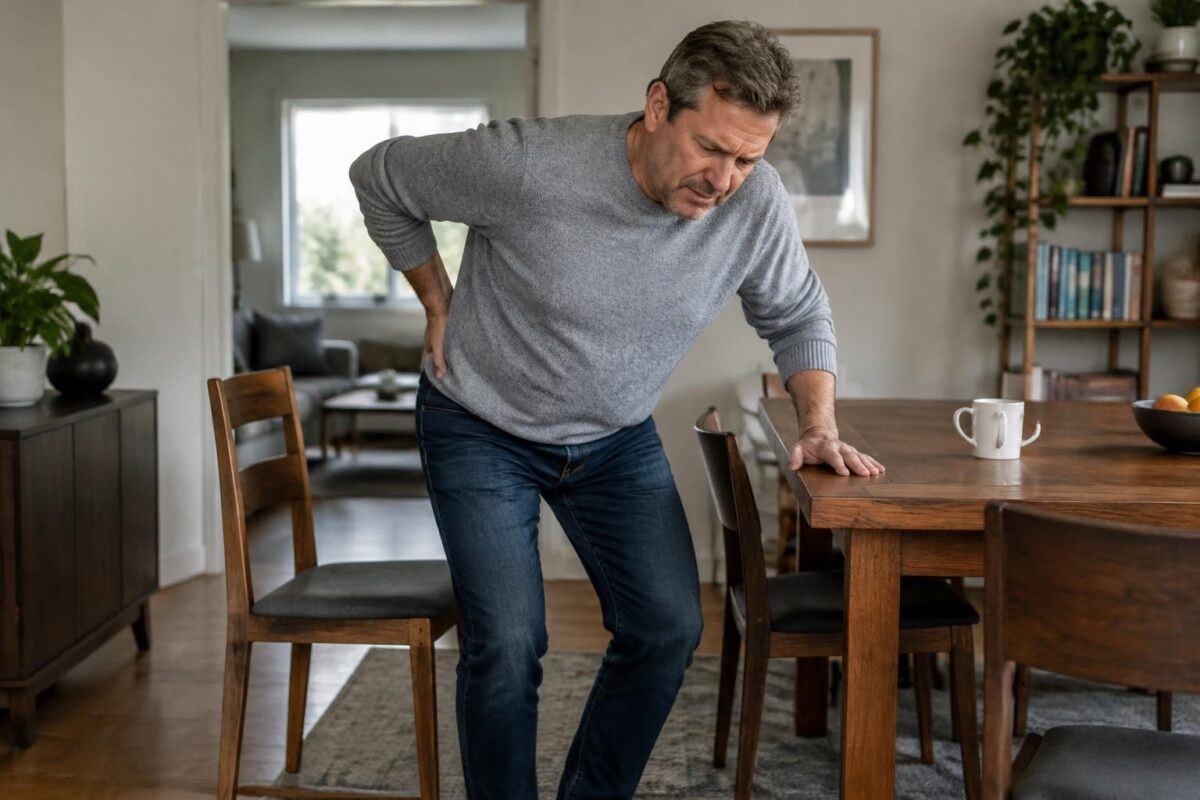
Sciatica and pain with progressive weakness
IN BRIEF Sciatica causes pain that radiates from the lower back down the leg; however, progressive muscle weakness is not a symptom to be taken lightly. It requires quick medical evaluation to search for the cause and determine the appropriate…

Sciatica and pain with general discomfort
IN BRIEF A sciatica causes pain that starts in the lower back or buttock and radiates down the leg. A general discomfort, especially if accompanied by fever or rapid worsening, should not be automatically attributed to sciatica: consult a healthcare…
What to do during the workday?
Regularly interrupt the sitting position
Avoid staying still for several hours. Stand up and walk for a few minutes approximately every 30 to 45 minutes, or more frequently if it helps. Take advantage of a phone call to stay standing and alternate tasks when possible. There is no perfect posture to maintain all day: varying positions is often more realistic and comfortable.
Adjust your workstation without seeking rigidity
Place feet flat on the floor or on a footrest. Adjust the chair so that the knees are close to a right angle and the pelvis is comfortable. The screen should be in front of you, at a height that avoids constantly tilting the head. Keep keyboard and mouse within reach, with relaxed shoulders. A lumbar support may help some individuals, but it does not replace breaks and movement.
Try gentle movements
Between tasks, take a few steps or gently mobilize the pelvis and back. You can try a light stretch of the buttock, without forcing and only if it does not increase symptoms. Stop if the pain radiates further down the leg, if tingling occurs, or if you don’t feel well. Exercises should not be considered a diagnosis or a universal treatment.

Sciatica and pain with a history of cancer: caution
IN BRIEF Sciatica causes pain that can radiate from the lower back down to the leg. With a history of cancer, new, persistent, or worsening pain should be quickly evaluated by a healthcare professional: its cause must be identified before…
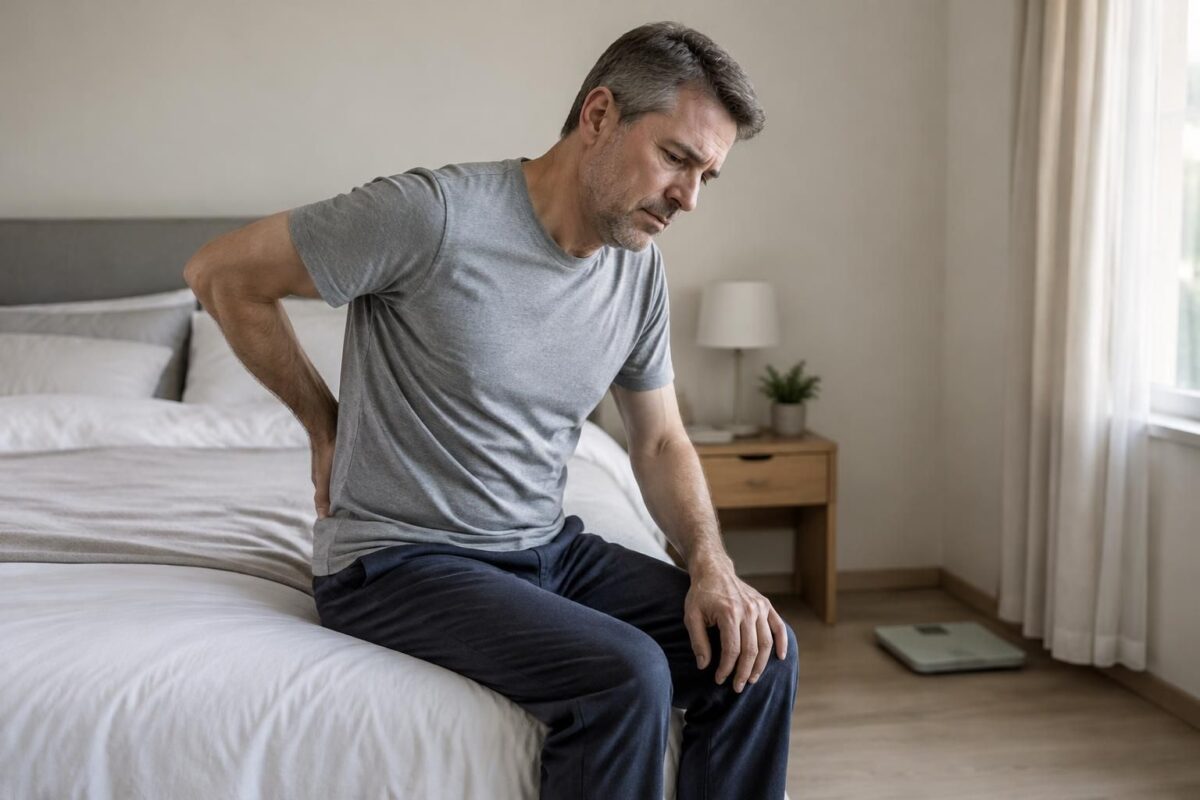
Sciatica and pain with unexplained weight loss
IN BRIEF Sciatica causes pain that can radiate from the lower back to the buttock and leg. Associated with unexplained weight loss, it requires medical evaluation to investigate the cause: this sign alone does not confirm a precise diagnosis. Consult…
Adjust commutes and remote work
In the car, move the seat closer so that your legs remain slightly bent and adjust the backrest to be comfortably seated. During a long journey, take regular breaks to walk. When working from home, avoid the couch or prolonged work on a laptop placed on your knees as much as possible: an elevated screen, a separate keyboard, and a chair with appropriate support can make the setup more practical.

Sciatica and pain with fever: why consult?
IN BRIEF Sciatica with pain and fever deserves a medical evaluation: fever is not usual in simple sciatica and may signal an infection or another problem requiring care. Consult promptly, especially if the pain is intense or worsening. In cases…

Sciatica and pain after trauma: warning sign
IN BRIEF A sciatica after trauma is pain that starts from the lower back or buttock and can radiate down the leg after a fall or impact. An assessment helps to investigate the cause and determine the appropriate course of…
When to seek professional advice?
Consult a healthcare professional if the pain persists, returns frequently, limits your activities, or is accompanied by numbness or weakness. Loss of bowel or bladder control, numbness in the saddle area, significant or progressive weakness, fever, or pain that worsens rapidly require urgent evaluation. Do not change a prescribed treatment without discussing it with your healthcare provider.
About the author
Sylvain Desforges, B.Sc., D.O., N.D., Doctor of Osteopathy, is the founding president of TAGMED and the ACMA association. His practice particularly focuses on chronic spinal pain and lower back pain compatible with sciatica.
Medical disclaimer
This information is educational and does not replace a consultation, diagnosis, or treatment by a licensed healthcare professional. The author is neither a physician nor a specialist in a medical field recognized by the Collège des médecins du Québec. Osteopathy and manual medicine approaches do not replace medical follow-up.
| Work reminder | To remember |
|---|---|
| Pain after several hours sitting | Prolonged posture can enhance lower back discomfort. |
| Pain radiating to the buttock or leg | Nerve irritation, including sciatica, is possible. |
| Tingling or numbness | Get these symptoms evaluated if they persist or worsen. |
| Slouched position or crossed legs | Readjust your position without trying to stay rigid. |
| Continuous sitting | Stand up and walk briefly every 30 to 45 minutes. |
| Work setup | Keep your feet flat and the screen at eye level. |
| Driving after work | Adjust the seat and take breaks during long drives. |
| Significant or progressive weakness | Consult a healthcare professional promptly. |
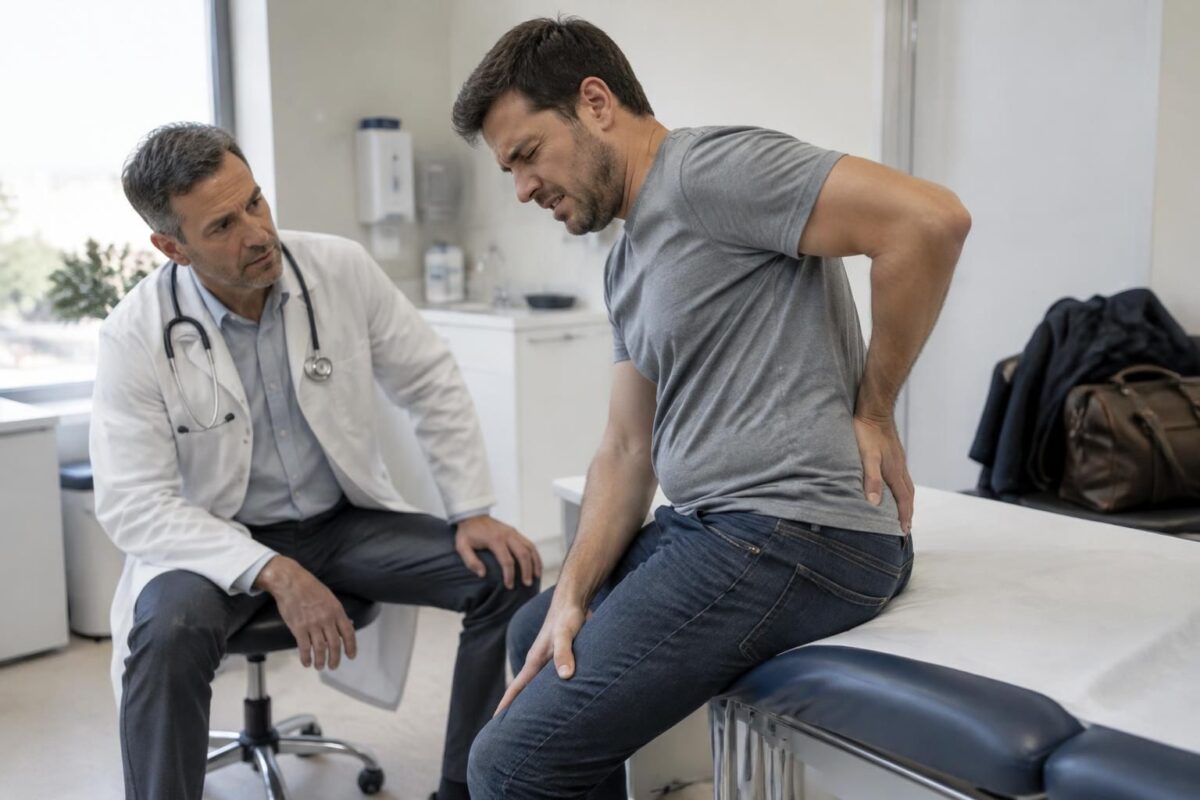
Sciatica and pain that appeared after an accident
IN BRIEF Sciatica after an accident is pain related to irritation or compression of the sciatic nerve, sometimes triggered or revealed by a fall or impact. It can start from the lower back or buttock and radiate down the leg.…
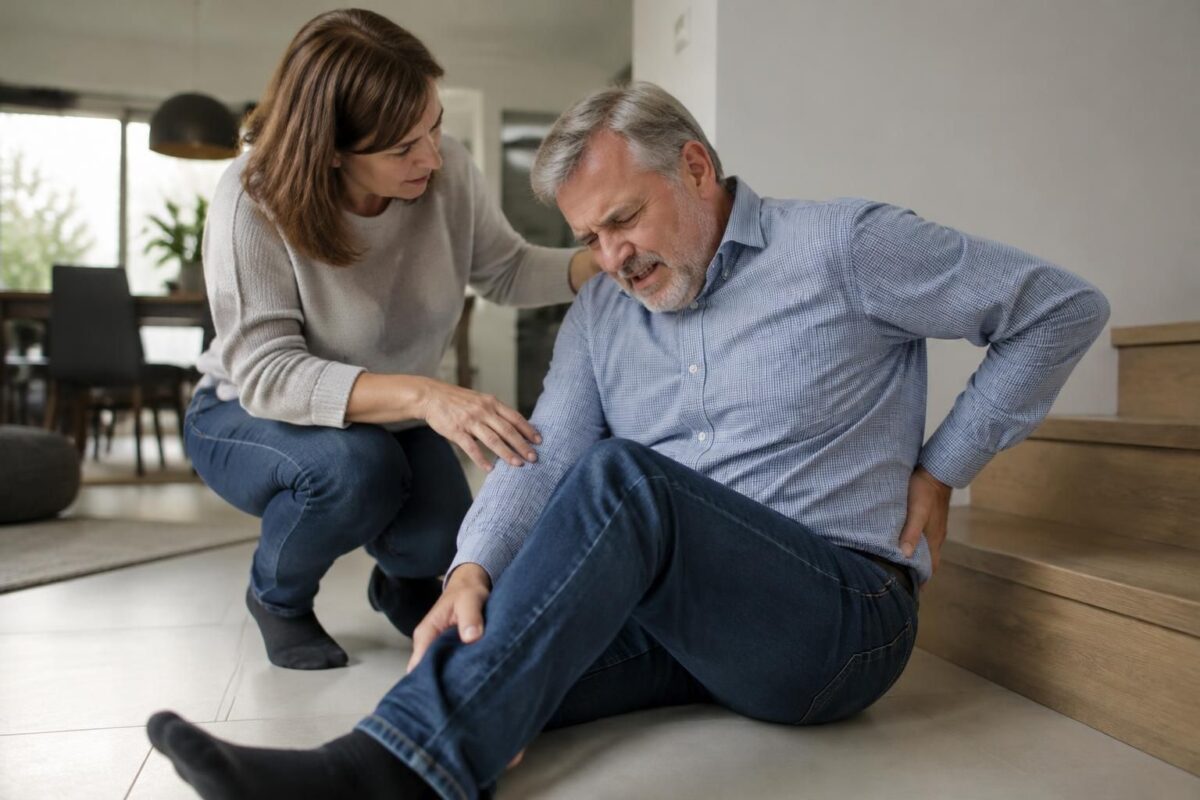
Sciatica and pain appeared after a fall
IN BRIEF A sciatic pain after a fall may stem from nerve irritation or an injury to the hip, buttock, or lower back. It can radiate down the leg and be accompanied by tingling or numbness. Rest, avoid movements that…
Sciatica and pain after a day of sitting work: illustrative testimonies
Note: the narratives below are fictional examples inspired by common situations. They do not represent verified testimonials or guaranteed results.
Claire, 42, telecommuting: “After several hours in front of my computer, I felt pain starting from my lower back and radiating into my buttock. I tended to sit still, hoping it would pass. I started adjusting my screen to eye level and getting up regularly to walk for a few minutes. This helps me vary my positions throughout the day, even though the pain still needs to be evaluated.”
Marc, 51, office work: “The discomfort mainly appeared at the end of the afternoon: first in my lower back, then extending to the back of my thigh. Crossing my legs and slumping in my chair seemed to make the position less comfortable. I now try to keep my feet flat, keep the keyboard close to me, and take short standing breaks.”
Nadia, 36, driving and sitting work: “After the morning commute, followed by a long period at my desk, I experienced tingling in my leg. I moved the driver’s seat closer to keep my knee slightly bent and take breaks during long trips. As the symptoms returned, I discussed it with a healthcare professional.”
Julien, 47, computer workstation: “I thought I had to stay very straight all day. In reality, I ended up tense, with pain in my buttock and the back of my leg. I now try to change positions regularly rather than maintain a rigid posture. I avoid movements that increase the pain and seek advice if the symptoms persist.”
Émilie, 29, improvised workspace: “I often worked on a kitchen chair, with my laptop positioned low. My back and neck were tense, and then pain started radiating to my leg. I elevated the screen and brought the keyboard closer. These adjustments improve the comfort of my setup, but they do not replace an evaluation if the pain continues.”
Pain radiating to the buttock or leg can have several causes and does not alone confirm sciatica. In case of persistent pain, tingling, or loss of strength, seek the advice of a healthcare professional. Consult a physician or an emergency service promptly in case of significant or progressive weakness, loss of bowel or bladder control, or numbness in the saddle area.
Sciatica and pain after a day of sitting work
After several hours at the office, pain may appear in the lower back, then extend to the buttock and the back of the thigh. When it follows the path of the sciatic nerve, it can sometimes radiate down to the calf or foot. This radiation, which may be accompanied by tingling or numbness, is often described as pain compatible with sciatica. It deserves attention, but does not necessarily indicate a specific lesion.
The prolonged sitting position is not necessarily the direct cause of sciatica, but it can exacerbate discomfort in some people. Remaining immobile for long periods, slumping, or leaning toward a computer can increase pressure on the lower back and fatigue the muscles. An inadequate chair, a screen that is too low, or feet that do not rest on the floor can also promote an uncomfortable posture. However, the reaction varies among individuals and depending on the potential causes of the pain.
To limit stiffness during the day, the goal is not to maintain a perfect posture for hours, but to change positions regularly. Stand up every 30 to 45 minutes if possible, walk for a few moments, and take advantage of phone calls to stay standing. At your workstation, place your feet flat or on a footrest, keep your shoulders relaxed, and bring the keyboard closer to you. Adjust the screen to avoid constantly tilting your head and support your lower back without wedging yourself into a rigid position.
If a gentle movement relieves your symptoms, you can incorporate short active breaks: walk, gently mobilize your pelvis, or stretch without straining. Any stretch that increases pain in the leg, tingling, or numbness should be stopped. There is no one-size-fits-all exercise; the choice depends particularly on the presumed cause and how your symptoms evolve.
Car journeys can prolong immobility. Adjust the seat to keep your legs slightly bent and your back supported, then take breaks during long trips. When working from home, avoid working all day from a couch or with a computer placed too low. An adjustable chair, lumbar support, and a raised screen can improve comfort, but no accessory can replace breaks and movement.
Persistent pain, pain that frequently returns, or pain accompanied by symptoms in the leg should be discussed with a healthcare professional. An assessment can clarify possible factors and determine appropriate measures, whether it’s adjusting tasks, gradually resuming certain activities, or considering support. In case of significant or progressive weakness, loss of bladder or bowel control, or numbness in the saddle area, consult a medical service without delay.
About the author — Sylvain Desforges, B.Sc., D.O., N.D., is an osteopath and founding President of TAGMED and the ACMA association. His practice focuses on chronic spinal pain, lower back pain, and symptoms that may suggest sciatica. His approach relates to the assessment and non-surgical options that can be considered depending on the situation, including specific osteopathy and certain neurovertebral decompression technologies.
Medical warning: this content is provided for educational purposes and does not replace a consultation, diagnosis, or treatment by a licensed healthcare professional. The author is neither a doctor nor a specialist in any recognized medical specialty. The manual and functional approaches mentioned do not constitute medical acts. If concerning symptoms arise or if there is rapid worsening, seek medical advice promptly.
After several hours of sitting at work, pain may occur in the lower back, buttock, or leg, sometimes with tingling. This discomfort may be compatible with sciatica, but it does not allow for determining the cause on its own. Regular breaks, a better-adjusted workstation, and a gradual return to movement can help limit discomfort, while some symptoms require medical evaluation.
Why can pain increase after a day of sitting?
Staying in the same position for an extended period places stress on the lower back and reduces opportunities to move. A slumped posture, a screen that is too low, or crossed legs can also promote tension. When pain radiates from the buttock to the thigh or lower down the leg, it may suggest nerve irritation, but other causes are possible. Therefore, the duration spent sitting is not sufficient to establish a diagnosis.
Discomfort does not always manifest at the same moment: it may intensify throughout the afternoon, when getting up, or during the first steps after a period of sitting. To better understand this phenomenon, refer to our article on sciatica and pain after a day of sitting, as well as the one dedicated to pain that appears while walking after having been seated.
Interrupt sitting and arrange your workstation
There is no perfect posture to maintain without moving all day. The goal is rather to vary positions and take frequent breaks. Try to stand up and walk for a few minutes regularly, according to your tolerance and the constraints of your work. If you work from home, you can also make some calls while standing or alternate between a sitting position and a standing position.
Adjust your seat so that your feet rest on the ground or on a footrest, and keep your knees comfortably bent. Place the screen directly in front of you, at a height that avoids constantly tilting your head, and bring the keyboard and mouse closer so that you do not have to stretch your arms. Lumbar support can be helpful if it provides comfort, but no seat or cushion replaces the need for position changes. For additional guidelines, refer to these guides on sitting posture and sciatica, sciatica in seated position, and how to sit at your desk, in your car, or on a couch.
Resume movement without straining
When getting up, take a few seconds to change position, then begin to walk slowly. Pain that is felt during the first steps does not necessarily mean that you should remain still; however, do not push it if it becomes sharp, significantly worsens, or is accompanied by weakness. Adapt your pace and duration according to your symptoms. Our article on pain at the beginning of walking after sitting addresses this situation, and the one on fast walking and sciatica explains why a cautious progression is preferable.
Gentle movements can also be tried if they remain comfortable. You can slowly mobilize your pelvis on your chair or stand up to walk a bit. A stretch should not trigger or worsen the pain that travels down the leg: stop if this occurs. Exercises should be adapted to your situation, especially if symptoms are recent or significant.
Adapt trips and the end of the day
Driving also enforces a prolonged position. Adjust the seat so you can reach the pedals without fully extending your legs, position the backrest comfortably, and bring the controls closer if necessary. During a long trip, plan for stops to get up and move. These adjustments pertain to comfort and do not constitute treatment for the cause of the pain.
If symptoms worsen at the end of the day, note the periods or activities that seem to trigger them: long meetings, driving, computer work, or lack of breaks. These observations can help a healthcare professional understand your situation. You will find additional information on the sciatica with symptoms worsening at the end of the day in Terrebonne and on the pain that prevents sitting in Montreal.
When to seek advice from a professional?
Consult a healthcare professional if the pain persists, frequently returns, limits your activities, or is accompanied by numbness or tingling. Seek prompt advice in case of significant or progressive weakness in a leg or foot. Loss of control over bladder or bowel, anesthesia in the saddle area, or rapid worsening requires urgent evaluation.
If pain prevents you from working, discuss your limitations with a doctor and, depending on your situation, with the occupational physician or your employer to consider temporary accommodations. The steps for returning to or stopping work depend on the medical evaluation and applicable framework: also refer to this guide on sciatica, stopping work, and returning. For individuals whose job requires long hours of sitting, this guide dedicated to the sitting position at the office for accountants offers adaptation suggestions.
About the author
Sylvain Desforges, B.Sc., D.O., N.D., Doctor of Osteopathy, is the founding president of TAGMED and the ACMA association. He dedicates his practice to chronic spinal pain, lower back pain, and pain associated with sciatica, particularly when the pain radiates down to the buttock, leg, calf, foot, or toes.
Through SOS Sciatique, he publishes educational content on the symptoms of sciatica, possible causes such as disc herniation, disc compression, foraminal stenosis, or irritation of a lumbar nerve root, as well as non-surgical approaches that can be considered based on the evaluation. At TAGMED Clinic, care may include, depending on the case, motorized neuro-vertebral decompression, specific osteopathy, or precision percussion.
For an evaluation related to sciatica treatment in Montreal / Mont-Royal or sciatica treatment in Terrebonne, consult the services available at TAGMED Clinic.
Medical disclaimer
The information published on SOS Sciatique is provided for educational purposes and does not replace a consultation, diagnosis, opinion, or treatment provided by a doctor or other licensed healthcare professional. The author of this article is neither a doctor nor a specialist in a medical specialty recognized by the Collège des médecins du Québec. The osteopathy, manual therapy, or functional support approaches described on this site do not constitute medical acts and are not intended to replace medical follow-up.
Consult a doctor or emergency service in case of loss of bladder or bowel control, anesthesia in the saddle area, significant or progressive weakness of the leg or foot, fever, recent trauma, severe pain, or rapid worsening. For more details, please read our Legal notice.

Sylvain Desforges, B.Sc., D.O., N.D., docteur en ostéopathie
Dr Sylvain Desforges, B.Sc., D.O., N.D., osteopath, is the founding president of TAGMED and of the ACMA association. He dedicates his practice to chronic spinal pain, low back pain and symptoms compatible with sciatica, particularly when pain radiates toward the buttock, leg, calf, foot or toes.
Through SOS Sciatique, he publishes educational content on sciatica symptoms, possible causes such as disc herniation, disc narrowing, foraminal stenosis or irritation of a lumbar nerve root, as well as non-surgical approaches that may be considered according to the evaluation. At Clinique TAGMED, care may include, depending on the case, motorized neurovertebral decompression, specific osteopathic care or precision percussion.
For an evaluation related to sciatica treatment in Montreal / Mount Royal or sciatica treatment in Terrebonne, please consult the services available at Clinique TAGMED.
Medical disclaimer
The information published on SOS Sciatique is provided for educational purposes only and does not replace a consultation, diagnosis, opinion or treatment provided by a physician or another authorized healthcare professional. The author of this article is neither a medical doctor nor a specialist in a medical specialty recognized by the Collège des médecins du Québec. The osteopathic, manual medicine or functional support approaches described on this site do not constitute medical acts and are not intended to replace medical follow-up.
Consult a physician or emergency service in cases of loss of bladder or bowel control, anesthesia in the saddle area, significant or progressive weakness in the leg or foot, fever, recent trauma, severe pain or rapid worsening of symptoms. For more details, please read our Legal Notice.