
Sciatica in Montreal: nerve root, disc, and foramen explained simply
26/10/2026
Disc herniation and recurrent sciatica
26/10/2026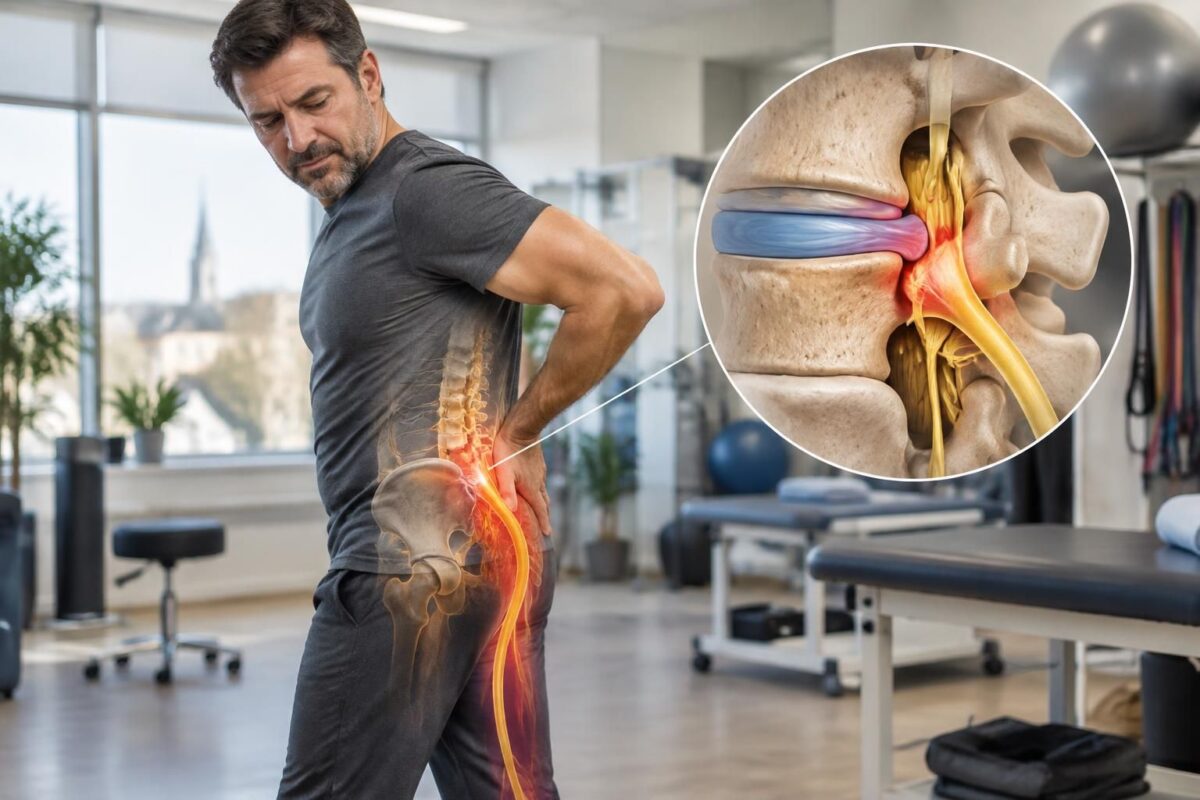
IN BRIEF Sciatica is pain that occurs when a nerve root in the lower back is irritated or compressed, sometimes by a disk or a narrowed foramen. Understanding these structures helps better locate the possible cause of symptoms and guide appropriate assessment and care. In Terrebonne, a healthcare professional can assess pain that radiates into the buttock or leg. Significant or progressive weakness, or urinary or bowel disorders, requires urgent care. |
In Terrebonne, sciatica refers to pain related to the irritation of a nerve root in the lower back. A worn or bulging disk can reduce the available space, while the foramen — the opening through which the nerve exits the spine — can become narrowed. The pain can then radiate from the buttock down the back of the leg, sometimes all the way to the foot. A professional assessment helps clarify the cause and consider appropriate care.
About the Author
Sylvain Desforges, B.Sc., D.O., N.D. is an osteopath and naturopath, founding president of TAGMED and the ACMA association. He publishes educational content on lower back pain and symptoms compatible with sciatica.
Medical Disclaimer
This content is educational and does not replace a consultation with an authorized healthcare professional. In case of significant or progressive weakness, loss of bowel or bladder control, or numbness in the saddle area, consult an emergency service without delay.
Pain that starts in the lower back and radiates down the leg may stem from an irritated nerve root. In Terrebonne, understanding the role of the disk and foramen helps better grasp the possible causes of sciatica, without substituting for a professional examination. The path of the pain, leg strength, and other symptoms guide the assessment and next steps. Sciatica refers to pain related to the irritation of a lumbar nerve root or the sciatic nerve. It can radiate from the buttock down the back of the thigh and sometimes to the calf, foot, or toes. However, pain in the leg alone does not confirm sciatica or a specific cause. Nerve roots exit the spinal column and contribute to the formation of nerves that supply the legs. The L4, L5, and S1 roots are often involved in sciatica-like pains. Irritation can cause pain, tingling, numbness, or weakness in a part of the leg. The affected area varies according to the nerve root involved, but the pathways overlap. The location of symptoms can guide the assessment; it does not always identify the root in question. To better understand the possible variations, consult our page on the pain pathway associated with the L4, L5, and S1 roots. Disks are located between the vertebrae. They help distribute loads and allow movement of the spine. A herniated disk occurs when a part of the disk bulges out. Depending on its position and surrounding tissues, it can irritate or compress a nerve root. An MRI or CT scan can show a herniation or disk wear without necessarily explaining the pain. The professional correlates imaging results with symptoms and physical examination. For an overview of potential causes and possible signs, refer to these resources on sciatica and causes, symptoms, and management options. The foramen, also known as the intervertebral foramen, is a small passage between two vertebrae. The nerve root traverses it to exit the column. A reduction in space in this passage can irritate the root. This is referred to as foraminal stenosis. This reduction in space can be associated with several changes, including wear of the joints or disks. The presence of stenosis on an image does not alone confirm that it causes the symptoms. The examination must also consider the pain pathway, sensitivity, and strength. To delve deeper into this topic, read this page on foraminal stenosis and radiculopathy in Terrebonne. Pain can present as a burning sensation, electric shock, stabbing pain, or dull ache. Some people also experience tingling or loss of sensitivity. The pain can worsen in certain positions or during activities like long-distance driving. Here’s an article on sciatic pain complicating driving. Sensations vary from person to person. An electric-like sensation in the calf, pain after exertion, or weakness in the leg may warrant an evaluation. These examples do not allow for a diagnosis at a distance. Consult our pages on the electric sensation in the calf and radiating pain in the leg after physical exertion. A new or worsening weakness deserves special attention. It may interfere with walking or make it difficult to lift the foot. To learn more about this type of difficulty, check our article on leg weakness and walking confidence. A healthcare professional usually starts by asking about the onset of the pain, its trajectory, associated sensations, and its evolution. They can then assess sensitivity, strength, reflexes, and certain movements. These elements help determine if the symptoms suggest irritation of a nerve root or another cause. Imaging is not necessary in all cases. A doctor may request it when symptoms persist, when the examination justifies it, or when a sign of severity appears. The results must be interpreted based on the examination and your history. The Merck Manual also provides general information on sciatica. To understand the nerve’s pathway, consult this resource on the sciatic nerve and the pathway of pain. The management depends on the suspected cause, the intensity of symptoms, and your health status. A professional can explain the options suited to your situation and refer you to a doctor when necessary. At the Clinique TAGMED, an evaluation can determine if nonsurgical approaches, such as specific osteopathy or motorized neurovertebral decompression, can be considered. Their relevance depends on the evaluation; no results can be guaranteed. For people in the area, services regarding sciatica treatment in Terrebonne are presented on SOS Sciatique. You can also consult general information on sciatica follow-up. Consult an emergency service without delay in case of loss of bladder or bowel control, loss of sensation in the saddle area, or significant or progressive weakness in a leg or foot. A fever, recent trauma, severe pain, or rapid worsening also require medical evaluation. A professional consultation allows for checking concerning signs and determining the next steps. Don’t wait if your strength decreases rapidly or if you have new urinary or bowel issues. About the Author Sylvain Desforges, B.Sc., D.O., N.D., osteopath and naturopath, is the founding president of TAGMED and the ACMA association. His practice focuses on chronic pain of the spine, lower back pain, and pain compatible with sciatica, especially when the pain radiates to the buttock, leg, calf, foot, or toes. Through SOS Sciatique, he publishes educational content on the symptoms of sciatica, its possible causes, and the nonsurgical approaches that may be considered after evaluation. At Clinique TAGMED, care may include, depending on the case, motorized neurovertebral decompression, specific osteopathy, or precision impacting. For an evaluation related to sciatica treatment in Montreal or Mont-Royal, or to sciatica treatment in Terrebonne, consult the services available at Clinique TAGMED. Medical Disclaimer The information published on SOS Sciatique is provided for educational purposes. It does not replace a consultation, diagnosis, advice, or treatment performed by a doctor or another licensed health professional. The author of this article is neither a doctor nor a specialist in a medical specialty recognized by the Collège des médecins du Québec. The approaches of osteopathy, manual medicine, or functional support described on this site do not constitute medical acts and are not intended to replace medical follow-up. Consult a doctor or emergency service in the case of loss of urinary or bowel control, anesthesia in the saddle region, major or progressive weakness in the leg or foot, fever, recent trauma, severe pain, or rapid worsening. For more details, please read our Legal Notice. Medical Disclaimer: The information and advice provided on this site do not replace the opinion, diagnosis, or treatment of a healthcare professional. Please note that Dr. Sylvain Desforges, osteopath, is neither a medical doctor nor a physician, and is not a specialist in a medical specialty as defined by the Collège des médecins du Québec. Manual medicine, functional medicine, and sports medicine as described on this site exclude any treatment or medical diagnosis made by a doctor or specialist. Always consult your doctor for any medical questions. For more details, please read our complete Legal Notice.The Nerve Root: The Starting Point of the Signal
The Disk: A Cushion Between the Vertebrae
The Foramen: The Passage of the Nerve Root
Recognizing the Symptoms of Sciatica
How the Evaluation Clarifies the Possible Cause
What Options to Consider in Terrebonne?
When to Consult Quickly
Sciatica in Terrebonne: Understanding the Nerve Pathway
- Nerve root: the starting point of the nerve near the lumbar vertebrae.
- Disc: a herniation or irritation can affect a neighboring root.
- Foramen: small opening between the vertebrae through which the root exits.
- Sciatica: pain often felt in the buttock and back of the leg.
- Numbness: tingling or reduced sensitivity possible in the leg or foot.
- Evaluation: the pathway of symptoms and examination help guide the management.

In Terrebonne, a pain that starts from the lower back and descends into the leg may correspond to an irritation of a nerve root, often related to a disc or a narrow passage called foramen. Simply understanding these elements helps describe symptoms better, choose the next steps, and recognize signs that require quick evaluation.

Sciatica in Terrebonne: radicular pain versus referred pain
IN BRIEF Sciatica refers to pain that radiates into the buttock and sometimes the leg. A radicular pain comes from the irritation of a nerve root and may be accompanied by tingling, numbness, or weakness; a referred pain spreads from…
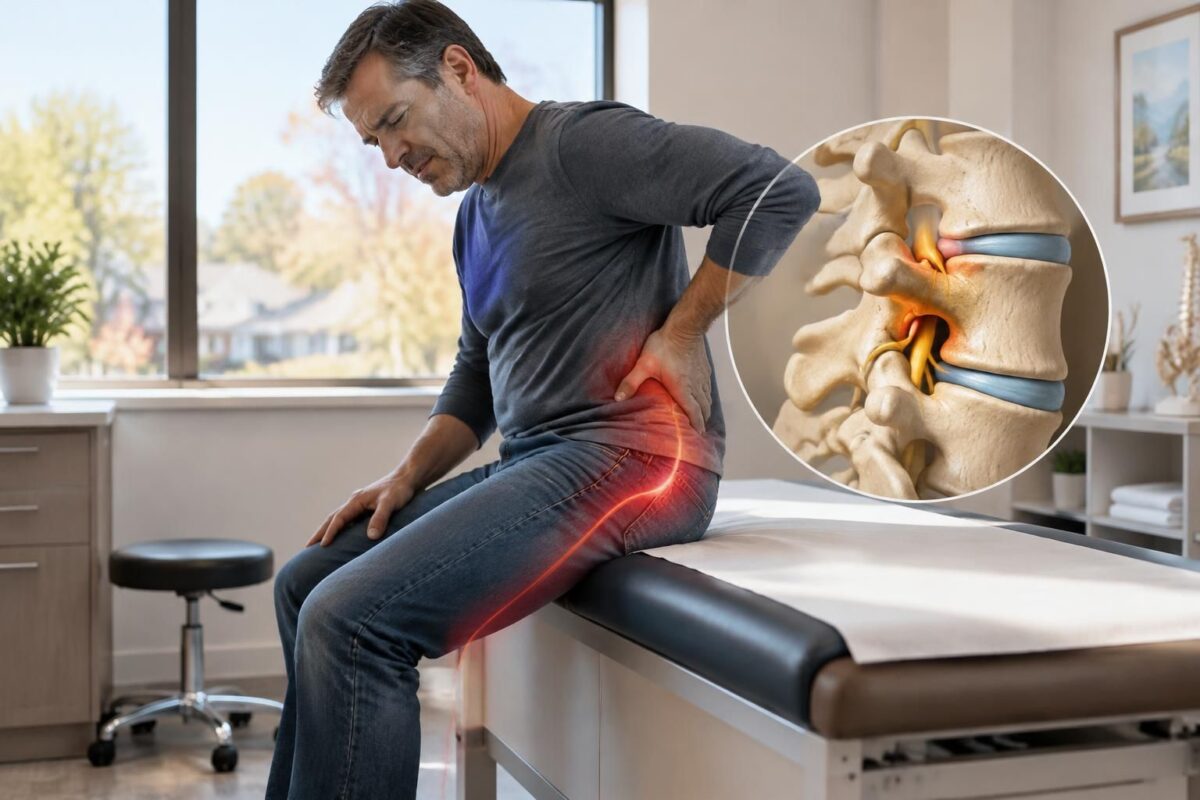
Sciatica in Terrebonne: understanding the L5-S1 foraminal compression
IN BRIEF The L5-S1 foraminal compression corresponds to a narrowing of the opening through which a nerve root passes, potentially contributing to sciatica. In Terrebonne, the assessment compares the side and course of the symptoms, neurological examination, imaging, and limited…
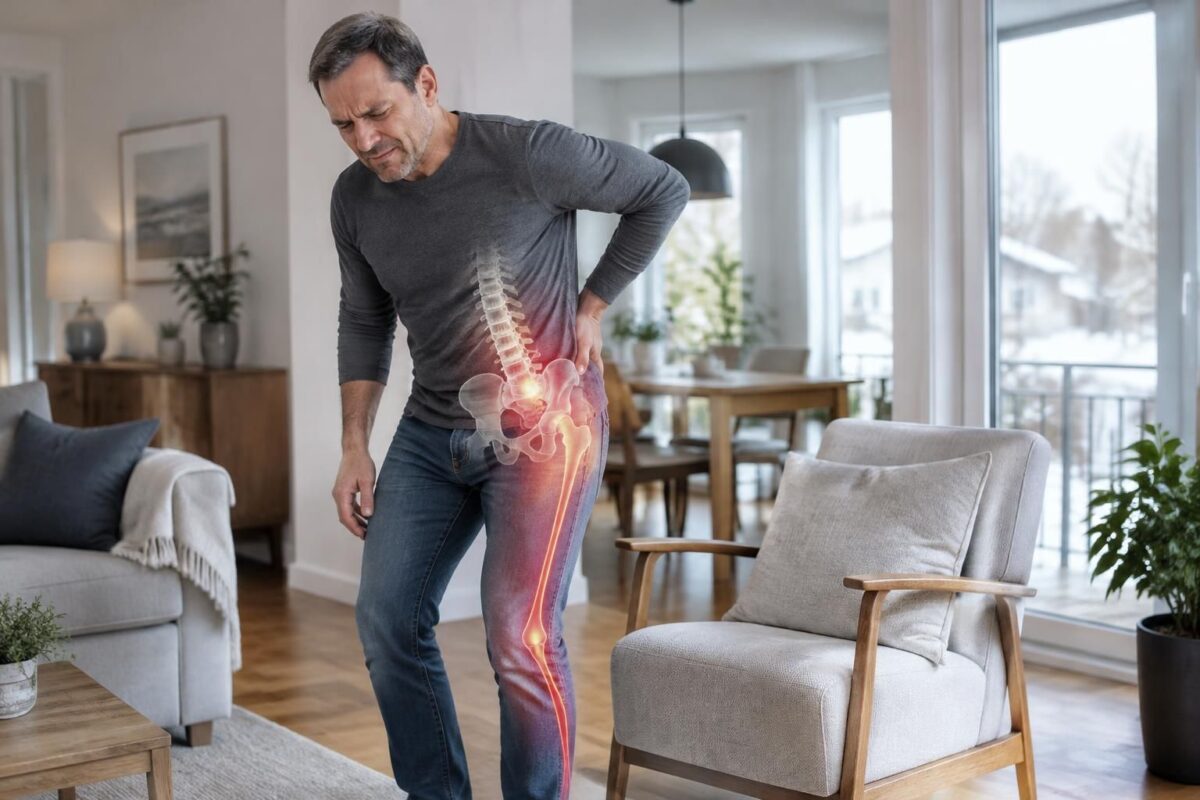
Sciatica in Terrebonne: why L5-S1 is often involved
IN BRIEF Sciatica corresponds to pain related to the irritation of a nerve root, which can extend from the buttock down to the leg. The L5-S1 level is often involved, as a disc herniation or irritation at this location can…
Sciatica: When a Nerve Root is Irritated
The nerves that serve the legs originate in the lower part of the spine. Upon exiting, near the vertebrae, they are called nerve roots. If one is irritated or compressed, pain can follow the pathway of the nerve into the buttock, back of the thigh, calf, or foot. This type of pain is often called sciatica, although several causes can produce similar symptoms.
Pain can be burning, electric, or accompanied by tingling and numbness. Some people also notice weakness. The pathway and sensations provide clues but cannot alone determine which root is involved or identify the cause with certainty.

Sciatica in Terrebonne: L5 and difficulty lifting the foot
IN SHORT The L5 sciatica can cause pain or numbness on the side of the leg, the top of the foot, and the big toe, sometimes with difficulty lifting the foot. In Terrebonne, an evaluation compares strength, sensitivity, reflexes, and…
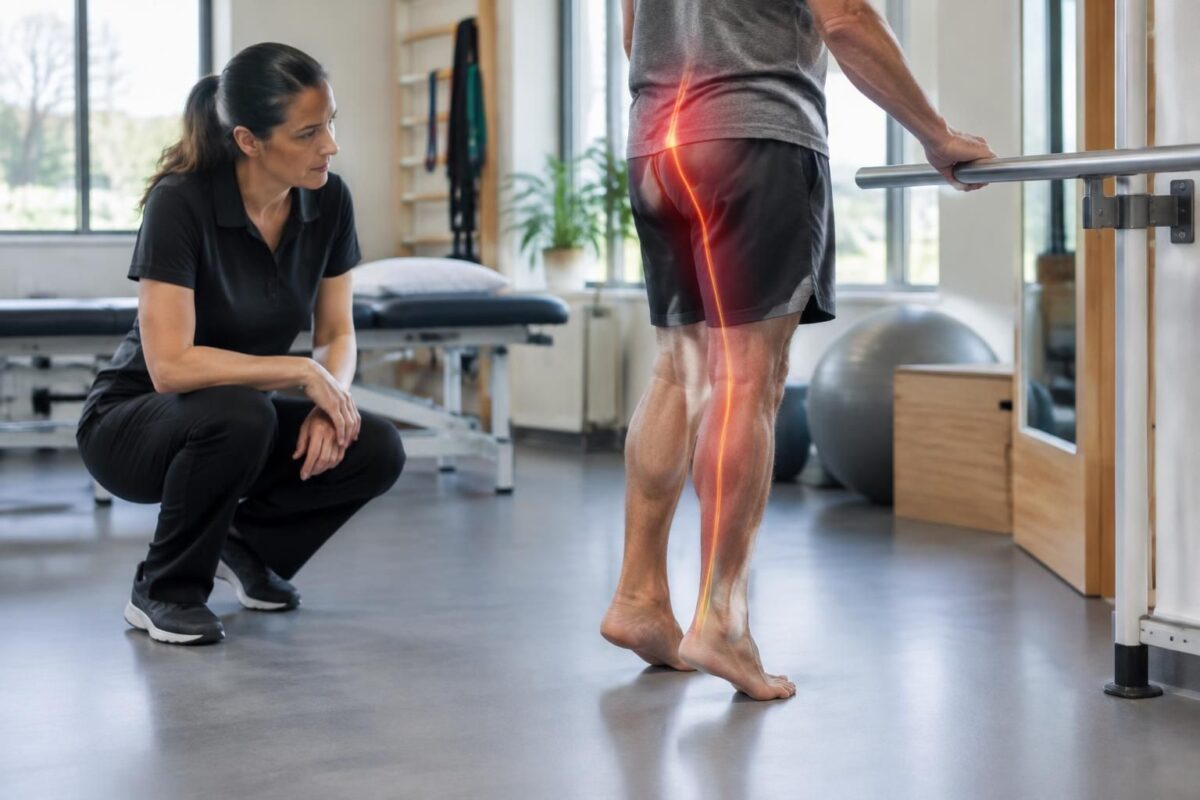
Sciatica in Terrebonne: S1 and difficulty standing on tiptoe
IN SHORT An S1 sciatica can irritate the nerve root associated with the calf and make it difficult to rise onto the balls of the feet. This sign should be evaluated with strength, sensitivity, reflexes, and walking: the pathway of…

Sciatica in Terrebonne: L4-L5 and pain towards the top of the foot
IN BRIEF A L4-L5 sciatica can radiate to the outer side of the leg and the top of the foot, sometimes reaching the big toe. This pathway can guide the assessment, though it does not suffice to confirm the cause:…
The Disc: A Cushion Between the Vertebrae
Between the vertebrae are discs that help distribute stress and allow for back movements. Over time, or after different stresses, a disc can bulge or part of its content can protrude. If this change affects a neighboring nerve root, it can contribute to irritation. This is commonly referred to as a herniated disc.
An MRI image showing a disk anomaly does not automatically mean it explains the pain. Imaging results must be interpreted with the symptoms and clinical examination. That’s why a healthcare professional may first check mobility, strength, reflexes, sensitivity, and the path of pain before recommending imaging.
The foramen: the exit door of the nerve
The foramen, also called the intervertebral foramen, is an opening between two vertebrae through which a nerve root passes. Imagine a narrow passage where a cable runs: if the space decreases, for example due to changes related to osteoarthritis or a protruding disk, the nerve can become irritated. A narrowing of the foramen does not necessarily cause symptoms; the clinical context remains essential.
Recommendations for moving forward in Terrebonne
Describe symptoms precisely
Note where the pain starts, how far it radiates, what aggravates it, and whether tingling or weakness occurs. This information can facilitate assessment by a physician or another authorized healthcare professional.
Stay active without overexerting
When tolerable, prioritize gentle movements and walking periods suited to your capabilities. Avoid prolonged strict bed rest and stop any activity that causes significant worsening. A professional can help you adjust your activities and discuss non-surgical options depending on your situation.
Recognize emergency signs
Consult an emergency service immediately if there is loss of bladder or bowel control, numbness in the saddle area, or significant or progressive weakness of the leg or foot. Pain that worsens rapidly, fever, or recent trauma also requires prompt medical attention.
Medical warning: this information is educational and does not replace a consultation, diagnosis, or treatment by an authorized healthcare professional. Osteopathy and manual approaches are not considered medical acts and do not replace medical follow-up.
About the author
Sylvain Desforges, B.Sc., D.O., N.D., osteopath and naturopath, is the founding president of TAGMED and the ACMA association. His practice focuses on chronic spinal pain, lower back pain, and pain associated with sciatica. At the TAGMED Clinic, the care offered may include, based on evaluation, motorized neurovertebral decompression, specific osteopathy, or precision impactor.
| Item | Simple explanation |
|---|---|
| Nerve root | Nerve branch coming from the lower back, often L5 or S1. |
| Disk | Pad between two vertebrae; a herniation can irritate a neighboring root. |
| Foramen | Opening between the vertebrae where the nerve root passes. |
| Narrowed foramen | A lack of space can contribute to nerve irritation. |
| Common pathway | Pain from the buttock down the back of the leg, sometimes to the foot. |
| To remember | An image of a hernia or narrowing does not, by itself, explain the pain. |
| Evaluation in Terrebonne | A professional can assess symptoms, strength, and sensitivity. |
Sciatica in Terrebonne: illustrative testimonies to understand the nerve root, the disk, and the foramen
Transparency note: the stories below are fictional examples, designed for educational purposes. They do not represent verified patient testimonials and do not allow for a diagnosis. Pain radiating down the leg can have several causes; an individual assessment is necessary to understand the origin.
Marc, 52 — “I thought the problem was in my leg”
“The pain started in my lower back, then spread to my buttock and the back of my thigh. Sometimes I had sharp pains down to my calf. At first, I thought I had injured my leg. I was told that sciatica can instead come from an irritated lumbar nerve root, near the spine, and that the pain is felt further along the nerve pathway.”
To illustrate simply: a nerve root resembles the beginning of an electrical cable. If it’s irritated near the spine, sensations can appear in the buttock, leg, or foot, even if these areas are not the initial source of the problem. The exact path of the symptoms helps the professional guide their assessment, although it does not suffice to confirm the cause by itself.
Julie, 44 — “The word ‘disk’ scared me”
“I had heard about disks and hernias, so I imagined my back was severely damaged. I understood that an intervertebral disk is found between two vertebrae and helps distribute loads. When it bulges or part of its content shifts, it can sometimes irritate a nerve root. But an image showing an anomaly does not automatically mean it explains all the pain.”
A herniated disk can contribute to sciatica, but it is not the only possible explanation. The intensity of the pain does not always correspond to the size of the observed anomaly. The professional considers the symptoms, their evolution, and the clinical examination; imaging is requested when the situation justifies it.
André, 61 — “I finally understood what the foramen was”
“The term ‘foramen’ was new to me. I was explained that it is a small opening between the vertebrae, a passage through which a nerve root exits the spine. If this space narrows, for example due to wear-related changes, the root can become irritated in some people.”
The foramen can be compared to an exit door for the nerve. A visible narrowing does not necessarily cause symptoms in everyone: its significance must be interpreted with the history of pain and examination results. Therefore, pain radiating down the leg does not, by itself, allow for a conclusion of foraminal compression.
Émilie, 39 — “The location helped me describe what I was feeling”
“I noted where the pain started and how far it went down. It started from the buttock and mainly followed the back of the thigh. These details helped me explain my symptoms during the assessment. I also learned to mention tingling, numbness, or potential weakness, rather than just talking about pain.”
Nerve irritation can be accompanied by burning, electric shocks, tingling, or a decrease in sensitivity. A new or progressive loss of strength deserves special attention. The diagnosis relies notably on the questions asked, the examination of strength, sensitivity, and reflexes, and where necessary, additional examinations.
When to Seek Help in Terrebonne
If low back pain radiates down the leg, persists, or limits your activities, an assessment by a healthcare professional can help clarify possible causes and options suited to your situation. In Terrebonne, clearly present the path of the pain, its evolution, and associated symptoms. Non-surgical approaches, including functional support or osteopathy, should be considered based on the evaluation and do not replace medical follow-up when necessary.
Consult an emergency service immediately in cases of loss of bladder or bowel control, numbness in the saddle region, significant or progressive weakness of the leg or foot, fever, recent trauma, severe pain, or rapid worsening.
Medical Disclaimer: this information is educational and does not replace consultation, diagnosis, or treatment by a physician or other licensed healthcare professional. Osteopathy and manual approaches are not medical acts and do not replace medical follow-up.
Sciatica in Terrebonne: Understanding the Nerve Root, Disk, and Foramen Simply
Pain that starts in the lower back or buttock and radiates down the leg may indicate sciatica. This term primarily describes a painful pathway related to the irritation of a nerve root in the lower back. The pain may be accompanied by burning, electric shocks, tingling, or numbness. Its intensity and pathway vary from person to person: therefore, it is best not to draw conclusions based solely on a symptom.
To understand the role of the nerve root, imagine an electrical cable leaving the spine to transmit messages to the leg. The part of the nerve that exits near the vertebrae is called a nerve root. When it is irritated, sensations may manifest farther away, in the buttock, thigh, calf, or foot. The location of the pain provides clues but does not allow for confirmation of which root is involved on its own.
Between the vertebrae are intervertebral disks. They help absorb loads and allow back movements. A disk includes a tough outer shell and a softer inner part. Over time or after various stresses, it can deform. A herniated disk occurs when part of the disk’s contents bulges through its shell. If this bulge approaches a nerve root, it may contribute to irritation. However, a visible anomaly on imaging does not automatically mean it is the cause of the pain.
The foramen, also called a foraminal hole, is a small opening located between two vertebrae. Nerve roots pass through these openings to exit the spine and join the rest of the body. If the space narrows, for example due to wear-related changes in the joints or disks, the root may be more exposed to irritation. This is sometimes referred to as foraminal stenosis. Clinical examination and, when indicated, imaging help the professional put these elements in context.
A consultation related to sciatica in Terrebonne may start with questions about the onset of pain, its path, the movements that modify it, and its impact on walking or sleeping. The professional may also assess mobility, sensitivity, strength, and certain reflexes. This process aims to distinguish radiating pain from other possible causes and determine if medical evaluation or additional tests are necessary.
Depending on the situation, a non-surgical approach may be considered. This may include movement advice, adapted exercises, or manual therapies. At the TAGMED Clinic, options may include specific osteopathy, motorized neurovertebral decompression, or precision percussion, depending on the evaluation. These approaches are not necessarily suitable for everyone and do not replace a diagnosis or medical follow-up. Gentle and adapted activity is often preferable to prolonged immobility, but movements that significantly worsen symptoms should be adjusted.
Sylvain Desforges, B.Sc., D.O., N.D., osteopath and naturopath, is the founding president of TAGMED and the ACMA association. His practice notably focuses on chronic spinal pain, low back pain, and symptoms compatible with sciatica. He is interested in integrating data-driven approaches and care technologies based on assessed needs.
Medical Disclaimer: this content is educational and does not replace consultation with a physician or other licensed healthcare professional. Seek prompt emergency care in cases of loss of bladder or bowel control, numbness in the saddle region, significant or progressive weakness of the leg or foot, fever, recent trauma, or rapid worsening of symptoms.
In Terrebonne, pain that starts in the lower back or buttock and radiates down the leg may be related to the irritation of a nerve root. To understand simply the relationship between root, disk, and foramen, imagine an electrical cable exiting the spine: the disk is located near its passage and the foramen is the opening through which the cable exits the spine. Irritation in this area can cause pain, tingling, or numbness in the leg.
The Path of the Nerve: Why Pain Radiates Down the Leg
Sciatica corresponds to pain related to the irritation of a nerve root in the lower back, most often associated with the lower lumbar levels. These roots contribute to forming the sciatic nerve, which traverses the buttock and then descends along the back of the thigh and leg. The pain may sometimes reach the foot or toes. To visualize this pathway, consult this presentation on the anatomy and role of the sciatic nerve as well as this explanation on why pain radiates down the leg.
The trajectory of symptoms can provide useful clues, but is not sufficient to determine the cause alone. Pain towards the outer edge of the foot, persistent discomfort in the heel, a burning sensation in the foot, or numbness of the big toe can accompany various forms of nerve irritation. These examples are detailed on the pages about pain towards the outer edge of the foot, persistent discomfort in the heel, burning sensation in the foot, and numbness of the big toe associated with lumbar pain.
The disc and the foramen: two elements to understand
Between the vertebrae are the intervertebral discs, which help distribute stress and allow movement of the spine. If a disc herniates or if part of its content irritates a neighboring root, nerve pain may appear. However, seeing a disc anomaly on an image does not automatically prove that it explains the symptoms: clinical examination and context also matter. For more information, consult this guide on sciatica, its causes and management and the information from Canadian Spine on sciatica and radiculopathy.
The foramen, also known as the intervertebral foramen, is an opening located between two vertebrae. A nerve root passes through it to connect to the rest of the body. If this space narrows, for example due to age-related changes in the joints or discs, the root may become further irritated. This condition is sometimes referred to as foraminal stenosis. The page dedicated to foraminal stenosis and sciatica in Terrebonne explains this concept in more detail.
When to request an evaluation in Terrebonne
An evaluation helps clarify the trajectory of pain, examine strength, sensitivity, and certain reflexes, and then determine whether further tests are relevant. An MRI or another imaging test is not necessary in all situations; its usefulness notably depends on the evolution of symptoms and the results of the examination. If pain wakes you at night or persists, you can refer to the information on night pain and persistent pain.
While awaiting appropriate advice, prolonged strict rest is generally not recommended without professional indication. Gentle movements, adjusted to your tolerance, can help maintain daily activity; however, stop any movement that significantly worsens symptoms. Management options vary depending on the cause, intensity, and duration of the pain. For an evaluation, consult the services for sciatica treatment in Terrebonne at the TAGMED Clinic.
Quickly seek emergency services in case of loss of bladder or bowel control, numbness in the saddle area, significant or progressive weakness in the leg or foot, fever, recent trauma, or rapid worsening. These signs require urgent medical evaluation.
About the author
Sylvain Desforges, B.Sc., D.O., N.D., osteopath and naturopath, is the founding president of TAGMED and the ACMA association. His practice focuses especially on chronic spinal pain, lower back pain, and pain compatible with sciatica. At the TAGMED Clinic, the care provided may include, depending on the evaluation, motorized neurovertebral decompression, specific osteopathy, or a precision hammer.
Medical warning
This content is provided for educational purposes and does not replace a consultation, diagnosis, or treatment by a physician or other licensed healthcare professional. The author is neither a physician nor a specialist in a medical specialty recognized by the Collège des médecins du Québec. Osteopathy, manual medicine, or functional support approaches do not constitute medical acts and do not replace medical follow-up. For more details, see the Legal notice.

Sciatica in Terrebonne: L5-S1 and symptoms in the calf
IN BRIEF A L5-S1 sciatica can cause pain that radiates down the calf, sometimes accompanied by tingling, numbness, or weakness. At Terrebonne, an assessment at the TAGMED Clinic helps to examine the symptom pathways, strength, and sensitivity, and then discuss…

Sciatica in Terrebonne: pain in the big toe, L5 root or another cause?
IN BRIEF Pain in the big toe accompanied by pain in the buttock or leg may be compatible with irritation of the L5 root, but other causes are possible. In Terrebonne, the evaluation notably compares strength, sensitivity, and gait to…

Dr Sylvain Desforges, B.Sc., D.O., N.D., osteopath, is the founding president of TAGMED and of the ACMA association. He dedicates his practice to chronic spinal pain, low back pain and symptoms compatible with sciatica, particularly when pain radiates toward the buttock, leg, calf, foot or toes.
Through SOS Sciatique, he publishes educational content on sciatica symptoms, possible causes such as disc herniation, disc narrowing, foraminal stenosis or irritation of a lumbar nerve root, as well as non-surgical approaches that may be considered according to the evaluation. At Clinique TAGMED, care may include, depending on the case, motorized neurovertebral decompression, specific osteopathic care or precision percussion.
For an evaluation related to sciatica treatment in Montreal / Mount Royal or sciatica treatment in Terrebonne, please consult the services available at Clinique TAGMED.
Medical disclaimer
The information published on SOS Sciatique is provided for educational purposes only and does not replace a consultation, diagnosis, opinion or treatment provided by a physician or another authorized healthcare professional. The author of this article is neither a medical doctor nor a specialist in a medical specialty recognized by the Collège des médecins du Québec. The osteopathic, manual medicine or functional support approaches described on this site do not constitute medical acts and are not intended to replace medical follow-up.
Consult a physician or emergency service in cases of loss of bladder or bowel control, anesthesia in the saddle area, significant or progressive weakness in the leg or foot, fever, recent trauma, severe pain or rapid worsening of symptoms. For more details, please read our Legal Notice.