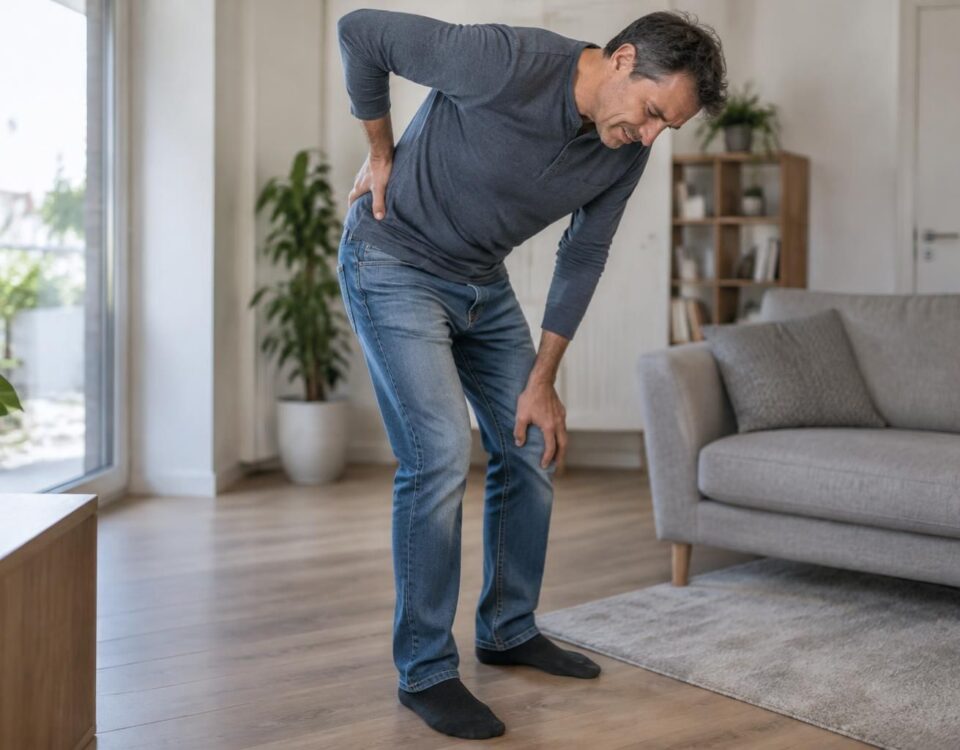
Sciatica in Terrebonne: reflexes, strength, and sensitivity in evaluation
04/11/2026
Disc bulge and sciatica: possible cause or simple discovery?
04/11/2026
IN BRIEF Chronic sciatica refers to pain that persists or recurs for more than three months. It is helpful to reassess the situation if the pain worsens, limits activities, or is accompanied by numbness or weakness. A professional can review possible causes, treatments, and the need for examinations or specialist advice in order to adjust management and support a gradual return to activities. |
Sciatica and Chronic Pain: When to Reassess?
A sciatica lasting more than 12 weeks, recurring frequently or limiting activities, deserves a new evaluation. A healthcare professional can review the symptoms, treatments previously attempted, and determine whether additional examinations are necessary. Management may be adjusted based on the cause and can include, among other options, prescribed medications, progressive rehabilitation, or other options discussed with the care team.
Consult promptly in case of significant or progressive weakness, loss of urinary or bowel control, or numbness in the saddle region.
Persistent pain that radiates from the lower back to the buttock or leg warrants a new health check. This article explains when to reassess chronic sciatica, what changes to report, what examinations a doctor may consider, and what management options may be discussed. It also specifies signs that require urgent consultation. Sciatica refers to pain that follows the path of a lumbar nerve root. It may start from the lower back or buttock and then radiate down the thigh, calf, or foot. Tingling, numbness, or weakness may also occur. We often refer to chronic pain when symptoms last more than 12 weeks. This duration alone does not determine the cause or severity of the problem. However, it indicates that it is useful to reassess, especially if the pain limits activities, disrupts sleep, or changes over time. If the pain persists beyond three months, make an appointment with a doctor or licensed healthcare professional. The reassessment allows for checking the evolution of symptoms, treatments tried, and their effects. It can also help distinguish a radicular pain from another cause of low back or leg pain. An earlier consultation may be indicated if the pain increases, if new symptoms appear, or if ongoing treatments no longer provide sufficient relief. It is not necessary to wait three months in the presence of a concerning change. Some symptoms require urgent medical evaluation. Go to the emergency room or contact emergency services in case of loss of bladder or bowel control, numbness in the saddle region, or significant or progressive weakness in a leg or foot. A fever, recent trauma, severe pain that rapidly worsens, or a concerning general condition also warrants prompt medical advice. These signs do not prove that a complication is present, but they require immediate evaluation. To prepare for the consultation, note where the pain starts and how far it radiates. Specify whether it affects one leg or both, whether it is accompanied by tingling or numbness, and if you notice any loss of strength. Also indicate what alleviates or worsens the symptoms, such as sitting, walking, coughing, or sneezing. Pain may vary depending on posture. This variation provides useful information, but it is not sufficient to identify the cause. You can read more about sciatica and pain variations based on posture. Sciatica most often affects the back of the thigh and may radiate down to the calf or foot. Cruralgia affects more the front of the thigh. Pain arising from the back, a joint, or a muscle can also spread to the buttock or leg without exactly following the path of a nerve root. The route of pain, examination of strength, reflexes, and sensitivity help the professional to direct their assessment. To better understand these elements, consult information on reflexes, strength, and sensitivity when assessing sciatica, as well as on the sensitive territory associated with nerve pain. Several factors can contribute to persistent sciatica. A herniated disc, spinal canal stenosis, or openings through which nerves pass can irritate a nerve root. Other health problems can produce symptoms that resemble sciatica. The duration of pain does not necessarily mean that a nerve is sustaining permanent damage. The sensitivity of the nervous system, sleep, stress, daily activities, and fear of movement can also influence the pain experience. These factors do not make the pain “imaginary.” They count in the overall evaluation and in the choice of care. An analysis of lifestyle habits can thus complement the clinical examination: time spent in one position, work demands, walking ability, sleep quality, and the effects of pain on mood. A gradual approach can help reduce limitations without promising complete symptom disappearance. You can find additional information on chronic sciatica. The professional typically starts by gathering history and examining mobility, strength, reflexes, and sensitivity. They also check if certain movements reproduce symptoms. This evaluation helps determine if further examinations may be useful. An MRI or CT scan is not necessary for every persistent sciatica. The doctor may consider imaging if symptoms change, if a neurological deficit appears, if appropriate care has not helped, or if the result could guide treatment decisions. Imaging should be interpreted alongside the symptoms and examination, as some abnormalities also appear in people without pain. Ask the doctor what the examination is meant to clarify and how its result could modify management. Repeating an image without a specific clinical question does not guarantee symptom improvement. The care plan depends on the suspected cause, the intensity of pain, neurological signs, and your goals. The doctor may review medications, their effects, and their side effects. Do not change a dose or stop a prescribed treatment without discussing it with the professional who is following you. Depending on the situation, the doctor may discuss a targeted infiltration or seek the opinion of a specialist. Surgery may be evaluated when symptoms remain severely disabling despite appropriate management, or when a neurological deficit justifies it. The decision takes into account the expected benefits, risks, and other options. Manual or complementary approaches may be considered after an evaluation and according to the symptoms. They do not replace a medical diagnosis and are not suitable for all situations. The TAGMED Clinic presents information on chronic sciatica and the care offered based on the evaluation. Services may include, depending on the case, motorized neurovertebral decompression, specific osteopathy, or precision percussion. No results can be guaranteed. A simple follow-up helps to describe the symptoms accurately. Each day or week, note the intensity of the pain, its trajectory, changes in sensitivity, and the activities that become difficult. Also mention the quality of sleep and the effect of treatments. This record can help the professional compare progress over time. Avoid staying in a position that clearly exacerbates your symptoms for long periods. If your condition allows it, change positions regularly and gradually resume daily activities. Stop an activity and seek advice if it triggers sharp pain, new weakness, or persistent worsening. Pain that travels down the leg does not always come from a nerve root. To examine this difference, consult the explanations on radicular pain and referred pain. Yes, if the symptoms return, last for several weeks, or limit your activities. A temporary improvement does not exclude the need for an opinion, especially if the pain returns stronger or new symptoms appear. No. Duration alone does not determine the need for surgery. A doctor evaluates the symptoms, the neurological examination, imaging results when indicated, and the effect of options already tried. Seek a new opinion if the pain persists beyond three months, evolves, disrupts sleep, or reduces your activities. Consult more quickly in cases of weakness, progressing numbness, or any warning signs described above. Sylvain Desforges, B.Sc., D.O., N.D., Doctor of Osteopathy and Naturopath, is the founding president of TAGMED and the ACMA association. His practice focuses on chronic spinal pain, lower back pain, and pain compatible with sciatica, particularly when the pain extends to the buttock, leg, calf, foot, or toes. Through SOS Sciatique, he publishes educational content on the symptoms of sciatica and possible causes such as disc herniation, disc pinching, foraminal stenosis, or irritation of a lumbar nerve root. At the TAGMED Clinic, care may include, depending on the evaluation, motorized neurovertebral decompression, specific osteopathy, or precision percussion. For an evaluation related to the sciatica treatment in Montreal or Mont-Royal or the sciatica treatment in Terrebonne, consult the available services at the TAGMED Clinic. The information published on SOS Sciatique is provided for educational purposes. It does not replace a consultation, diagnosis, opinion, or treatment performed by a doctor or another licensed healthcare professional. The author of this article is neither a physician nor a specialist in a medical specialty recognized by the Collège des médecins du Québec. The approaches of osteopathy, manual medicine, or functional support described on this site do not constitute medical acts and do not aim to replace medical follow-up. Consult a doctor or an emergency service in case of loss of urinary or bowel control, anesthesia in the saddle area, significant or progressive weakness of the leg or foot, fever, recent trauma, severe pain, or rapid worsening. For more details, please read our Legal notice. Medical disclaimer: The information and advice provided on this site do not replace the advice, diagnosis, or treatment of a healthcare professional. Please note that Sylvain Desforges, B.Sc., D.O., N.D., Doctor of osteopathy, is neither a medical doctor nor a physician, and is not a specialist in a medical specialty as defined by the Collège des médecins du Québec. Manual medicine, functional medicine, and sports medicine as described on this site exclude any treatment or medical diagnosis made by a physician or specialist. Always consult your doctor for any medical questions. For more details, please read our full Legal Notice.Reassessing Persistent Pain After Three Months
Consult Quickly in Case of Warning Signs
What Changes Should Be Reported?
Differentiating Sciatica, Cruralgia, and Referred Pain
Why Can Pain Last?
What Examinations May the Professional Consider?
MRI or CT Scan: Not Automatically
What Options to Discuss During Reassessment?
How to track progress between two consultations?
Frequently asked questions about the reevaluation of chronic sciatica
Should I consult if the pain improves at times?
Does sciatica lasting several months mean I need surgery?
When should I seek a new medical opinion?
About the author
Medical disclaimer
A healthcare professional can reevaluate the symptoms, check for neurological signs, and determine whether examinations or treatment adjustments are necessary.Reevaluation to consider
Consult without delay

A sciatica that persists or recurs regularly deserves reevaluation, especially if its intensity, location, or effects on your activities change. When pain lasts more than 12 weeks, a healthcare professional can review the symptoms, previously attempted treatments, and the necessity for further examinations. This approach helps adjust management without assuming that new imaging or intervention is always necessary.

Sciatica and recurrent pain: why does it come back?
IN BRIEF Recurrent sciatica refers to pain that recurs from the lower back or buttock and may extend down the leg. It can be maintained by nerve irritation, a lumbar cause, or a too-rapid return to activities. An evaluation helps…
When to request a new evaluation?
Consult your doctor if the pain does not improve after several weeks of management, if it persists beyond three months, or if it prevents you from sleeping, walking, or performing your usual activities. A re-evaluation is also indicated when symptoms change: pain that radiates lower in the leg, new numbness, more frequent episodes, or increasingly short relief.
Note how long the pain has been present, its path, the movements that worsen or relieve it, as well as the treatments and exercises tried. This information helps the professional distinguish sciatica from other possible causes, such as non-radiating lumbar pain or a femoral nerve condition.
Signs that require prompt attention
Significant or progressive weakness in the leg or foot, loss of bladder or bowel control, or numbness in the saddle region justify urgent consultation. Also seek advice quickly in case of fever, recent trauma, severe pain, or rapid deterioration. Do not delay consulting while trying to manage these symptoms on your own.

Sciatica and recurring pain episodes
IN BRIEF Recurrent sciatica is pain that follows the path of the sciatic nerve and comes in episodes. It may be linked to nerve irritation and factors such as posture or lack of movement. An evaluation helps guide management; moving…
Is it necessary to redo an MRI or CT scan?
Imaging is not automatically necessary because sciatica persists. The doctor may consider it if symptoms have evolved, if neurological signs appear, if the appropriate treatment does not bring the expected improvement, or if results could guide a therapeutic decision. A herniated disc, stenosis, or another visible change on imaging alone is not enough to explain the pain: results must be correlated with clinical examination.

Sciatica and pain that varies from day to day
IN BRIEF Sciatica can vary from day to day depending on fatigue, activities, and the sensitivity of the nervous system. These fluctuations are common and do not necessarily mean that the situation is worsening. A gradual return to movement and…
Reassessing the treatment plan
The re-evaluation allows for checking if medications remain useful and tolerated, and to discuss other options. The professional may recommend active rehabilitation, with progression adjusted to your abilities. Activities such as walking or gentle swimming may be considered if they are well tolerated. Avoid modifying or stopping a prescribed treatment without discussing it with your doctor.
Depending on the suspected cause and your situation, injections or a specialized consultation may also be discussed. A surgical evaluation may be considered in certain cases, especially when the pain remains very disabling despite non-surgical care or when there is neurological impairment. The benefits, risks, and alternatives must be explained by the medical team.

Sciatica and pain that varies with activity
IN BRIEF Sciatica is pain related to irritation of a lumbar nerve root; it can vary with movements and activities. Gentle mobility, such as walking, and adapted exercises can help maintain flexibility and strength, while prolonged rest can increase stiffness.…
Monitoring symptoms daily
While awaiting your appointment, note the evolution of the pain and your capabilities: walking duration, sleep, tolerance to sitting position, and activities performed. Try to change positions regularly rather than staying still for long periods. Gentle movement every 30 to 45 minutes can help limit stiffness, without forcing through sharp pain. An appropriate support can also take into account the impact of stress and fatigue on the experience of pain.
If you wish to explore complementary approaches, discuss them with your doctor or a qualified professional to check their relevance and safety for your situation. Regular re-evaluation allows for maintaining a coherent plan, identifying significant changes, and guiding decisions based on your symptoms and objectives.

Sciatica and pain that varies with posture
IN BRIEF Sciatica can vary depending on posture, as certain positions or their duration increase sensitivity of the nerve. Alternating positions, moving regularly, and adjusting sitting or standing periods can help distribute strains better and gradually improve tolerance to movement.…
About the author
Sylvain Desforges, B.Sc., D.O., N.D., Doctor of Osteopathy and Naturopath, is the founding president of TAGMED and the ACMA association. His practice specifically addresses chronic spinal pain, low back pain, and pain compatible with sciatica.

Sciatica and pain worsened in lumbar flexion
IN BRIEF Aggravated lumbar flexion sciatica refers to pain that increases when bending the lower back forward and can radiate from the buttock to the leg. This movement may exacerbate the irritation of a nerve root, for example, in the…
Medical disclaimer
This information is educational and does not replace a consultation, diagnosis, or treatment by a qualified healthcare professional. The author is neither a doctor nor a specialist in a medical specialty recognized by the Collège des médecins du Québec. In case of loss of bladder or bowel control, numbness in the saddle area, significant or progressive weakness, fever, recent trauma, severe pain, or rapid deterioration, consult a doctor or an emergency service.
| When to re-evaluate? | To consider |
|---|---|
| Pain persisting for more than 12 weeks | See a healthcare professional to re-examine symptoms and the care plan. |
| Pain that intensifies or changes | Request a new opinion, especially if treatments do not provide improvement. |
| New numbness or weakness | Consult quickly to evaluate neurological signs. |
| Persistent symptoms despite care | The professional may consider reviewing exams or treatment options. |
| Loss of bladder or bowel control, or numbness in the saddle region | Consult an emergency service immediately. |
The testimonials below are fictional and composite accounts, created for educational purposes. They do not describe specific patients and cannot be used to make a diagnosis. A pain that persists, changes, or limits your activities deserves to be discussed with a healthcare professional.
“The pain keeps coming back” — Marc, 52 years old
“My pain descended from my lower back to my hip and leg. It sometimes decreased, then returned after long periods of sitting. As the episodes repeated for several months, I made another appointment with my doctor instead of continuing to manage each flare-up as if it were isolated. We reviewed the evolution of my symptoms and what I could do daily.”
Key takeaway: recurring episodes or pain that persists beyond a few weeks may justify a new evaluation, especially if symptoms interfere with sleep, work, walking, or usual activities.
“The symptoms have changed” — Nadia, 47 years old
“Initially, I mainly felt pain in my hip and thigh. A few weeks later, tingling appeared in my foot. As the problem evolved, I requested a new opinion rather than continuing the same exercises on my own. The professional reassessed my situation and explained what options could be considered based on the examination.”
Key takeaway: the onset or worsening of numbness, tingling, or weakness should be reported quickly. Based on your symptoms and the clinical examination, a professional may determine if further tests are indicated.
“The treatment hasn’t helped me enough” — Julien, 60 years old
“I followed the recommendations I received, but after several weeks, I remained limited in walking and sitting. Rather than multiplying treatments without assessing the situation, I made another appointment to discuss what had been tried, what helped, and what aggravated the pain. This reevaluation allowed for a revision of the plan with my care team.”
Takeaway: if a treatment does not bring the expected improvement, if its side effects become difficult to tolerate, or if your functioning deteriorates, seek a new opinion. Medications, rehabilitation, injections, and other options should be discussed with the relevant professionals based on your situation.
“The pain started to take over my life” — Sophie, 43 years old
“Due to constant pain, I reduced my outings and moved less and less for fear of triggering an attack. I was also exhausted and worried. I addressed these difficulties during a consultation. We talked about a gradual return to activities and ways to get support to cope better with the pain.”
Takeaway: persistent pain can affect sleep, mood, and confidence in movement. These aspects are important to mention during a consultation: the reevaluation is not just about the back or leg, but also about the consequences of pain in your daily life.
When to request a reevaluation?
It is reasonable to consult if the pain persists for about 12 weeks, frequently returns, intensifies, or continues to limit your activities despite measures already tried. A professional will be able to review your symptoms, examination, and previous treatments, and then decide whether imaging or a specialized opinion is appropriate. An MRI or CT scan is not necessary for every pain: its usefulness depends on the clinical context.
Consult promptly in case of new or progressive weakness in the leg or foot, or worsening numbness. Loss of urinary or bowel control, numbness in the saddle area, fever, recent trauma, or severe pain that worsens rapidly require urgent evaluation.
Important: these accounts are illustrative and do not replace a consultation, diagnosis, or personalized treatment. The information provided is educational; it does not substitute for the opinion of a physician or another licensed healthcare professional.
A sciatica usually manifests as pain that starts in the lower back or buttock and radiates down the leg. It may be accompanied by tingling, numbness, or weakness. When symptoms persist or recur over several months, it is important to reassess: the pain can evolve, needs may change, and the management plan may sometimes need to be adjusted.
Chronic pain is often referred to when it lasts beyond three months. This duration does not necessarily mean that an injury is worsening or that improvement is impossible. However, persistent pain justifies a clinical evaluation, especially if symptoms limit walking, sleeping, working, or usual activities. A healthcare professional can reevaluate symptoms, their evolution, and treatments already tried.
A reevaluation is particularly relevant when pain does not improve despite appropriate management, when it becomes more intense, or when it changes its pathway. Any new numbness, any decrease in strength, or any difficulty using the foot or leg should also be reported. Based on the examination results and the pain history, a physician may deem it necessary to request imaging, such as an MRI or CT scan. These tests are not routine: their indication depends on the clinical context and how their results might inform care.
Several factors may contribute to the persistence of symptoms, including a herniated disc, spinal stenosis, or other lumbar issues. Activity level, prolonged positions, and sleep can also affect daily life. Since multiple causes can produce similar symptoms, it is best to avoid drawing conclusions based solely on pain or self-diagnosing.
Reevaluation also allows for examining whether treatments remain appropriate. Medications may require adjustment by the prescriber, particularly if their effect diminishes or if side effects arise. Rehabilitation, gradual resumption of activities, and certain targeted interventions can be discussed with the relevant professionals. Manual or complementary approaches should be chosen carefully and do not replace medical diagnosis or indicated care. The goal is to construct a realistic strategy tailored to symptoms and revised according to progress.
A comprehensive approach considers function, lifestyle habits, and the emotional repercussions of pain. Reducing prolonged periods in the same position, modifying the workplace, and gradually resuming movement can help manage activities better. Psychological support can also be useful if pain leads to distress, worry, or withdrawal from enjoyable activities.
Sylvain Desforges, B.Sc., D.O., N.D., Doctor of Osteopathy and Naturopath, is the founding president of TAGMED and the ACMA association. His practice focuses particularly on chronic spinal pain and lumbar pain compatible with sciatica. Depending on the assessment and the individual’s situation, care at the TAGMED Clinic may include motorized spinal decompression, specific osteopathy, or precision impact treatment. These approaches do not replace a medical evaluation when it is necessary.
Consult promptly with a physician or emergency service in case of loss of urinary or bowel control, numbness in the saddle area, significant or progressive weakness in the leg or foot, fever, recent trauma, severe pain, or rapid worsening. The information in this text is educational and does not replace a diagnosis or follow-up by a licensed healthcare professional.
A sciatica that persists or recurs for several months deserves reevaluation, especially if the pain changes, further limits your activities, or is accompanied by neurological symptoms. Checking in with a healthcare professional helps verify possible causes, adjust care, and choose realistic goals to gradually regain mobility and comfort.

Sciatica and pain worsened in lumbar extension
IN BRIEF Lumbosacral sciatica aggravated in extension is a pain that radiates down the buttock or leg and increases when the lower back arches. This position can exacerbate irritation of a nerve root, particularly in cases of stenosis; however, it…
Reevaluating chronic sciatica: the next steps
Chronic pain is generally referred to when it lasts more than 12 weeks. This duration does not necessarily mean that an injury is worsening, but it justifies reevaluating the situation if symptoms do not improve, frequently recur, or respond less well to previously tried measures. Sciatica can notably be associated with a herniated or bulging disc, narrowing of the canal or foramen, or irritation of a nerve root. To better understand some causes of persistent pain, consult the resources on chronic sciatica and its possible causes and bulging discs with recurrent sciatica.
Note what has changed since the last assessment: the pain’s trajectory, its intensity, the times it appears, the positions that trigger or relieve it, as well as its consequences on sleep, walking, and work. Pain that worsens when walking, is exacerbated in a sitting position, or improves when leaning forward may guide the evaluation, though it is not sufficient to establish a diagnosis. You can learn more about pain aggravated by walking, pain intensified in a sitting position, and pain relieved by leaning.
Depending on the evolution of symptoms and examination results, the professional may determine if imaging, such as an MRI or CT scan, is relevant. It is not systematic: it is mainly considered when its results can alter the management, for example, in the presence of new neurological signs, persistent pain despite appropriate care, or a procedure to plan. An evaluation can also clarify if a foraminal compression, particularly at the L5-S1 level, should be considered; see the page on L5-S1 foraminal compression for more on this.
Reevaluation also allows revising the care plan: medications with the prescriber, active rehabilitation, adjusting activities, and, in some cases, evaluation for an injection or surgical consultation. Surgery is not indicated solely because the pain lasts a long time; the decision depends on symptoms, examination, imaging, and the impact on daily life. To better understand the criteria that may lead to discussing surgery, consult the resources on persistent sciatica and the time to consider surgery and when to consult for sciatica.
Meanwhile, staying active progressively can help limit stiffness and loss of confidence in movement. Break up sitting or standing periods, resume activities according to your tolerance, and seek advice before undertaking exercises that significantly increase pain. Practical tips are presented in these guides on persistent sciatica and measures to consider for chronic sciatica.
Quickly consult a doctor or emergency service in cases of loss of bladder or bowel control, anesthesia in the saddle region, significant or progressive weakness of the leg or foot, fever, recent trauma, severe pain, or rapid worsening. These symptoms require immediate evaluation.

Sciatica and pain relieved by bending: possible stenosis
IN BRIEF A sciatica-type pain relieved by leaning forward may be compatible with lumbar stenosis, a narrowing that can irritate or compress nerves. Flexion may temporarily decrease pressure, but does not confirm the diagnosis or treat the cause. A professional…

Sylvain Desforges, B.Sc., D.O., N.D., docteur en ostéopathie
Dr Sylvain Desforges, B.Sc., D.O., N.D., osteopath, is the founding president of TAGMED and of the ACMA association. He dedicates his practice to chronic spinal pain, low back pain and symptoms compatible with sciatica, particularly when pain radiates toward the buttock, leg, calf, foot or toes.
Through SOS Sciatique, he publishes educational content on sciatica symptoms, possible causes such as disc herniation, disc narrowing, foraminal stenosis or irritation of a lumbar nerve root, as well as non-surgical approaches that may be considered according to the evaluation. At Clinique TAGMED, care may include, depending on the case, motorized neurovertebral decompression, specific osteopathic care or precision percussion.
For an evaluation related to sciatica treatment in Montreal / Mount Royal or sciatica treatment in Terrebonne, please consult the services available at Clinique TAGMED.
Medical disclaimer
The information published on SOS Sciatique is provided for educational purposes only and does not replace a consultation, diagnosis, opinion or treatment provided by a physician or another authorized healthcare professional. The author of this article is neither a medical doctor nor a specialist in a medical specialty recognized by the Collège des médecins du Québec. The osteopathic, manual medicine or functional support approaches described on this site do not constitute medical acts and are not intended to replace medical follow-up.
Consult a physician or emergency service in cases of loss of bladder or bowel control, anesthesia in the saddle area, significant or progressive weakness in the leg or foot, fever, recent trauma, severe pain or rapid worsening of symptoms. For more details, please read our Legal Notice.