

Chronic sciatica: symptoms to watch for
07/11/2026
Sciatica and complete rest: helpful or counterproductive?
07/11/2026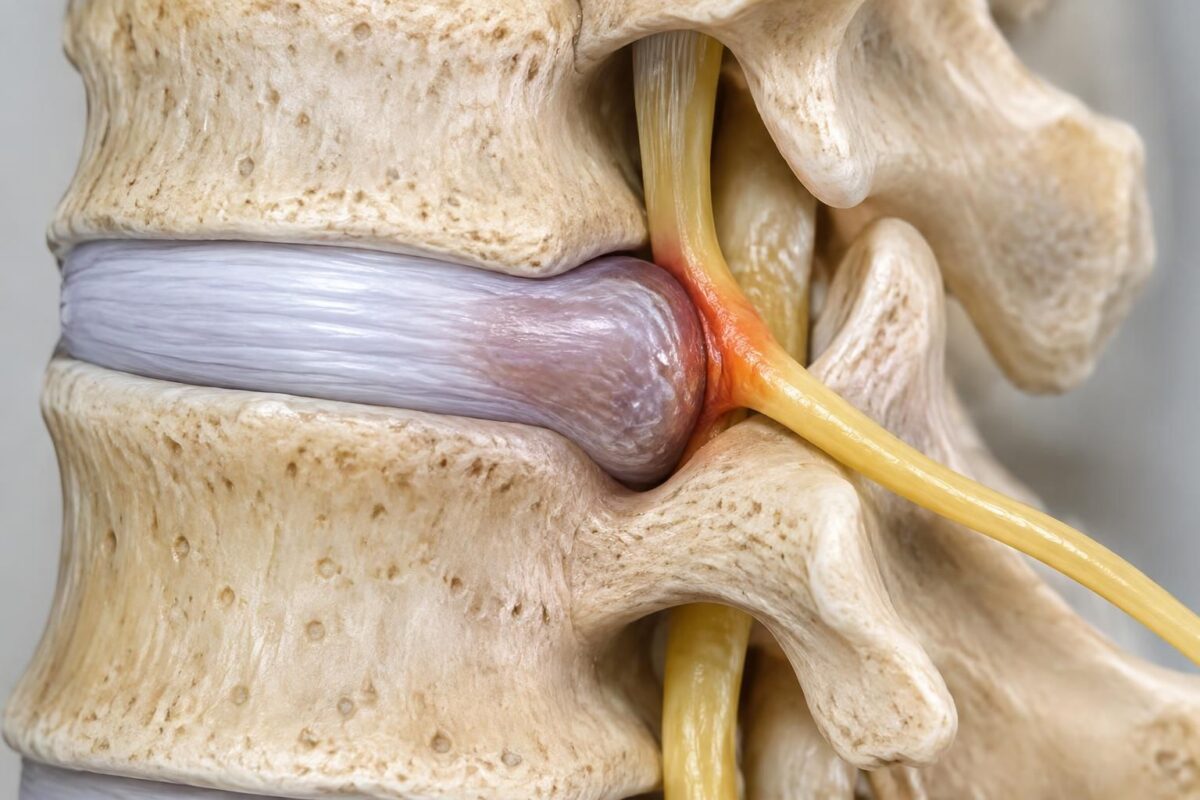
IN BRIEF A disc bulge can reduce the space of the foramen, the opening through which a nerve exits, and contribute to its irritation. This can cause lower back pain radiating into the buttock or leg, tingling, or numbness. An assessment helps to link symptoms to imaging results and choose suitable management, such as progressive exercises or conservative care, to improve mobility and daily activities. |
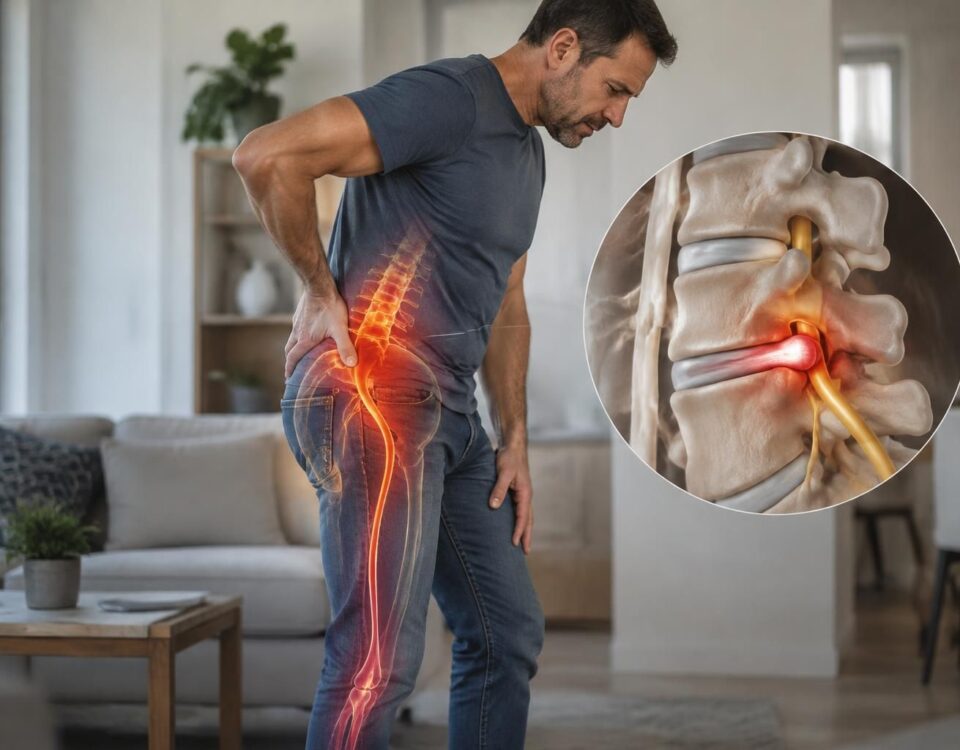
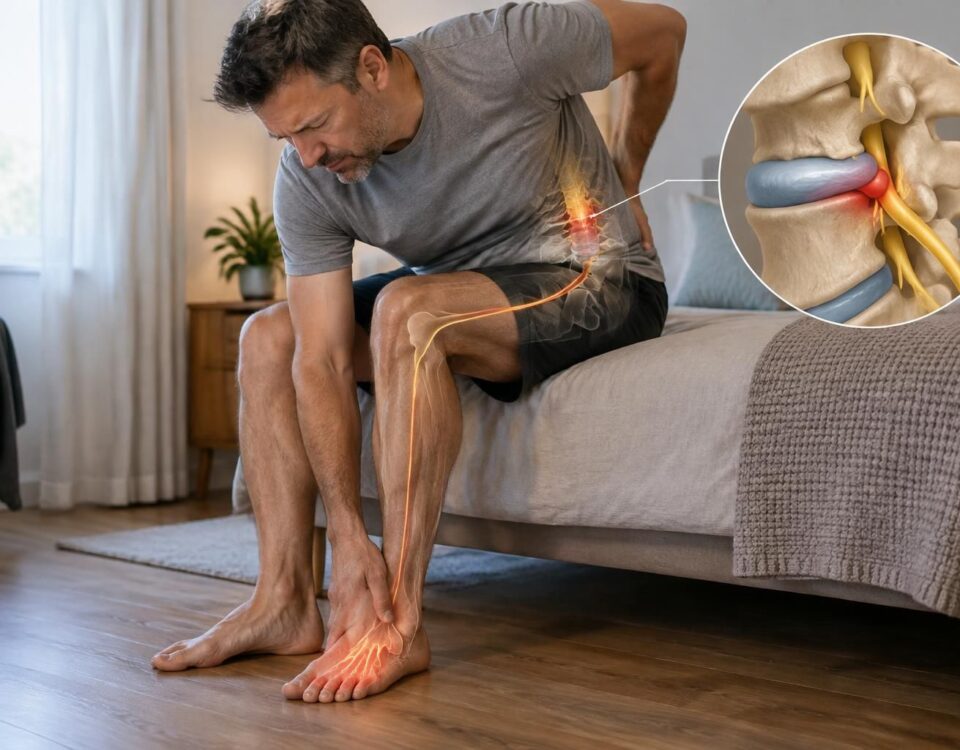
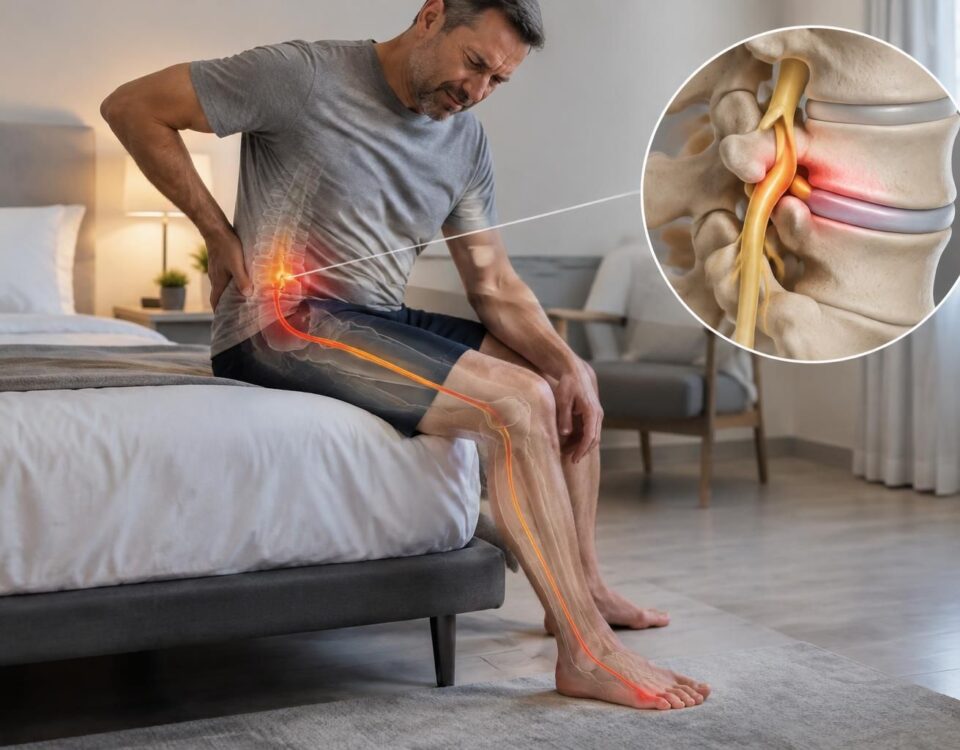
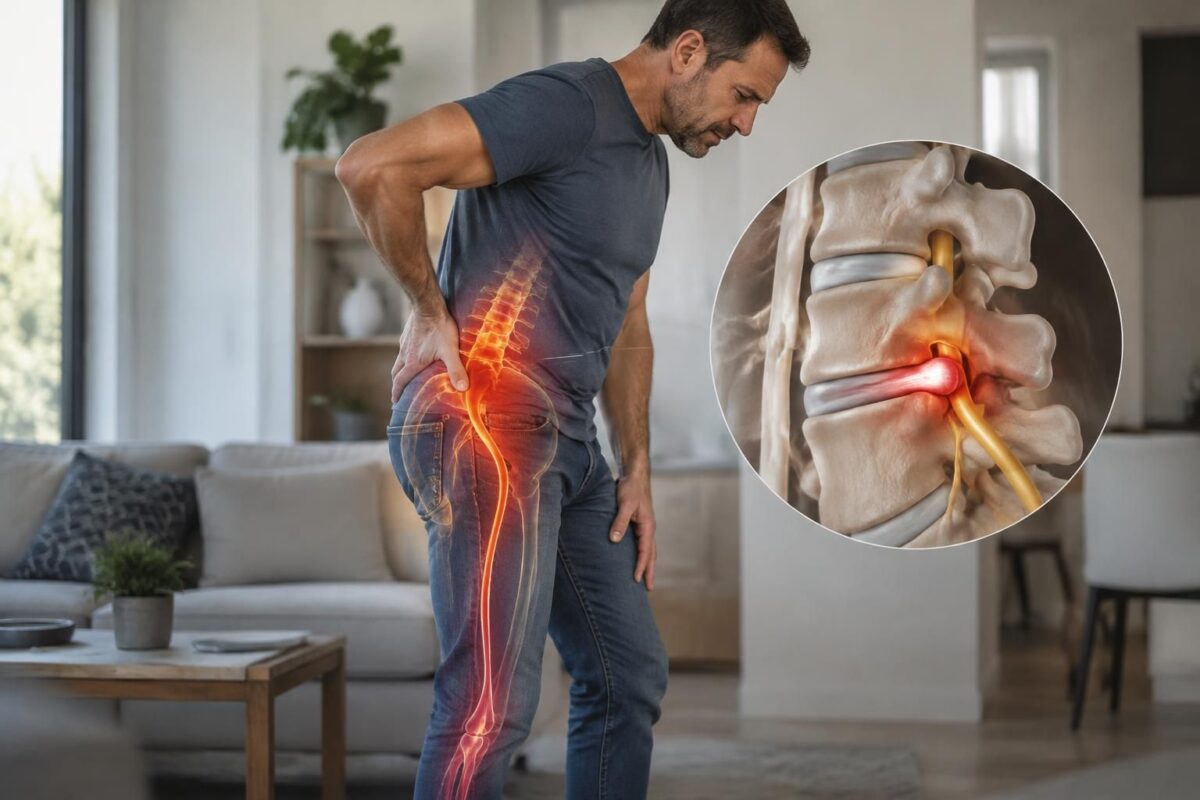
A disc bulge refers to an intervertebral disc that slightly overflows its boundaries. If it reduces the space of a foramen — the opening through which a nerve root passes — it can contribute to its irritation and cause lower back pain that radiates to the buttock or leg, sometimes accompanied by tingling or numbness. Imaging should be interpreted along with symptoms and clinical examination, as a bulge is not always the cause of pain.
Management may include a temporary adaptation of activities, progressive exercises, and suitable strengthening. Significant or progressive weakness, loss of bladder or bowel control, or anesthesia in the saddle region requires urgent evaluation.
A disc bulge can reduce the space of a foramen, the opening through which a nerve root exits the spine. This proximity can irritate a nerve and cause pain in the back or neck, sometimes accompanied by symptoms in a leg or arm. However, a bulge visible on imaging does not always cause symptoms. The evaluation must link the examination results to your pain and functioning.
Disc Bulge and Foraminal Irritation: Understanding the Link
The intervertebral disc is located between two vertebrae. It helps distribute loads and dampen some of the stresses associated with movement. It consists of a softer center, called the nucleus, and a tougher outer covering, known as the annulus fibrosus.
A bulge describes an overflow of the disc beyond its usual boundaries. It is typically more spread out than a herniation, where a portion of the disc protrudes in a more localized manner. Terms may vary according to reports and professionals. To better understand this distinction, see the explanations on the disc bulge and herniation.
The foramina are the openings located on each side of the vertebrae. Nerve roots pass through them to reach different parts of the body. If a bulge, wear-related changes, or other structures reduce this space, the nerve root can become more sensitive or irritated. This situation can be described as foraminal irritation.
A Bulge Alone Does Not Establish the Cause of Pain
A bulge image does not alone prove that the disc explains your symptoms. Some people have a bulge without pain. Others experience significant pain with modest changes on imaging. The professional must consider the location of the pain, its trajectory, its evolution, and clinical examination findings.
Disc bulge L5-S1 and pain toward the foot
IN SHORT A L5-S1 disc bulge corresponds to a disc that slightly overruns between the last lumbar vertebra and the sacrum. It can irritate a nerve root and cause pain resembling sciatica down to the foot, but this anomaly visible…
What Symptoms May Indicate Foraminal Irritation?
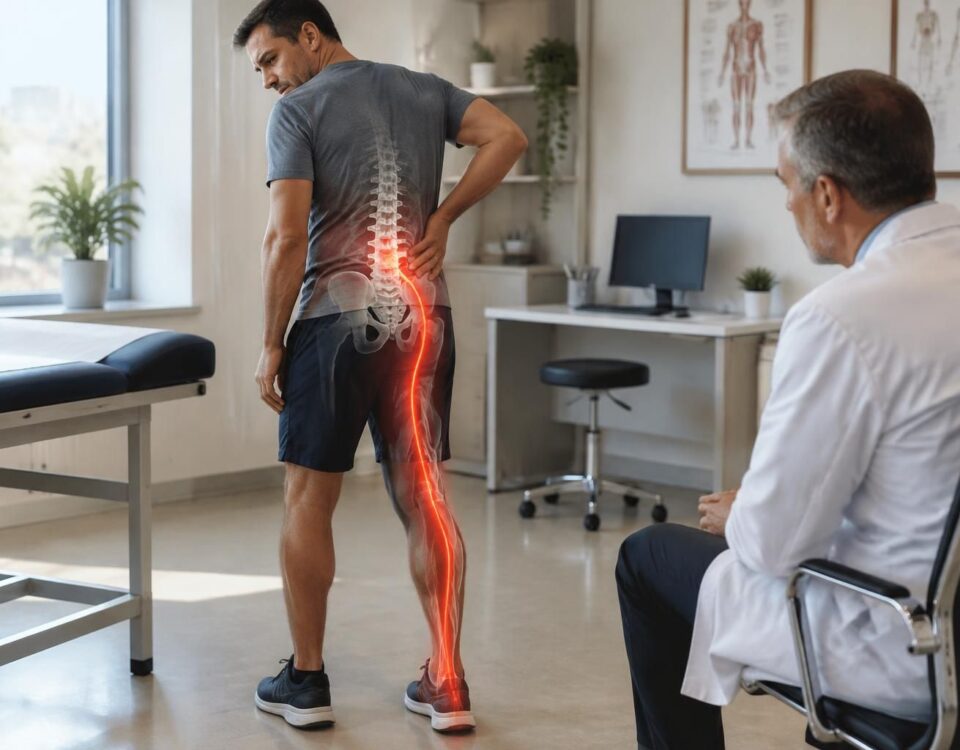
Symptoms depend on the affected area and the concerned nerve root. In the lower back, irritation may cause lower back pain and sometimes pain that radiates into the buttock or leg. Tingling, numbness, or burning sensations may also appear. These signs may correspond to sciatica-type pain, without confirming the cause by themselves.
In the neck, irritation of a root may cause cervical pain radiating toward the shoulder, arm, or hand. Changes in sensitivity or decreased strength may also occur. Marked or progressive weakness requires prompt evaluation.
Symptoms may vary depending on positions and activities. Some individuals notice discomfort after prolonged sitting, driving, or twisting movements. An episode may also occur after lifting. For more information on these scenarios, see the pages on pain after lifting and pain after twisting the back.
Disc herniation L4-L5 and leg pain
IN BRIEF A L4-L5 disc bulge is a protrusion of the lumbar disc that can contribute to pain in the buttock or leg if a nerve root is irritated. An MRI in a neutral position does not always show what…
Why Can the Foramen Narrow or Become Sensitive?
A bulge can contribute to reducing the available space near a nerve root. Other changes may also participate in this reduction, such as modifications to the joints or neighboring tissues. The role of each element varies from person to person.
Repeated stresses, certain prolonged positions, and sudden movements can trigger or exacerbate symptoms in some individuals. This does not mean that a single movement always explains the issue. The development can also be influenced by the general condition of the disc and by other changes in the spine, including lumbar degeneration.
Pain radiating down the leg may be related to nerve irritation, but other causes are possible. A medical or professional evaluation helps determine the next steps, especially if symptoms persist or worsen.
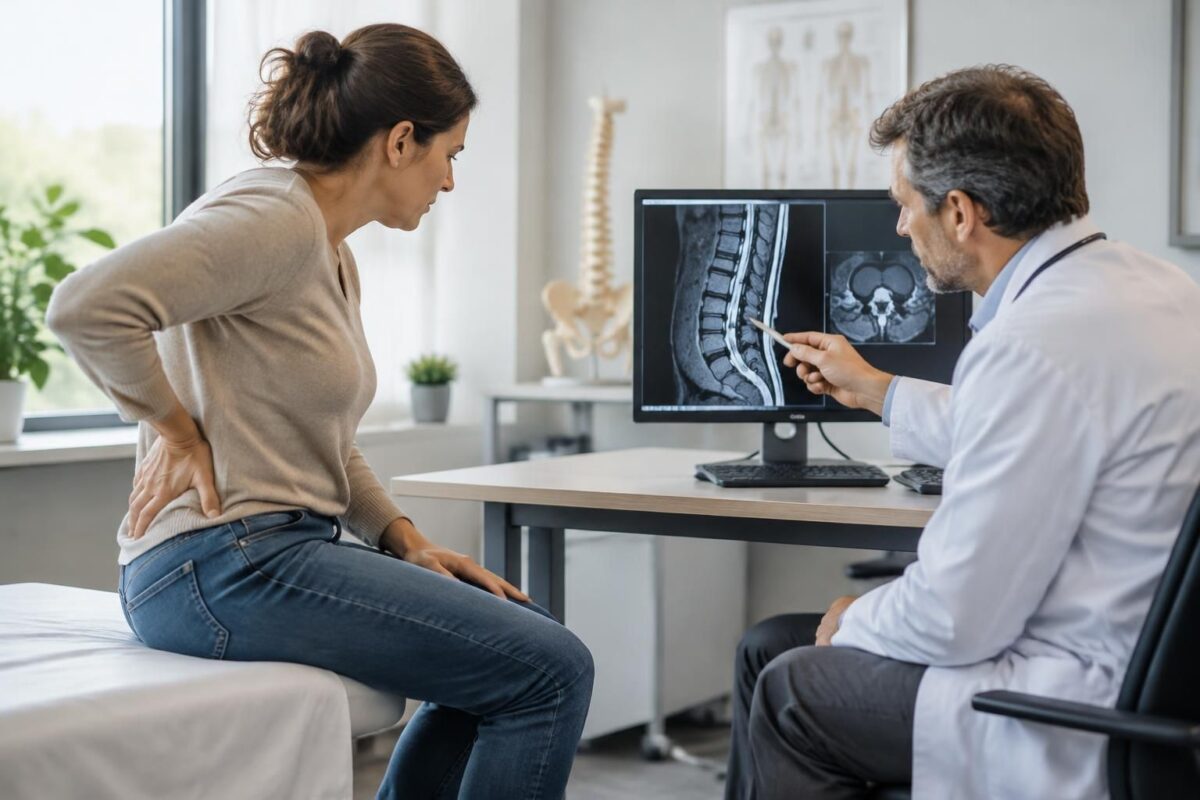
Disc bulge and sciatica: possible cause or simple discovery?
IN SHORT A disc bulge is a diffuse protrusion of a disc, sometimes associated with sciatica, but often discovered incidentally on imaging. To determine if it explains symptoms, one must compare the image to their path, the neurological examination, and…
How Does the Evaluation Proceed?
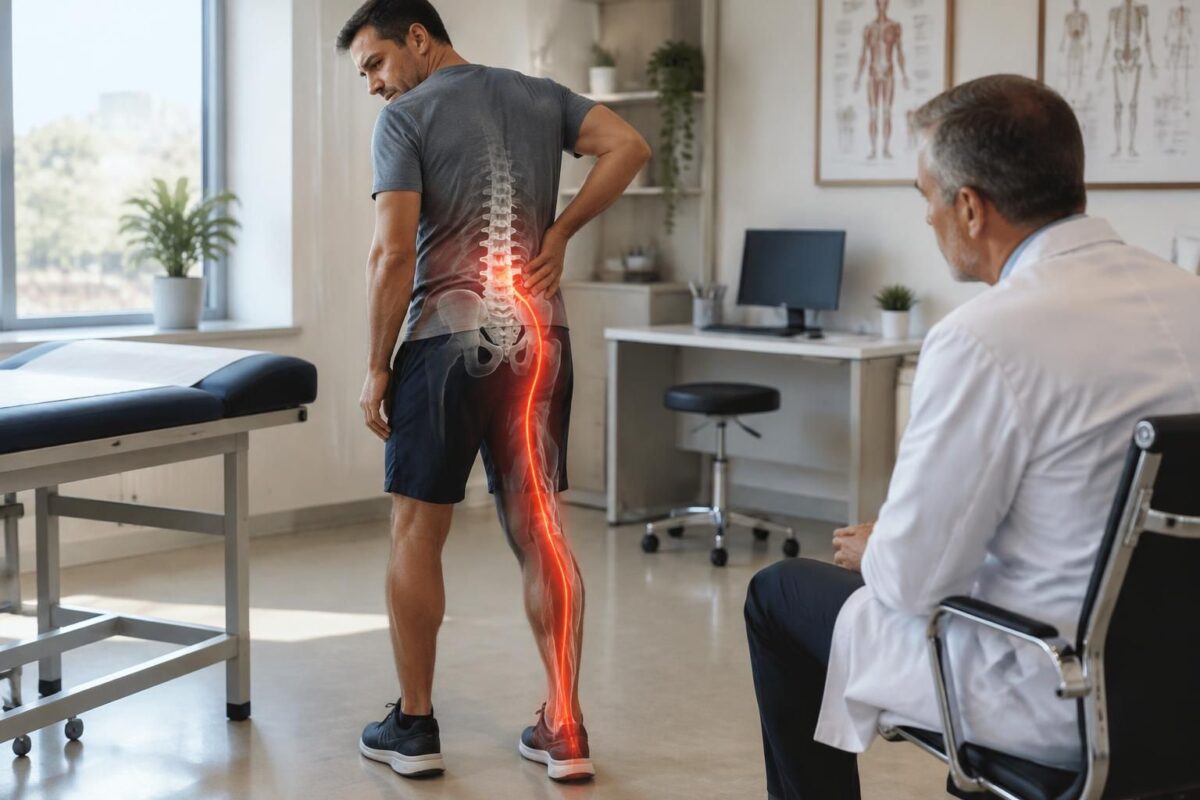
The evaluation begins with your symptoms and their evolution. The professional inquires about movements or positions that worsen or alleviate the pain, its trajectory, and its effects on sleep, walking, driving, and work.
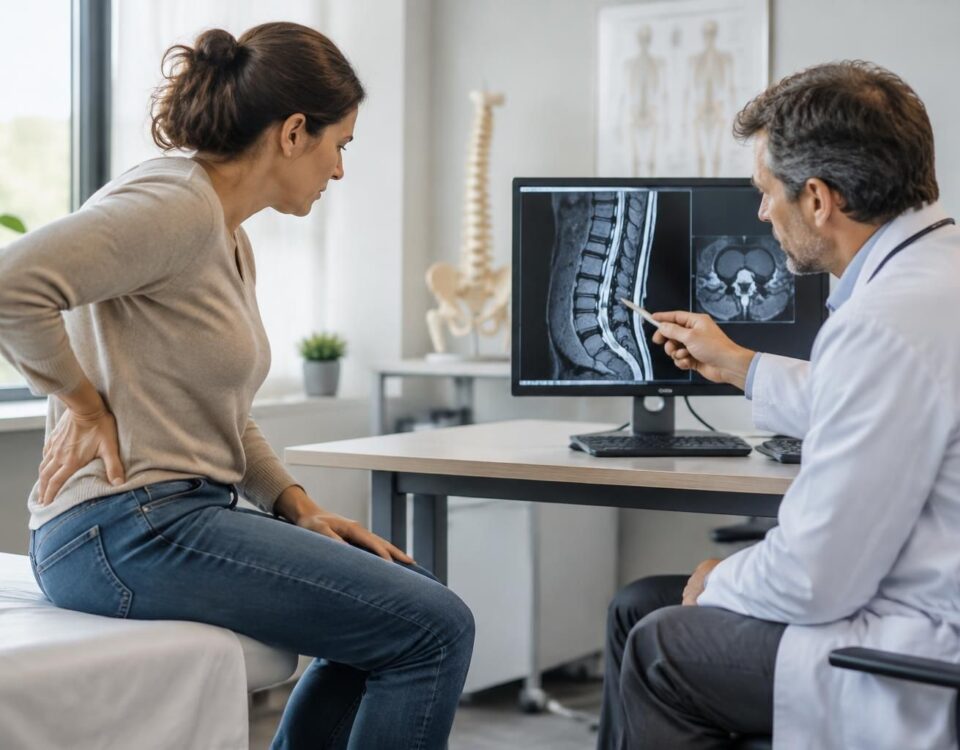
The examination may focus on mobility, sensitivity, and strength. It may also check if certain movements reproduce the symptoms. Imaging, such as an MRI, is not necessary in all cases. The professional may consider it when symptoms are significant, persist despite care, or are accompanied by concerning neurological signs.
A report from imaging should be interpreted with the symptoms and the examination. The presence of a bulge does not alone determine the appropriate treatment. For further information on protrusions and nerve symptoms, see the page dedicated to disc protrusion and nerve irritation.

Lumbar Disc Protrusion and the Choice of a Non-Surgical Approach
IN SHORT A disc protrusion is a bulging of a disc between the vertebrae; it often does not cause any symptoms. If it is accompanied by pain, a non-surgical approach may include appropriate activity, prescribed medications, and progressive rehabilitation. It…
What Options May Be Considered?
Care depends on the likely cause, the intensity of symptoms, and their effect on your activities. A professional may recommend a medical evaluation, symptom management measures, or a manual approach tailored to your situation. A doctor may also discuss medication options with you, if appropriate.
At TAGMED Clinic, the evaluation can help determine if a non-surgical approach is suitable. Depending on the case, options may include specific osteopathy, precision percussion, or motorized neurovertebral decompression. These approaches are not suitable for everyone and do not guarantee results. Their relevance must be assessed according to symptoms, history, and observed signs.
For information about services, consult TAGMED Clinic, or the pages on the treatment of sciatica in Montreal and Mont-Royal and the treatment of sciatica in Terrebonne.
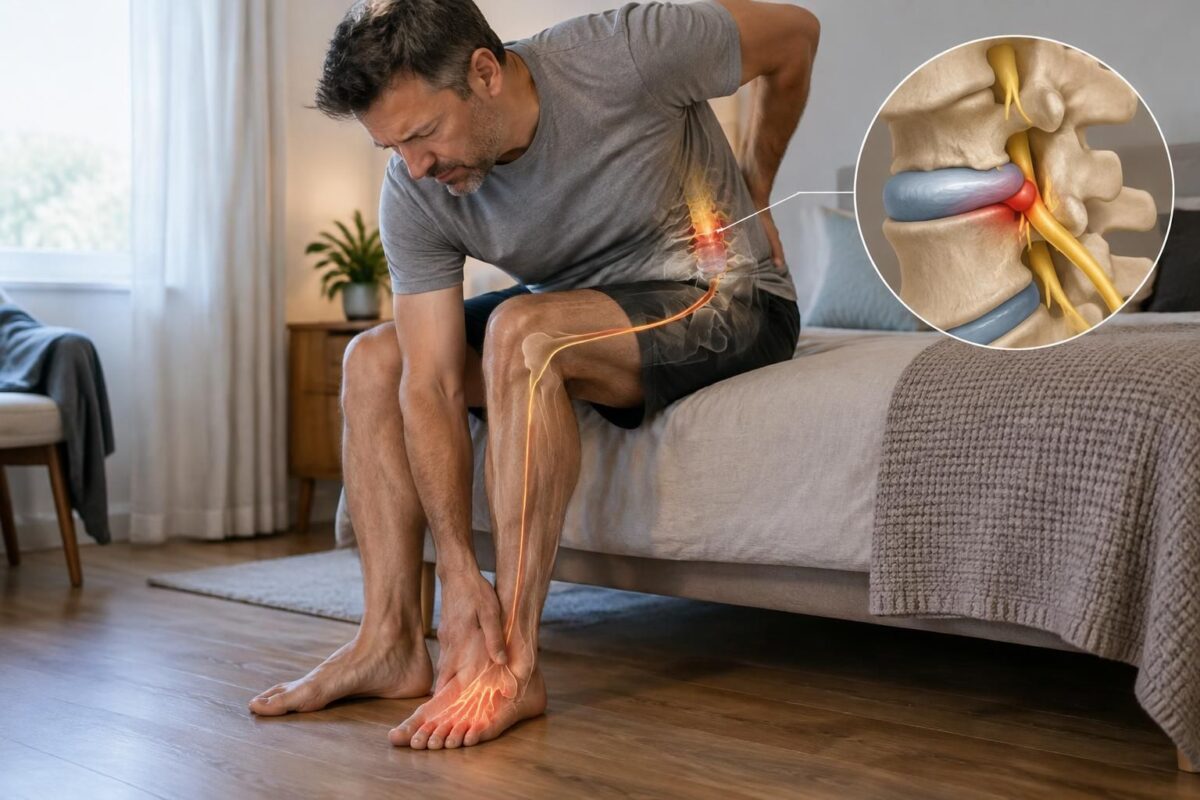
Disc herniation and pain on the top of the foot
IN BRIEF A disc protrusion is an intervertebral disc that bulges without necessarily rupturing. Pain on the top of the foot may sometimes be related to irritation of a lumbar nerve, but it does not alone confirm disc involvement. An…
When to consult quickly?
Consult a professional promptly if you notice new or progressive weakness in a leg or arm, significant loss of sensation, or marked worsening of pain. These signs require appropriate evaluation.
Go to the emergency room in case of loss of bladder or bowel control, numbness in the saddle region, significant or progressive weakness, fever with pain, recent trauma, or rapid worsening.
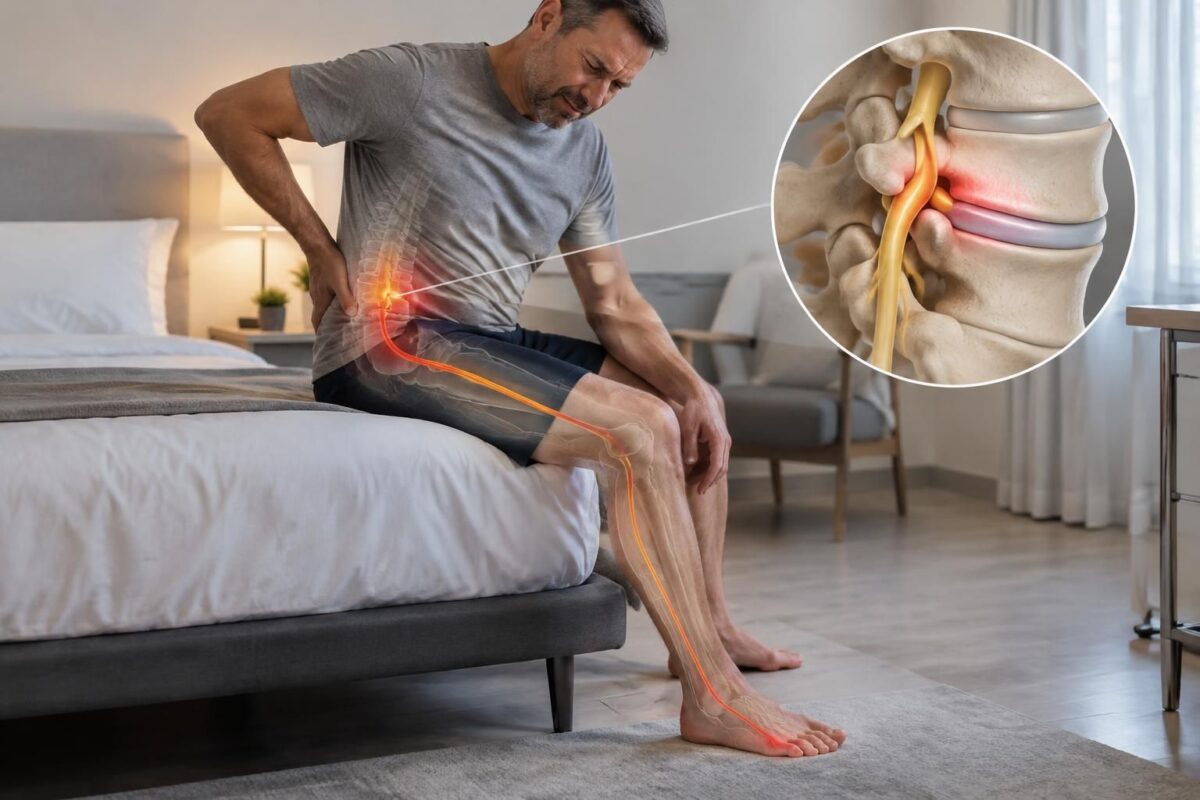
Disc protrusion and pain on the outer edge of the foot
IN BRIEF A disc bulge is a bulging of the disc that can sometimes irritate a nerve root and cause pain down to the outer edge of the foot. However, this pain is not always related to the disc: a…
About the author
Sylvain Desforges, B.Sc., D.O., N.D., Doctor of Osteopathy and naturopath, is the founding president of TAGMED and the ACMA association. His practice focuses on chronic spinal pain, lower back pain, and pain compatible with sciatica, especially when extending to the hip, leg, calf, foot, or toes.
Through SOS Sciatique, he publishes educational content on sciatica symptoms, possible causes such as disc herniation, disc compression, foraminal stenosis, or irritation of a lumbar nerve root, as well as non-surgical approaches that may be considered after an evaluation. At TAGMED Clinic, care may include, depending on the case, motorized neurovertebral decompression, specific osteopathy, or precision percussion.
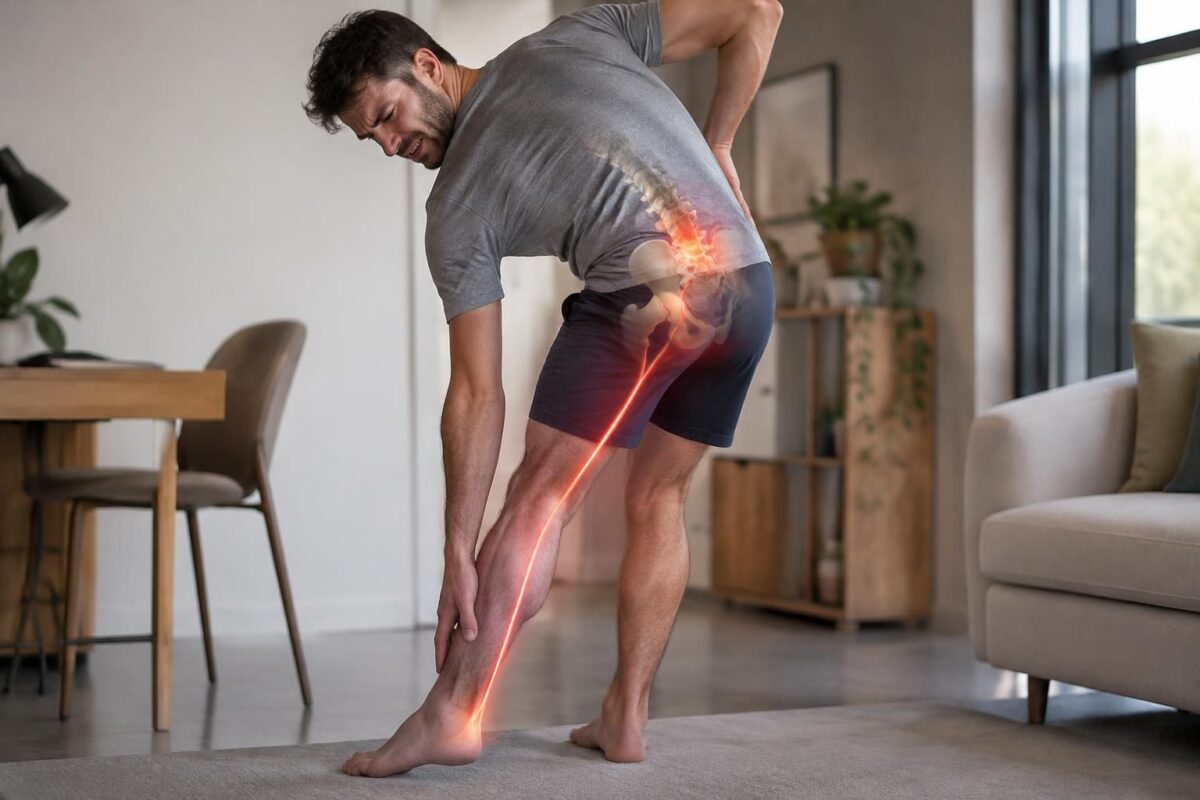
IN BRIEF A disc herniation is a bulging of a disc in the spine, often without symptoms. If it irritates a lumbar nerve root, the pain may radiate down the leg to the foot and sometimes be felt in the…
Medical Disclaimer
Medical disclaimer: The information and advice provided on this site do not replace the opinion, diagnosis, or treatment of a healthcare professional. Please note that Sylvain Desforges, B.Sc., D.O., N.D., doctor of osteopathy, is neither a doctor of medicine nor a physician and is not a specialist in a medical specialty defined by the Collège des médecins du Québec. Manual medicine, functional medicine, and sports medicine as described on this site exclude any treatment or diagnosis made by a physician or medical specialist. Always consult your doctor for any medical questions. For more details, please read our full legal notice.
The information published on SOS Sciatique is provided for educational purposes. It does not replace a consultation, diagnosis, advice, or treatment carried out by a physician or another licensed healthcare professional. The author of this article is neither a physician nor a specialist in a medical specialty recognized by the Collège des médecins du Québec. The approaches of osteopathy, manual medicine, or functional support described on this site do not constitute medical acts and are not intended to replace medical follow-up.
Disc bulge: the disc
- The disc slightly protrudes from its contour.
- It may be asymptomatic.
- It may sometimes contribute to nerve irritation.
Foraminal irritation: the nerve
- The foramen is the opening through which a nerve root passes.
- Narrowing or inflammation may irritate the nerve.
- Pain, tingling, or numbness may radiate into a limb.

A disc bulge can reduce the space around a nerve root and contribute to foraminal irritation, but imaging alone cannot explain the symptoms. An evaluation allows linking findings to pain and functional limitations, then establishing a gradual plan: calm irritation, maintain tolerated movement, and gradually resume activities.

Intervertebral disc protrusion and pain in the big toe
IN BRIEF A disc protrusion is a bulging of the disc that can irritate a lumbar nerve root, particularly L5, and cause pain, tingling, or numbness down to the big toe. This symptom alone does not confirm a disc origin:…
Understanding the link between disc and foramen
The intervertebral disc is located between two vertebrae. Its bulge refers to a protrusion from its contour, not necessarily corresponding to a herniation. The foramen is the opening through which a nerve root exits the spine. If this space is reduced or if neighboring tissues are irritated, symptoms may appear along the nerve pathway.
In the lower back, this may manifest as lower back pain radiating to the hip or leg, sometimes accompanied by tingling, numbness, or a feeling of weakness. In the neck, discomfort may extend to the shoulder, arm, or hand. However, a bulge visible on imaging may be present without pain: symptoms, clinical examination, and activities that trigger them must be considered together.
Recommendations for the first few days
Stay active without overdoing it
Avoid prolonged complete rest. If a position, such as sitting, significantly increases pain or radiating symptoms, temporarily reduce its duration and change posture regularly. Short walks or gentle movements can help maintain your mobility, as long as they do not cause persistent worsening. Avoid forced stretches and exercises that exacerbate symptoms in the arm or leg.
Adapting movements that strain the back
During a painful period, break tasks into smaller parts and avoid repeated combinations of bending, twisting, and heavy lifting. To pick up an object, get close to the load, bend at the hips and knees as much as possible, then stand up without sudden movements. These adjustments are temporary: the goal is to gradually resume activities, not to protect the back indefinitely.
Assessing the situation and progressing
A healthcare professional can examine mobility, strength, sensitivity, and positions that reproduce or decrease your symptoms. Imaging is not necessary in all cases; it may be considered depending on the progression, the severity of signs, or the results of the evaluation. Also consult a doctor if the pain persists, worsens, or severely limits walking, sleeping, or working.
Depending on the clinical picture, management may include individualized exercises, gradual strengthening of the trunk and hips, postural advice, and appropriate manual techniques. A neurovertebral decompression approach can be discussed after evaluation, but it is not suitable for everyone and does not guarantee a result. Progress is also measured by concrete gains: walking longer, sleeping better, or resuming certain tasks with less apprehension.
Recognizing signs of urgency
Consult quickly in case of significant or progressive weakness of the arm, leg, or foot. Loss of bladder or bowel control, numbness in the saddle region, or rapid worsening requires urgent evaluation. These symptoms should not be attributed to a simple bulge without medical advice.
Warning: this information is educational and does not replace consultation, diagnosis, or treatment by a licensed healthcare professional.
| Disc bulge | Foraminal irritation |
|---|---|
| What happens | The disc slightly exceeds its boundaries. |
| Affected area | The foramen, the passage where a nerve root exits. |
| Possible pain | Back pain, sometimes radiating to a leg. |
| Nerve signs | Possible if a nerve root is irritated. |
| Possible causes | The bulge may contribute to the narrowing of the foramen. |
| Important point | An imaging result is not sufficient to establish the cause of the symptoms. |
| Evaluation | It takes into account symptoms, mobility, and nerve function. |
Testimonials on disc bulge and foraminal irritation
Note: the stories below are fictitious examples created for informational purposes. They do not correspond to real patients and do not predict the progression of an individual. Symptoms and responses to treatment vary according to each situation.
“I was stuck after sitting”
After several weeks of lower back pain, I felt marked stiffness when getting up from my chair. Sometimes, pain radiated into my buttock. My evaluation helped me better understand the movements that aggravated my symptoms and adapt my activities. I began a gradual progression of exercises rather than alternating between complete rest and too rapid a return.
“The tingling in my leg worried me”
The lower back pain was accompanied by tingling in the leg, especially after prolonged sitting. I was told that a disc bulge or a foraminal irritation could sometimes contribute to nerve symptoms, but an imaging result should be interpreted with the symptoms and clinical examination. This approach helped me monitor the progression of my strength, sensitivity, and ability to walk.
“I wanted to drive again without apprehension”
Long trips triggered pain in my lower back and buttock. I adjusted my position, added breaks, and gradually resumed walking and recommended exercises. Progress was mainly noticeable in my daily activities: I could sit a little longer and get up more easily, without this meaning that the symptoms had disappeared overnight.
“I was afraid that every movement would worsen my disc”
After reading my imaging report, I was afraid to bend or lift an object. A clear explanation helped me understand that a finding like a bulge alone is not enough to determine the cause of the pain. With an adapted plan and a gradual return to movements, I regained more confidence in my actions.
“The pain radiated down to my calf”
In addition to lower back pain, I felt a burning sensation radiating into my leg. The evaluation focused on my symptoms, mobility, and strength to check for possible associated nerve irritation. The plan was adjusted according to my tolerance, with realistic functional goals rather than the promise of an immediate result.
A significant or progressive weakness, marked loss of sensitivity, difficulties controlling the bladder or bowels, or numbness in the saddle region justify prompt or urgent medical evaluation.
Disc bulge and foraminal irritation: understanding the link to pain
A disc bulge corresponds to a bulging of the intervertebral disc beyond its usual contour. Located between two vertebrae, the disc helps distribute loads and absorb movements. It consists of a softer center, called the nucleus, surrounded by a fibrous envelope. Over time, repeated stress or certain movements can change its shape. However, this finding does not automatically mean that a person will experience pain: imaging should be interpreted based on symptoms and clinical examination.
The term foraminal irritation describes a possible irritation of the nerve structures in a foramen, that is, the opening between the vertebrae through which a nerve root exits the spine. If a bulge, joint changes, or other factors reduce the available space, the root may become sensitive. The relationship between the disc and the foramen depends on the affected area, the extent of narrowing, and the reaction of surrounding tissues. Thus, a bulging image alone does not determine the exact cause of pain.
In the lumbar region, symptoms may include lower back pain, stiffness, or discomfort during certain movements, particularly when bending or sitting for long periods. If a nerve root is irritated, the pain may also radiate down into the buttock and leg. Tingling, numbness, or a feeling of weakness may accompany this radiation. In the cervical region, irritation may manifest as neck pain extending to the shoulder, arm, or hand. Symptoms vary from person to person.
A sudden bend, a twist under load, or the repetition of movements straining the back can contribute to the onset or exacerbation of symptoms. Prolonged sitting, lack of recovery, and a too-rapid return to demanding activities may also perpetuate discomfort in some people. However, there is no single cause that applies to everyone. The evaluation aims to understand the movements that aggravate or relieve the symptoms, their progression, and activities that have become difficult.
A health professional can examine mobility, strength, sensitivity, and, if necessary, certain reflexes. Imaging is not required in all cases; it may be considered depending on the duration and intensity of symptoms, neurological signs, or the response to care. Treatment is tailored to the results of the evaluation and the individual’s goals. It may include advice to temporarily adjust certain activities, progressive exercises, strengthening, mobility work, and manual approaches. Motorized neurovertebral decompression may also be discussed in certain situations, following assessment, although it may not be suitable for all profiles.
Progression is also measured by regained abilities: walking longer, better tolerating sitting, sleeping more comfortably, or gradually returning to work and leisure activities. An individualized strategy seeks to reduce limitations while developing confidence in movement. If pain is accompanied by significant or progressive weakness, loss of urinary or bowel control, or numbness in the saddle region, urgent consultation is necessary. Rapid deterioration, fever, or recent trauma also warrant medical evaluation.
About the author: Sylvain Desforges, B.Sc., D.O., N.D., Doctor of Osteopathy and Naturopath, is the founding president of TAGMED and the ACMA association. His practice particularly focuses on chronic spinal pain and pain associated with nerve irritation. The care provided may include, depending on the assessment, specific osteopathy, motorized neurovertebral decompression, or precision impactor. The information in this text is educational and does not replace a consultation, diagnosis, or treatment by a licensed healthcare professional. The author is neither a physician nor a specialist in a recognized medical specialty.
A disc bulge can sometimes contribute to a foraminal irritation when the disc reduces the space where a nerve root passes. However, imaging alone is not sufficient to explain the symptoms: their distribution, progression, and clinical assessment results are essential to understand the situation and choose an appropriate management approach.
Disc Bulge and Foraminal Irritation: Understanding the Symptoms
The intervertebral disc acts as a cushion between vertebrae. When it slightly protrudes, it can alter the available space around neighboring structures. If a nerve root is irritated in the foramen, pain may radiate from the lower back to the buttock or leg, often with tingling, numbness, or weakness. To distinguish potential mechanisms, consult explanations on disc-root conflict and disc protrusion with L5 irritation.
A bulge does not necessarily cause pain, and the intensity of symptoms does not always correspond to the severity of the abnormality described in the MRI. Results should be interpreted considering the examination, movements that aggravate or relieve pain, and daily capabilities. To better understand these nuances, read resources on disc bulges, stenosis, and symptoms in the leg, discopathy, protrusion, and herniation in MRI, as well as the MRI report of the back.
The term “bulge” does not automatically mean “hernia.” These terms describe different aspects of the disc but do not, on their own, determine the exact cause of pain. The distinction is explained in this article about the difference between disc herniation and disc bulge. Mechanisms may also combine, particularly when a disc protrusion is accompanied by disc pinch. To delve into symptoms and management options, also consult the file on disc bulge, its symptoms, and its treatment.
When symptoms radiate to the foot, their location can guide the evaluation but is not sufficient to establish a diagnosis. Additional information is available on disc protrusion associated with foot numbness and what MRI may show in the presence of disc herniation and sciatica.
Management is defined according to the symptoms and evaluation: temporary adaptation of activities, gradual resumption of movement, and progressive exercises may be considered with a healthcare professional. Quick medical assessment is necessary in cases of significant or progressive weakness, loss of urinary or bowel control, or anesthesia in the saddle region.

Sylvain Desforges, B.Sc., D.O., N.D., docteur en ostéopathie
Dr Sylvain Desforges, B.Sc., D.O., N.D., osteopath, is the founding president of TAGMED and of the ACMA association. He dedicates his practice to chronic spinal pain, low back pain and symptoms compatible with sciatica, particularly when pain radiates toward the buttock, leg, calf, foot or toes.
Through SOS Sciatique, he publishes educational content on sciatica symptoms, possible causes such as disc herniation, disc narrowing, foraminal stenosis or irritation of a lumbar nerve root, as well as non-surgical approaches that may be considered according to the evaluation. At Clinique TAGMED, care may include, depending on the case, motorized neurovertebral decompression, specific osteopathic care or precision percussion.
For an evaluation related to sciatica treatment in Montreal / Mount Royal or sciatica treatment in Terrebonne, please consult the services available at Clinique TAGMED.
Medical disclaimer
The information published on SOS Sciatique is provided for educational purposes only and does not replace a consultation, diagnosis, opinion or treatment provided by a physician or another authorized healthcare professional. The author of this article is neither a medical doctor nor a specialist in a medical specialty recognized by the Collège des médecins du Québec. The osteopathic, manual medicine or functional support approaches described on this site do not constitute medical acts and are not intended to replace medical follow-up.
Consult a physician or emergency service in cases of loss of bladder or bowel control, anesthesia in the saddle area, significant or progressive weakness in the leg or foot, fever, recent trauma, severe pain or rapid worsening of symptoms. For more details, please read our Legal Notice.