Sciatica in Terrebonne: disc protrusion and pain under the knee
24/11/2026
Disc herniation and sciatica: understanding the loss of disc height
24/11/2026
IN BRIEF
| Cauda Equina Syndrome refers to pain radiating down the leg accompanied by a loss of sensation around the genitals, anus, or inner thighs. This symptom may indicate severe nerve compression: it is not discomfort to treat at home. Go to the emergency room immediately, especially if you have difficulty urinating, incontinence, or weakness in the leg. |
Cauda Equina syndrome — between the legs, around the genitals or anus — may signal severe nerve compression. Go to the emergency room immediately, even if you have no other symptoms, especially if you have difficulty urinating, loss of bladder or bowel control, or weakness in a leg. Don’t wait for a routine appointment.
This information is educational and does not replace a medical evaluation.
Back pain associated with Cauda Equina syndrome can indicate significant nerve compression in the lower back. This situation requires urgent medical evaluation, especially if you also experience difficulty urinating, loss of bowel control, or progressive weakness in a leg. Do not wait for a clinic appointment to have these symptoms checked.
Sciatica refers to pain following the path of a nerve in the buttock and leg. It may be accompanied by tingling, numbness, or weakness. The Cauda Equina syndrome affects the area that would be in contact with a saddle: the inner thighs, genitals, perineum, or the area around the anus.
Numbness in this area is different from isolated numbness in the foot or leg. It may indicate damage to the nerves that control sensation and certain urinary and intestinal functions. Therefore, it should be taken seriously, even if the pain seems moderate.
When should you go to the emergency room?
Go to the emergency room immediately if you have new numbness in the saddle area with back or leg pain. Call emergency services if you cannot move safely. Do not wait to see if the symptom goes away and do not drive if your condition prevents you from doing so safely.
Seek immediate medical help if you also notice:
- new difficulty starting or controlling urination;
- loss of bladder or bowel control;
- loss of sensation around the genitals or anus;
- significant or progressive weakness in a leg or foot;
- symptoms affecting both legs or rapidly worsening.
These signs may correspond to severe nerve compression in the lower back, sometimes called cauda equina syndrome. Only a healthcare professional can assess the situation and determine the necessary examinations and care. Quick intervention is important.
What could be the causes?
A herniated disc, disc protrusion, or narrowing around the nerves may irritate or compress a nerve root. The presence of leg pain alone does not determine the cause or severity. A medical examination is necessary when warning signs appear.
Pain that increases while driving can have several explanations. However, if accompanied by saddle area numbness or urinary or intestinal changes, urgent evaluation remains a priority. For more information on pain while driving, read this article on disc protrusion and pain that increases while driving.
Buttock pain radiating down the thigh may also be consistent with nerve irritation, without alone confirming sciatica. You can read more about deep buttock pain and radiation into the thigh.
A foraminal herniated disc may reduce the space around a nerve root. This article explains this situation: foraminal disc herniation and sciatica. This information does not replace a medical examination, especially in the presence of saddle area numbness.
Numbness in the foot and leg weakness
Numbness limited to the foot does not mean the same thing as loss of sensation in the saddle area. However, new numbness, weakness, or a leg giving way warrants evaluation. If weakness progresses or is accompanied by saddle area numbness, consult the emergency room immediately.
To better recognize the signs to watch for in the foot, check the page on foot numbness and sciatica in Terrebonne. For a leg giving way, also read the information on sciatica and the leg giving way.
What to do after the urgent evaluation?
The professional evaluating you will decide if examinations are necessary and what follow-up is appropriate for your situation. If a medical emergency is ruled out, a healthcare professional can then discuss appropriate options based on your condition. The choice of care depends on the evaluation, symptoms, and their evolution.
TAGMED Clinic offers services in Montreal and Terrebonne. Depending on the evaluation and the needs, care may include specific osteopathy or motorized neurovertebral decompression. These services do not replace urgent medical evaluation and should not delay a visit to the emergency room when saddle numbness is present. For services, visit TAGMED Clinic.
About the author
Sylvain Desforges, B.Sc., D.O., N.D., Doctor of Osteopathy and Naturopath, is the founding president of TAGMED and the ACMA association. He dedicates his practice to chronic pain of the spine, lower back pain, and pain associated with sciatica, especially when the pain radiates to the buttock, leg, calf, foot, or toes.
Through SOS Sciatica, he publishes educational content on the symptoms of sciatica, possible causes such as disc herniation, disc pinching, foraminal stenosis, or irritation of a lumbar nerve root, as well as non-surgical approaches that may be considered based on the assessment. At TAGMED Clinic, care may include, as applicable, motorized neurovertebral decompression, specific osteopathy, or a precision impactor.
For an evaluation related to sciatica treatment in Montreal / Mont-Royal or sciatica treatment in Terrebonne, check the services available at TAGMED Clinic. In case of emergency signs, go to the emergency department first.

Sciatica and pain with progressive weakness
IN BRIEF Sciatica causes pain that radiates from the lower back down the leg; however, progressive muscle weakness is not a symptom to be taken lightly. It requires quick medical evaluation to search for the cause and determine the appropriate…

Sciatica and pain with general discomfort
IN BRIEF A sciatica causes pain that starts in the lower back or buttock and radiates down the leg. A general discomfort, especially if accompanied by fever or rapid worsening, should not be automatically attributed to sciatica: consult a healthcare…
Medical Warning
The information published on SOS Sciatica is provided for educational purposes and does not replace a consultation, diagnosis, advice, or treatment performed by a doctor or another licensed healthcare professional. The author of this article is neither a doctor nor a specialist in a medical specialty recognized by the Collège des médecins du Québec. The osteopathy, manual medicine, or functional support approaches described on this site do not constitute medical acts and are not intended to replace medical follow-up.
Consult a doctor or emergency service in case of loss of bladder or bowel control, numbness in the saddle area, significant or progressive weakness in a leg or foot, fever, recent trauma, severe pain, or rapid worsening. For more details, please read our Legal Notice.
Medical disclaimer: The information and advice provided on this site do not replace the advice, diagnosis, or treatment of a healthcare professional. Please note that Sylvain Desforges, B.Sc., D.O., N.D., Doctor of osteopathy, is neither a medical doctor nor a physician, and is not a specialist in a medical specialty as defined by the Collège des médecins du Québec. Manual medicine, functional medicine, and sports medicine as described on this site exclude any treatment or medical diagnosis performed by a doctor or medical specialist. Always consult your physician for any medical questions. For more details, please read our full Legal Notice.
What Numbness Might Indicate
- A loss of sensitivity around the genitals, anus, or between the thighs corresponds to saddle numbness.
- With sciatica, this symptom may indicate significant nerve compression.
- One should not wait to see if it goes away.
What to Do Without Delay
- Go to the emergency department immediately or call emergency services.
- Report any difficulty urinating, loss of bladder or bowel control, or progressive weakness in a leg.
- A quick assessment is essential to determine the cause and necessary care.

Sciatica accompanied by numbness in the saddle region — around the genitals, perineum, or anus — may signal severe nerve compression. Immediate emergency evaluation is necessary, even if the pain seems tolerable or if the numbness is recent and limited. Do not wait for a routine appointment and do not attempt to treat this symptom solely at home.

Sciatica and pain with a history of cancer: caution
IN BRIEF Sciatica causes pain that can radiate from the lower back down to the leg. With a history of cancer, new, persistent, or worsening pain should be quickly evaluated by a healthcare professional: its cause must be identified before…
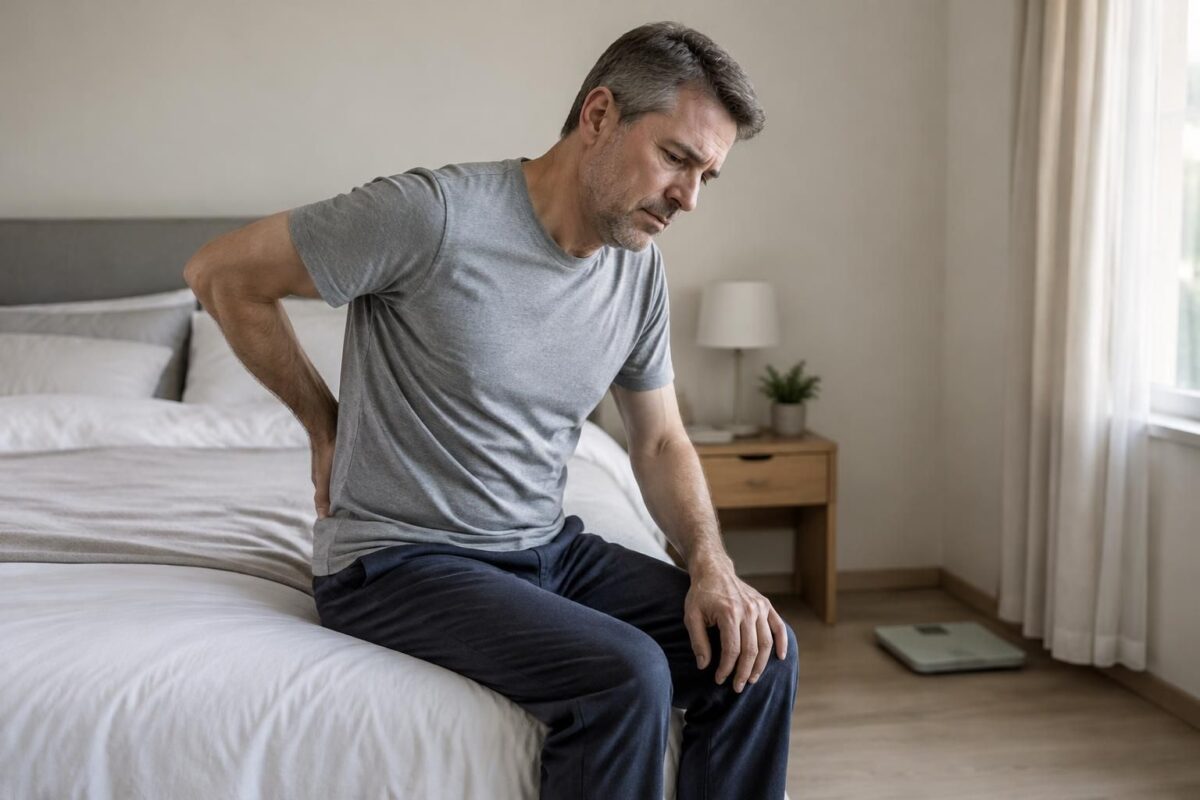
Sciatica and pain with unexplained weight loss
IN BRIEF Sciatica causes pain that can radiate from the lower back to the buttock and leg. Associated with unexplained weight loss, it requires medical evaluation to investigate the cause: this sign alone does not confirm a precise diagnosis. Consult…
Why This Numbness is Concerning
Sciatica usually refers to pain that originates from the lower back or buttock and radiates down a leg. It can be accompanied by tingling, numbness, or weakness. However, a loss of sensation in the saddle area is a particular warning sign. It may be linked to damage to the nerves involved in sensation and control of the bladder and bowel. A possible cause is cauda equina syndrome, which requires urgent medical evaluation. Only a healthcare professional can determine what is causing the symptoms.

Sciatica and pain with fever: why consult?
IN BRIEF Sciatica with pain and fever deserves a medical evaluation: fever is not usual in simple sciatica and may signal an infection or another problem requiring care. Consult promptly, especially if the pain is intense or worsening. In cases…

Sciatica and pain after trauma: warning sign
IN BRIEF A sciatica after trauma is pain that starts from the lower back or buttock and can radiate down the leg after a fall or impact. An assessment helps to investigate the cause and determine the appropriate course of…
What to Do Without Delay
Go to Emergency Services
If you experience new or unusual numbness in this area, go to the emergency department immediately. If you cannot move safely, call the emergency services in your area. Do not drive yourself if your leg is weak, if pain interferes with your movements, or if you feel unwell. Inform the staff that you have sciatica-like pain and saddle numbness, and indicate when the symptoms started.
Report Any Associated Changes
Immediately mention any difficulty starting to urinate, loss of bladder or bowel control, decreased sensation when wiping, significant or progressive weakness in a leg, or symptoms affecting both legs. Do not wait for all these signs to appear: saddle numbness alone justifies urgent evaluation.
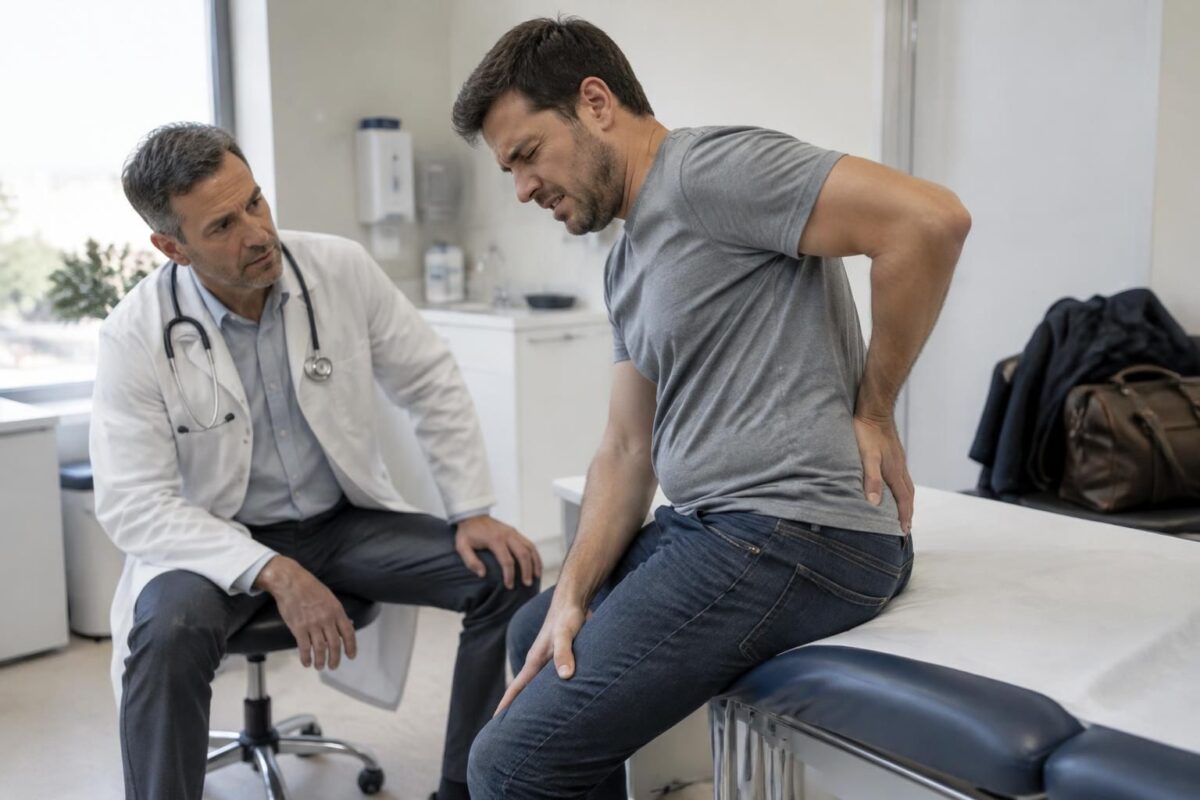
Sciatica and pain that appeared after an accident
IN BRIEF Sciatica after an accident is pain related to irritation or compression of the sciatic nerve, sometimes triggered or revealed by a fall or impact. It can start from the lower back or buttock and radiate down the leg.…
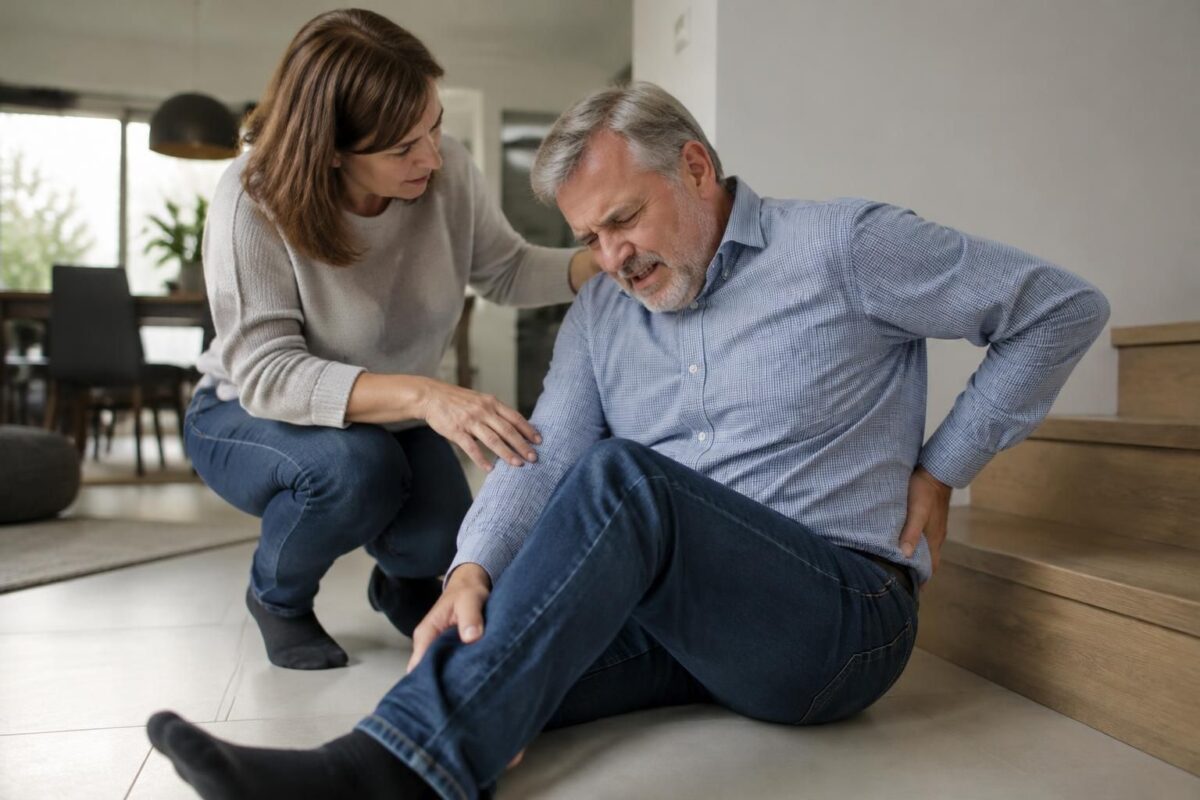
Sciatica and pain appeared after a fall
IN BRIEF A sciatic pain after a fall may stem from nerve irritation or an injury to the hip, buttock, or lower back. It can radiate down the leg and be accompanied by tingling or numbness. Rest, avoid movements that…
What to Avoid
Do not delay consultation to try stretching, exercising, prolonged rest, medication, or manual treatment. Avoid back manipulations and decompression techniques before being evaluated. These approaches do not rule out a neurological emergency and should not replace medical examination. If you have already taken medication, note its name and the time of ingestion to provide the information to the healthcare team.
After the urgent assessment, follow the recommendations of the medical team and ask which activities are appropriate. If additional support is considered later, it must take the diagnosis into account and not replace medical follow-up.
Medical Warning
This information is educational and does not replace a consultation, diagnosis, or treatment by a licensed healthcare professional. Osteopathy and manual approaches are not medical acts. In the presence of a saddle numbness, loss of urinary or bowel control, or significant or progressive weakness, consult an emergency service immediately.
| Sciatica | Saddle Numbness |
|---|---|
| Pain that may radiate into the buttock and leg | Loss of sensitivity around the genitals, anus, or inner thighs |
| May be accompanied by tingling or numbness in the leg | Warning sign requiring urgent medical evaluation |
| Pain alone does not establish the cause | With sciatica, may indicate severe nerve compression |
| Monitor for the onset of weakness or worsening | In case of urinary or bowel disorders, significant weakness or saddle numbness, go to the emergency room immediately |
Fictional Testimonials: Sciatica and Saddle Numbness
Important: the testimonials below are fictional examples and not accounts from real patients. A saddle numbness — around the genitals, anus, or inner thighs — associated with sciatica can signal a medical emergency. An evaluation in the emergency room should be obtained without delay.
“The pain started in my lower back and radiated down my leg. When I noticed a loss of sensation around my groin, I realized it was not a symptom to monitor at home. I went to the emergency room immediately.”
“I had shooting pains in my leg and a strange sensation in the saddle region. I also had difficulty urinating. I sought emergency medical help instead of waiting for an appointment.”
“My numbness was accompanied by a worsening weakness in my leg. I called emergency services to be evaluated quickly.”
In the presence of a saddle numbness, difficulty urinating, loss of bladder or bowel control, or significant or progressive weakness in a leg, contact emergency services or go to the emergency room now. These symptoms require urgent medical evaluation; do not delay care to try home treatment.
Sylvain Desforges: Supporting People Affected by Sciatica and Saddle Numbness
Sylvain Desforges, B.Sc., D.O., N.D., Doctor of Osteopathy and naturopath, is the founding president of the TAGMED clinics and the ACMA association. For many years, he has dedicated his practice to managing chronic pain and evolving care approaches. His experience leads him to focus particularly on spinal pain, lower back pain, and symptoms that may indicate sciatica.
Sciatica generally refers to pain that follows the path of the sciatic nerve. It can start from the lower back or buttock and then radiate down the thigh, calf, foot, or toes. Burning sensations, electric shocks, tingling, or numbness may also be present. A herniated disc, irritation of a nerve root, or narrowing of certain spaces in the spine are among the possible causes. Only a proper evaluation can help determine the source of the symptoms.
In his educational content, Sylvain Desforges explains the signs associated with sciatica and the importance of distinguishing between typical pain and a symptom that requires prompt attention. The saddle numbness — the area around the genitals, perineum, and inner thighs — is a warning sign. When it appears with lower back pain or pain radiating into the leg, it may indicate serious nerve damage. This situation should not be treated as ordinary sciatica nor addressed solely through manual care.
A loss of sensitivity in this area, difficulty urinating, loss of urinary or bowel control, or significant or progressive weakness in a leg or foot warrants a urgent medical evaluation. Emergency services should be contacted without delay, especially if multiple symptoms occur together. Rapid intervention can be crucial when significant nerve compression is suspected. Educational information alone does not allow for a remote diagnosis.
At the TAGMED clinic, support options are considered based on the evaluation and situation of each individual. These may include specific osteopathy, motorized neurovertebral decompression, or the use of a precision instrument. The technologies mentioned in Sylvain Desforges’ practice also include laser and shockwave therapy, depending on the available services and clinical relevance. These approaches may not necessarily be suitable for all patients and do not replace a medical diagnosis or follow-up with a licensed professional.
Sylvain Desforges’ approach emphasizes information, needs assessment, and the integration of evidence-based approaches. His goal is to help individuals better understand their symptoms and non-surgical support options when appropriate. In the presence of saddle numbness or other serious neurological signs, the priority remains quick access to medical evaluation.
Medical Warning: this information is provided for educational purposes and does not replace a consultation, diagnosis, opinion, or treatment by a physician or other licensed healthcare professional. Sylvain Desforges is neither a physician nor a specialist in a medical specialty recognized by the Collège des médecins du Québec. Osteopathy, manual medicine, or functional support practices do not constitute medical acts and do not replace medical follow-up.
Pain radiating into the buttock or leg may be consistent with sciatica, but a saddle numbness — around the genitals, perineum, or anus — is a particular warning sign. It requires an urgent medical evaluation, especially if it occurs with difficulty urinating, loss of control of urine or stools, or new weakness in one or both legs.
Perineal Numbness: When to Act Without Delay
A diminished sensation in the area where the body touches a saddle can signal significant nerve impairment in the lower back. It is impossible to determine the cause remotely: nerve irritation related to a lumbar disc herniation is one possibility, but only a healthcare professional can assess the situation and decide on necessary examinations.
Go immediately to the emergency room or contact emergency services if this numbness is new or worsening, especially if accompanied by urinary retention, incontinence, a difficulty in feeling the passage of urine or stool, or progressive weakness in the legs. Do not wait for a manual therapy appointment to have these symptoms checked out.
A pain that awakens you at night also deserves appropriate attention, especially if it is new, intense, or associated with other symptoms. To better identify situations that require medical advice, consult information on sciatica and pain that awakens.
Understanding Possible Causes Without Delaying Assessment
Sciatica generally describes pain following the path of a nerve in the buttock and leg. Pain in the buttock can also be associated with a disc protrusion. Other factors, such as narrowing around a nerve root or a spondylolisthesis associated with nerve irritation, may also be examined based on symptoms and clinical assessment. These possibilities alone do not establish a diagnosis.
A foot weakness, for example, a new difficulty in lifting the front of the foot or walking normally, also requires rapid evaluation. Additional guidelines are presented in this article on foot weakness and sciatica. If weakness progresses or is accompanied by perineal numbness, prioritize emergency services.
Choosing the Right Care Approach
Once urgent signs are evaluated and medical recommendations obtained, non-surgical assistance can be discussed depending on the situation. At TAGMED Clinic, proposed options may include motorized neurovertebral decompression, specific osteopathy, or precision percussion, depending on the assessment. These approaches do not replace a medical consultation and should not delay urgent examination in the presence of perineal numbness.
To learn about available services, consult the TAGMED Clinic, particularly for an assessment related to treatment of sciatica in Montreal / Mont-Royal or treatment of sciatica in Terrebonne. If you experience perineal numbness, loss of urinary or bowel control, or significant or progressive weakness, first seek urgent medical attention.
About the Author
Sylvain Desforges, B.Sc., D.O., N.D., Doctor of Osteopathy and Naturopath, is the founding president of TAGMED and the ACMA association. He dedicates his practice to chronic spinal pain, lower back pain, and pain compatible with sciatica, especially when pain radiates towards the buttock, leg, calf, foot, or toes.
Through SOS Sciatique, he publishes educational content on sciatica symptoms, possible causes such as disc herniation, disc pinching, foraminal stenosis, or irritation of a lumbar nerve root, as well as on non-surgical approaches that may be considered based on the assessment. At TAGMED Clinic, care may include, depending on the case, motorized neurovertebral decompression, specific osteopathy, or precision percussion.
Medical Disclaimer
The information published on SOS Sciatique is provided for educational purposes and does not replace a consultation, diagnosis, opinion, or treatment performed by a physician or other authorized healthcare professional. The author of this article is neither a physician nor a specialist in a medical specialty recognized by the Collège des médecins du Québec. The osteopathy, manual medicine, or functional support approaches described on this site do not constitute medical acts and are not intended to replace medical follow-up.
Consult a physician or emergency service in case of loss of urinary or bowel control, anesthesia in the perineal area, significant or progressive weakness of the leg or foot, fever, recent trauma, severe pain, or rapid deterioration. For more details, please read our Legal Notice.

Sylvain Desforges, B.Sc., D.O., N.D., docteur en ostéopathie
Dr Sylvain Desforges, B.Sc., D.O., N.D., osteopath, is the founding president of TAGMED and of the ACMA association. He dedicates his practice to chronic spinal pain, low back pain and symptoms compatible with sciatica, particularly when pain radiates toward the buttock, leg, calf, foot or toes.
Through SOS Sciatique, he publishes educational content on sciatica symptoms, possible causes such as disc herniation, disc narrowing, foraminal stenosis or irritation of a lumbar nerve root, as well as non-surgical approaches that may be considered according to the evaluation. At Clinique TAGMED, care may include, depending on the case, motorized neurovertebral decompression, specific osteopathic care or precision percussion.
For an evaluation related to sciatica treatment in Montreal / Mount Royal or sciatica treatment in Terrebonne, please consult the services available at Clinique TAGMED.
Medical disclaimer
The information published on SOS Sciatique is provided for educational purposes only and does not replace a consultation, diagnosis, opinion or treatment provided by a physician or another authorized healthcare professional. The author of this article is neither a medical doctor nor a specialist in a medical specialty recognized by the Collège des médecins du Québec. The osteopathic, manual medicine or functional support approaches described on this site do not constitute medical acts and are not intended to replace medical follow-up.
Consult a physician or emergency service in cases of loss of bladder or bowel control, anesthesia in the saddle area, significant or progressive weakness in the leg or foot, fever, recent trauma, severe pain or rapid worsening of symptoms. For more details, please read our Legal Notice.