
Sciatica and soft chairs: why pain may increase
16/07/2026
Sciatica: pain alleviated when sitting and narrow lumbar canal
16/07/2026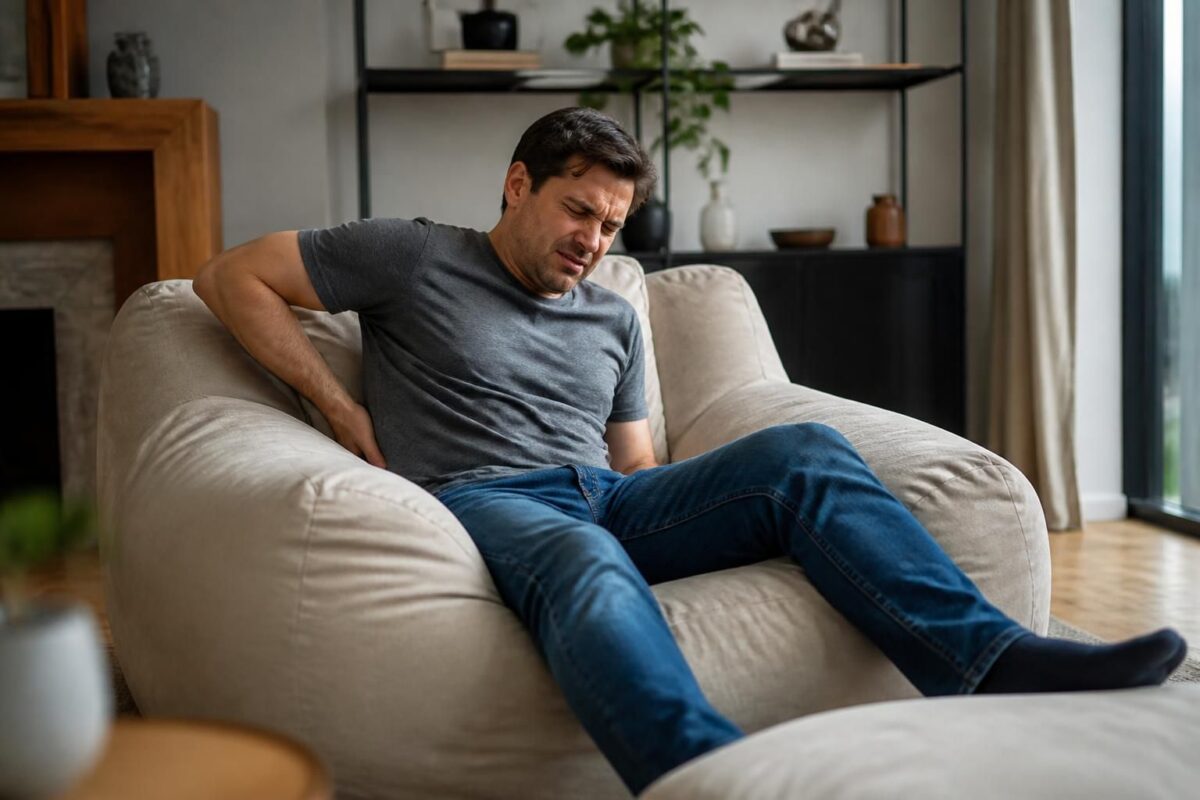
IN BRIEF
In short, sciatica and soft chairs: sitting for long periods on a seat that is too soft can increase pain by compressing the lumbar discs and irritating the sciatic nerve. Benefits: flare-ups can be prevented by adopting a dynamic posture, using adequate support, getting up regularly, and avoiding static positions. How it works: immobility and a lack of decompression contribute to pain, while a firm seat and micro-movements reduce pressure and improve comfort. |
Sciatica and soft chairs: why the pain may increase
Sitting for a long time in a soft chair can worsen pain because the body may slump, compressing the sciatic nerve and increasing tension and pain.
The key factor is not the firmness of the seat, but prolonged immobility: the longer you remain still, the greater the strain on the lumbar discs.
- Change positions and move approximately every 30 minutes.
- Maintain a well-aligned spinal posture and avoid twisting.
- Use a seat with appropriate support and alternate with brief periods of standing whenever possible.
As a healthcare professional, I have observed that sciatica can worsen quickly when a soft chair does not provide adequate support. Excessively soft padding can allow the pelvis to sink and promote excessive pressure on the lumbar discs and nerve root. This article explains why and provides simple guidelines to help limit flare-ups and improve comfort at work or at home.
Why a soft chair can worsen pain
A seat that sinks under the body’s weight causes the pelvis to tilt backward and changes the lumbar curve. This position can compress the sciatic nerve and trigger pain that may radiate into the buttock or thigh. A lack of support encourages a fixed posture that perpetuates nerve irritation and may intensify pain, even during everyday activities.
A soft chair can also reduce the spine’s natural decompression and increase lumbar tension. A seat that does not help maintain a normal spinal curve can make every movement more uncomfortable and limit the breaks needed for recovery.
To learn more about the positions to avoid with sciatica and better understand the mechanisms involved, consult this guide: Positions to avoid with sciatica.
How to identify a suitable chair
A suitable chair should keep the lumbar spine aligned and provide effective support without forcing the posture. Check the seat height to ensure that your feet rest flat on the floor and your knees are bent at approximately 90 degrees. The backrest should be adjustable and provide stable lumbar support. Avoid seats that sink quickly and force the lower back into an excessive arch.
The seat depth should leave a small gap between its edge and the back of the thigh to avoid pressure on the blood vessels and nerves. Use a footrest if necessary to maintain a neutral position of the pelvis and hips. If your chair is too soft or too firm, choose one with medium firmness and a material that retains its shape without sagging.
For practical advice on what to choose and what to avoid, consult this guide: Sciatica: positions to avoid.
Good daily practices
Change positions every 20 to 30 minutes and keep your back straight without unnecessarily twisting the pelvis. Avoid crossing your legs and keep your feet flat on the floor. If you work at a computer, adjust the screen to eye level and position the keyboard so that your forearms remain relaxed and parallel to the work surface.
An ergonomic chair with adjustable lumbar support can significantly reduce the load on lumbar structures. For more ideas and examples, consult these resources: Sciatica and sitting and Sciatica in Montreal: why the same treatment does not work for everyone.
When to seek professional care
Seek professional care if the pain persists despite postural adjustments and breaks, or if you notice warning signs such as loss of sensation, muscle weakness, urinary problems, or fever.
To explore complementary options and discuss your situation with professionals, consult the following resources: Sciatica and difficulty remaining seated for long periods, Sciatica in Montreal: why the same treatment does not work for everyone, and Tips for choosing a chair suitable for sciatica.
Relevant professional training is available through institutions such as NUMSS and NAO—the National University of Medical Sciences and the National Academy of Osteopathy. Recognized professional associations in this field include ACMA and the College of Canadian Osteopaths.
If you are considering integrating clinical approaches, be aware that some resources favour alternatives to physiotherapy. Options are available through TAGMED clinics in Montreal or Terrebonne for personalized assessments and advice.
For more information and additional perspectives, the following resources may be useful: Pain on the top of the foot and the L5 nerve root, Understanding the path of pain before taking action, and Sciatica and sitting: what to do.
Consult the following links to learn more about practical considerations and equipment choices: Positions to avoid with sciatica, Sciatica and difficulty remaining seated for long periods, and Sciatica in Montreal: why the same treatment does not work for everyone.
Medical disclaimer: The information and advice provided on this website are not a substitute for the advice, diagnosis, or treatment of a healthcare professional. Please note that Dr. Sylvain Desforges, osteopath, is neither a Doctor of Medicine nor a physician, and is not a specialist in any medical specialty as defined by the Collège des médecins du Québec. Manual medicine, functional medicine, and sports medicine, as described on this website, exclude any medical treatment or diagnosis provided by a physician or medical specialist. Always consult your physician with any medical questions. For more details, please read our full Legal Disclaimer.
- Prolonged pressure on the lumbar discs due to a soft seat.
- Increased lumbar curvature (lordosis) when the pelvis sinks into the chair.
- Lack of decompression of the sciatic nerve during prolonged sitting.
- Pelvic imbalance due to an asymmetric posture (crossing legs).
- Risk of twisting the torso when carrying a load near the chair.
- Change positions every half hour to encourage decompression.
- Lumbar support and seat adjustment to limit sinking.
- Flat feet and seat height adjusted to keep the pelvis neutral.
- Active breaks: walking or short stretches.
- Avoiding twists of the torso and rotations when carrying loads.
- Using a lumbar cushion or support accessory to stabilize the pelvis.

A soft chair can increase the pain associated with sciatica when the body lacks support and the spine is not properly aligned. In this article, learn why the apparent comfort of a soft seat may lead to worsening pain and which simple measures can help limit its harmful effects while sitting.
Why a soft chair can intensify pain
An overly soft seat allows the pelvis to sink and contributes to a loss of neutral spinal alignment. This posture can cause the torso to twist or shift, increasing pressure on the lumbar discs and sciatic nerve. As a result, pain signals intensify and may continue even after standing up.
Impact on the pelvis and discs
Without adequate support, the back may assume an unnatural working position, with pelvic tilting or poorly controlled lordosis. This pattern increases the load on the discs and may trigger or reactivate sciatic pain, especially during repetitive movements or while continuously handling light loads.
Risk associated with immobility
In a soft chair, it is tempting to remain seated for a long time because it feels comfortable. However, immobility contributes to pain: disc compression and nerve-root irritation worsen with time. Comfort alone is not enough; the frequency of breaks matters.

Sciatica and pain that increases after a long walk
IN BRIEF in English In brief, Sciatica and pain that increases after a long walk is pain that follows the path of the sciatic nerve and may worsen during walking. This phenomenon can arise from nerve irritation or compression at…
Sciatica and pain that appears after a few minutes of walking
IN BRIEF Sciatica is a pain that follows the path of a nerve root from the lower back down to the leg. When it appears after a few minutes of walking, it indicates nerve irritation or compression, often due to…
Good practices for limiting the negative effects of a soft chair
Essential adjustments and accessories
Invest in appropriate lumbar support and a cushion if necessary. Adjust the seat height so that your feet rest flat on the floor and your knees are bent at 90 degrees. A backrest that supports the natural curve of the spine is essential to prevent postural collapse.
Recommended positioning and movements
Pay close attention to your posture: keep your back straight, shoulders relaxed, and gaze level. Avoid crossing your legs and keep your feet flat on the floor. Choose a slight backrest recline of approximately 100 to 110 degrees, which can modestly unload the lumbar discs and reduce pressure on the nerve.
Breaks and alternating positions
Schedule regular breaks: every half hour, stand up, stretch, or walk a few steps. Alternating between sitting and standing allows the spine to decompress naturally and helps prevent pain spikes.

Sciatica and prolonged walking: why does the pain increase?
IN BRIEF In brief, sciatica is pain that follows the path of the sciatic nerve and can intensify during prolonged walking, especially in the presence of lumbar stenosis or a herniated disc. The goal is an active and tailored management…

Sciatica and walking: helpful or aggravating?
IN BRIEF In brief, sciatica and walking is the analysis of whether walking can help or worsen pain related to the sciatic nerve. What is it? Sciatica is pain that radiates from the lower back down the leg, often due…
Complementary exercises and habits
Add simple exercises during breaks to maintain mobility without increasing pain: piriformis stretches, gentle trunk flexion, and decompression exercises with the legs elevated against a wall. When repeated without forcing the movement, these actions complement workplace ergonomics and promote recovery.
| Element related to soft chairs | Impact on sciatic pain |
|---|---|
| Insufficient lumbar support | Promotes hyperlordosis and compression of the sciatic nerve. |
| Soft surface that sinks under the pelvis | Deforms alignment and increases pressure on the discs. |
| Lack of lateral support | Twists and misalignment of the pelvis, worsening compression. |
| Inappropriate seat height | Poor biomechanics, pressure on discs, and pain. |
| Extended sitting time without breaks | Increases disc pressure and nerve irritation. |
| Absence of backrest incline option | Loss of alignment and increased compression. |
| Inappropriate or nonexistent armrests | Encourages twists and an unstable posture. |
| Insufficient chair adjustment | Prevents alignment adjustment, prolonging pain. |

Sciatica and travel return: pain that travels down the leg
IN SHORT Sciatica is pain that runs down the leg, caused by irritation or compression of the sciatic nerve. In the context of return from travel, it may appear after long trips or repetitive movements. In practice, understanding this mechanism…
Sciatica and travel: how to recognize a worsening
IN BRIEF In brief, sciatica and travel describe the worsening of sciatic pain during a trip, with radiation into the leg and radicular signs. Benefits: it allows for quick identification of warning signs, adjustment of breaks and movements, and traveling…
Testimonials: Sciatica and soft chairs—why the pain may increase
“I thought my soft chair would provide comfort, but after sitting still for 30 to 45 minutes, my sciatic pain increases sharply. The lack of movement and pressure on the lumbar discs trigger pain that shoots into my thigh. Since then, I have made myself take breaks and look for positions that allow me to change posture easily.”
“While travelling, I quickly realized that sitting for a long time in my soft chair does not help. Prolonged sitting compresses the spine and triggers radiating pain. Even a slight change of position or a standing break gives me more relief than any plush cushion. The message is clear: comfort is not enough; regular decompression is necessary.”
“As a mother who often carries my child, spending time in a soft chair became a trap. My pelvis becomes imbalanced, and the slightest awkward movement reactivates the pain. I learned to focus on simple actions: keeping my feet flat, alternating positions, and avoiding twisting. The sciatic nerve needs true decompression, not passive comfort.”
“I thought complete comfort would be enough, but the pain proves otherwise: a soft chair can worsen a flare-up if immobility sets in. To limit the pain, I prefer positions that reduce tension on the lumbar spine and add targeted decompression exercises. The key is to move and avoid twisting the torso, even when the seat feels comfortable.”
Dr. Sylvain Desforges is a recognized practitioner in the fields of osteopathy, naturopathy, and manual medicine. As the head of TAGMED clinics and the ACMA association, he embodies a vision focused on healthcare innovation and the continuous improvement of clinical practices. Guided throughout his career by a commitment to evidence-based care, he has specialized in chronic pain management and the integration of advanced technologies to address causes and symptoms rather than merely masking them. His goal is to optimize his patients’ health and well-being through a personalized, multidisciplinary approach.
In his practice, he places particular importance on posture and equipment choices, especially when discussing sciatica and the role of a soft chair. He notes that sciatic pain may worsen when the body remains immobile and poorly supported, and that overly soft or poorly adjusted seats do not provide the necessary lower-back support. Prolonged sitting can increase pressure on the discs and irritate the nerve roots. In practice, even the most comfortable resting areas can become triggers if the torso is twisted or poorly aligned. In this context, the choice of furniture, cushions, and daily habits becomes part of the therapeutic strategy.
His methodology is based on a precise assessment and progressive care. He combines manual techniques with technological tools: spinal decompression to relieve pressure on the nerve roots, laser therapy to reduce inflammation and promote regeneration, and shockwave therapy to stimulate tissue healing. This combination is intended to address the underlying mechanisms and promote recovery while guiding the patient toward more favourable everyday postures, particularly at work or at home.
Education and rehabilitation lie at the heart of his approach. He offers personalized programs combining targeted exercises, ergonomic advice, and tailored sleep strategies. The goal is to teach patients how to limit painful episodes, adopt preventive habits, and reduce reliance on medication whenever possible. The philosophy is clear: pain that can be understood and anticipated can be better controlled.
For those wishing to explore his approach and the available services, the TAGMED website presents care options, multidisciplinary teams, and resources dedicated to chronic pain, including protocols for sciatica and the prevention of aggravation related to unsuitable seating. Dr. Desforges firmly believes that every patient deserves an appropriate and effective response, and his practice aims to provide lasting results rather than temporary relief.
This article explains why a soft chair can worsen sciatica and details the mechanisms underlying this aggravation, along with the actions and workstation choices that can help limit daily pain. It provides clear explanations of how sitting affects the spine, practical advice for choosing a suitable seat, and reliable resources for exploring the subject in greater depth.
A soft chair can encourage a posture that does not properly support the lumbar curve, leading to compression of the lumbar discs and irritating pressure on the sciatic nerve root. In practice, an overly soft seat may allow the pelvis to sink and accentuate lumbar lordosis or hold it in an imbalanced position. Although this phenomenon may seem subtle, it accumulates over time and may increase pain, particularly during extended periods of seated work.
To limit these effects, choose a chair with appropriate firmness and reliable lumbar support. Make sure the seat height allows your feet to remain flat on the floor and your knees to stay aligned with your hips, helping maintain spinal alignment and avoid twisting the trunk. Consider using accessories such as lumbar support or a small cushion behind the lower back to maintain a pelvic tilt that favours the intervertebral space. Regular breaks every half hour and micro-movements may also help prevent aggravation during standing or seated work.
To learn more about the postures to avoid and the choices to favour, consult these resources on positioning and ergonomic advice for sciatica and sitting:
Positions to avoid with sciatica,
What type of chair is optimal for sciatic pain,
Sciatica pain and big toe pain while sitting,
and other useful references listed below to guide you in choosing a seat and adopting appropriate daily habits.
Possible mechanical causes of sciatica,
Tips for sitting with sciatica.
Also keep in mind that an excessively firm seat can create pressure points around the hips, while an overly soft seat may fail to support the lower back. The goal is balance: a seat that is neither too hard nor too soft and that follows the body’s curves without exaggerating them. For optimal, lasting support, favour an open hip angle and subtle spinal decompression during rest periods to limit tension on the sciatic nerve.
For a comprehensive approach, these additional resources can help you understand the mechanisms and respond quickly during a flare-up:
Sciatica in Montreal: pain that radiates down the leg,
Sciatic pain and loss of sensation: why seek professional care,
Postures to avoid. You can also consult these guides on seating ergonomics and solutions for sciatica to make the best choices for your comfort and recovery.
Sciatica and airplane: prolonged sitting and leg pain
IN BRIEF In brief, sciatica related to prolonged sitting on the plane describes pain that arises or worsens when one remains seated for long periods during a flight, due to pressure on the lumbar discs and the sciatic nerve. How…

Sciatica and train: pain after a long journey
IN BRIEF In brief, Sciatica after a long train journey is pain that radiates along the sciatic nerve after long periods of sitting. The problem often arises from an inadequate posture and a poorly mobilized pelvis during the trip. The…

Dr Sylvain Desforges, B.Sc., D.O., N.D., osteopath, is the founding president of TAGMED and of the ACMA association. He dedicates his practice to chronic spinal pain, low back pain and symptoms compatible with sciatica, particularly when pain radiates toward the buttock, leg, calf, foot or toes.
Through SOS Sciatique, he publishes educational content on sciatica symptoms, possible causes such as disc herniation, disc narrowing, foraminal stenosis or irritation of a lumbar nerve root, as well as non-surgical approaches that may be considered according to the evaluation. At Clinique TAGMED, care may include, depending on the case, motorized neurovertebral decompression, specific osteopathic care or precision percussion.
For an evaluation related to sciatica treatment in Montreal / Mount Royal or sciatica treatment in Terrebonne, please consult the services available at Clinique TAGMED.
Medical disclaimer
The information published on SOS Sciatique is provided for educational purposes only and does not replace a consultation, diagnosis, opinion or treatment provided by a physician or another authorized healthcare professional. The author of this article is neither a medical doctor nor a specialist in a medical specialty recognized by the Collège des médecins du Québec. The osteopathic, manual medicine or functional support approaches described on this site do not constitute medical acts and are not intended to replace medical follow-up.
Consult a physician or emergency service in cases of loss of bladder or bowel control, anesthesia in the saddle area, significant or progressive weakness in the leg or foot, fever, recent trauma, severe pain or rapid worsening of symptoms. For more details, please read our Legal Notice.