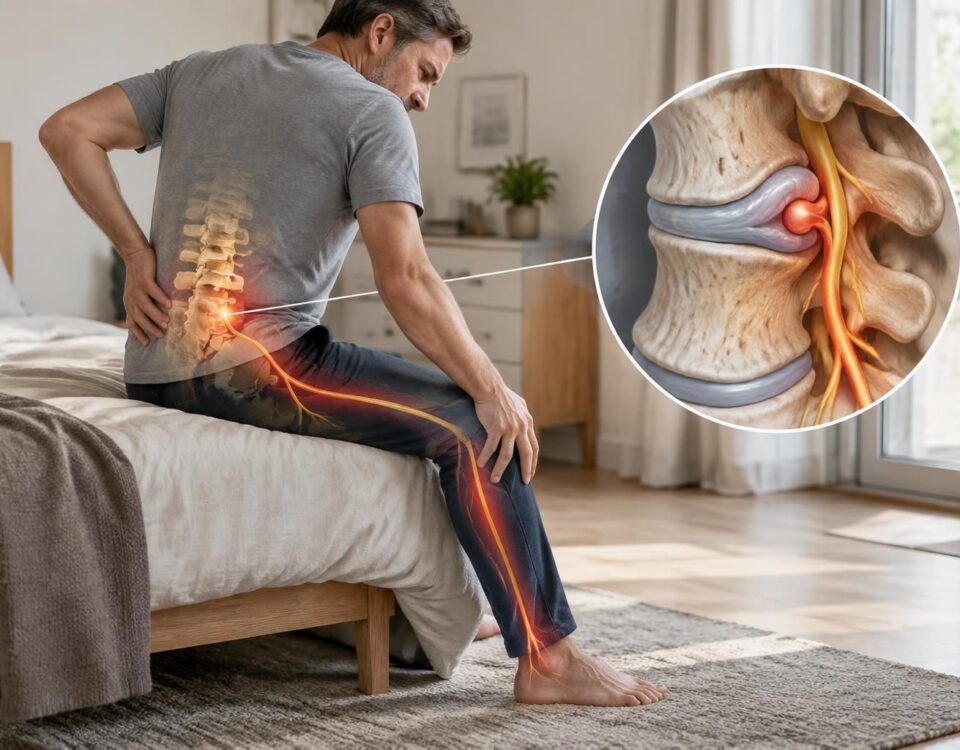
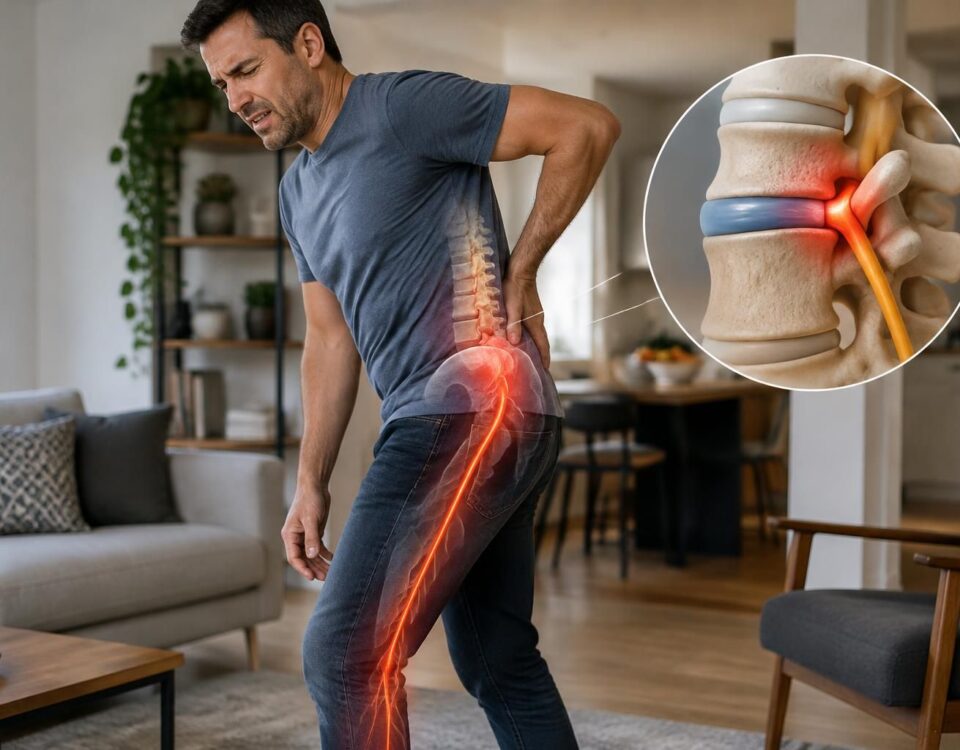
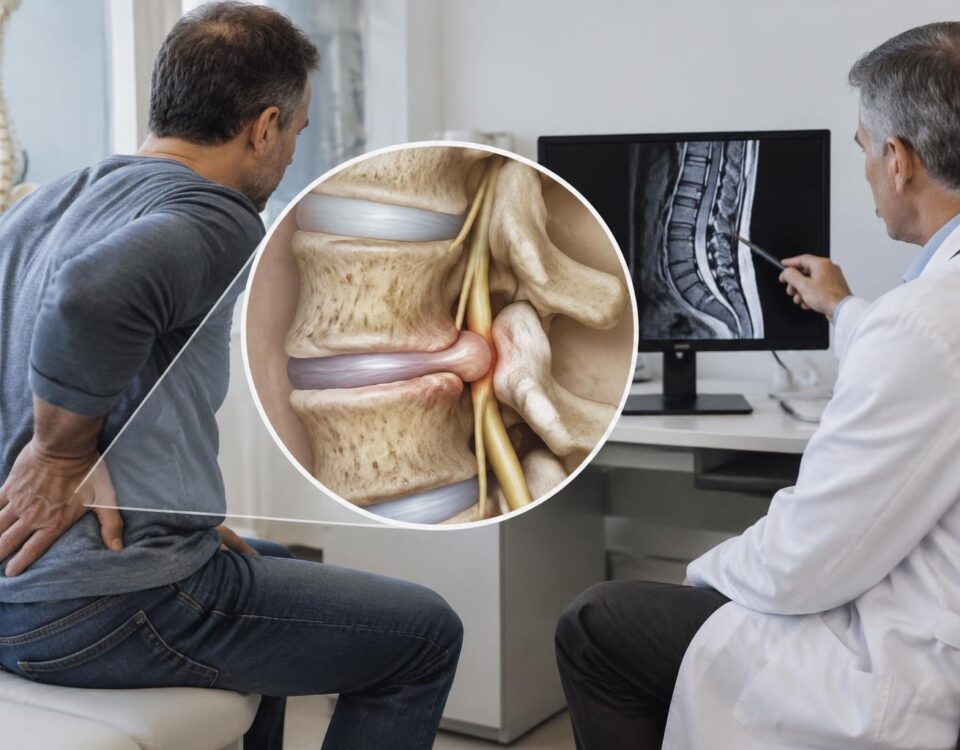
Sciatica and pain that varies with posture
30/10/2026
Sciatica and movement that provides temporary relief: is it enough?
30/10/2026
IN BRIEF
| A disc protrusion is a bulging of the disc that can irritate a lumbar nerve root, particularly L5, and cause pain, tingling, or numbness down to the big toe. This symptom alone does not confirm a disc origin: the assessment takes into account other signs and, if necessary, imaging. Significant or progressive weakness of the foot, or urinary or intestinal issues, requires urgent consultation. |
A lumbar disc protrusion can irritate a nerve root and cause pain that radiates down the leg to the foot, sometimes to the big toe, accompanied by tingling or a sensation of numbness. However, a protrusion visible on imaging is not necessarily the cause of the pain: a local problem in the foot may also explain it.
An evaluation by a healthcare professional helps clarify the origin of the symptoms. Consult quickly in case of significant or progressive weakness of the foot, urinary or intestinal issues, or numbness in the saddle area.
A disc protrusion can sometimes irritate a nerve root and cause pain that radiates down the leg to the big toe. This symptom may correspond to irritation of the L5 root, but it is not sufficient to confirm the cause. Clinical examination, symptom progression, and, if necessary, imaging help determine if the disc is truly involved. Intervertebral discs are located between the vertebrae. They help distribute stress and allow for movements of the spine. A protrusion occurs when a disc bulges beyond its usual contour, without necessarily rupturing its outer envelope. The protrusion does not always cause pain. It may be visible on an MRI in a person who feels no symptoms. Pain sometimes arises if the disc irritates a sensitive structure, such as a nerve root. Depending on the affected root, the pain may radiate into the buttock, leg, and foot. Pain or tingling on the top of the foot near the big toe may be consistent with irritation of the L5 root. However, several causes can provoke pain in the big toe. The localization must, therefore, be interpreted alongside other signs and examination results. Lumbar nerve irritation can cause pain in the lower back or buttock, followed by radiation into the thigh, leg, or foot. Some people also experience tingling, numbness, or a burning sensation. Pain may be present in the big toe even if the back is only mildly painful. Affecting L5 may sometimes be accompanied by difficulty lifting the foot or the big toe. This sign warrants evaluation, especially if it appears suddenly or worsens. To learn more about possible pathways, consult the information on irritation of the L5 root and on pain on the top of the foot associated with L5. The S1 root can produce a different pathway, often towards the back of the leg and the outer edge or sole of the foot. These pathways are not the same for everyone. Therefore, pain in the big toe alone does not distinguish an L5 issue from another cause. You can also read this article on foot pain related to the L5 or S1 roots. In a disc protrusion, the disc bulges beyond its normal contour. In a herniated disc, part of the disc’s content passes through a rupture in its envelope. This difference describes the appearance of the disc but does not automatically reveal the origin of the pain or its intensity. A protrusion or herniation may be present without compressing a nerve and without causing symptoms. Conversely, a minor anomaly can sometimes be accompanied by nerve irritation. Therefore, MRI should be interpreted with the symptoms and examination, not in isolation. To better understand what imaging can show, consult this article on herniated disc, sciatica, and MRI. A healthcare professional can examine the strength, sensitivity, reflexes, and movements that reproduce the symptoms. They also take into account where the pain starts and its pathway. Pain in the big toe may also be related to a joint, tendon, peripheral nerve, or another condition. Imaging is not always necessary at the onset of symptoms. A doctor may request it based on the progression, examination, and presence of specific signs. An MRI can show the discs and nerve structures, but an anomaly observed is not necessarily the cause of the symptoms. Supplementary resources describe the possible symptoms of a disc protrusion, its possible effects on health, and the elements discussed during an evaluation of a protrusion on MRI. The result of an MRI should be correlated with the symptoms. If pain is present, follow-up depends on its intensity, duration, progression, and clinical examination. A professional can help clarify the options suited to the situation. The support is not aimed at promising the disappearance of the disc bulge but can focus on comfort and function. Prolonged strict rest is generally not advised unless there are specific medical indications. It is often preferable to maintain tolerated activities and avoid movements that significantly worsen the symptoms. Adjustments to the workplace and regular position changes can also be discussed. For guidelines on ergonomics, consult this guide on disc protrusion and work arrangements. At the TAGMED Clinic, an evaluation can allow for discussions of possible care depending on the case, including specific osteopathy or motorized neurovertebral decompression. These approaches do not replace a medical diagnosis and may not be suitable for everyone. A consultation allows for examination of the situation and verification if a medical referral is needed. Information is available for sciatica treatment in Montreal and Mont-Royal and sciatica treatment in Terrebonne. Quickly consult a doctor or an emergency service if you notice significant or progressive weakness in the leg or foot, new difficulty walking, loss of sensitivity around the perineum, or loss of control over the bladder or intestines. Pain accompanied by fever, a recent trauma, or rapid deterioration also requires immediate evaluation. Numbness in the big toe associated with low back pain warrants evaluation if the symptom persists or intensifies. Local information is offered about numbness in the big toe and low back pain in Terrebonne. Sylvain Desforges, B.Sc., D.O., N.D., Doctor of Osteopathy and Naturopath, is the founding president of TAGMED and the ACMA association. He dedicates his practice to chronic pain of the spine, low back pain, and pain consistent with sciatica, especially when the pain radiates down to the buttock, leg, calf, foot, or toes. Through SOS Sciatique, he publishes educational content on sciatica symptoms, possible causes such as herniated discs, disc pinching, foraminal stenosis, or irritation of a lumbar nerve root, as well as non-surgical approaches that may be considered based on evaluation. At TAGMED Clinic, care may include, depending on the case, motorized neurovertebral decompression, specific osteopathy, or precision percussion. For an evaluation related to sciatica treatment in Montreal / Mont-Royal or sciatica treatment in Terrebonne, consult the available services at TAGMED Clinic. Medical disclaimer: The information and advice provided on this site do not replace the advice, diagnosis or treatment of a healthcare professional. Please note that Sylvain Desforges, B.Sc., D.O., N.D., Doctor of osteopathy, is neither a medical doctor nor a physician, and is not a specialist in a medical specialty as defined by the Collège des médecins du Québec. Manual therapy, functional medicine, and sports medicine as described on this site exclude any medical treatment or diagnosis made by a physician or specialist. Always consult your doctor for any medical questions. For more details, please read our complete Legal Notice. The information published on SOS Sciatique is for educational purposes and does not replace a consultation, diagnosis, advice, or treatment performed by a physician or other licensed healthcare professional. The author of this article is neither a physician nor a specialist in a medical specialty recognized by the Collège des médecins du Québec. The approaches of osteopathy, manual medicine, or functional support described on this site do not constitute medical acts and are not intended to replace medical follow-up. Consult a doctor or an emergency service in case of loss of urinary or intestinal control, anesthesia in the saddle area, significant or progressive weakness of the leg or foot, fever, recent trauma, severe pain, or rapid deterioration. For more details, please read our Legal Notice.Disc protrusion and pain in the big toe: what is the link?
What symptoms may accompany pain in the big toe?
Protrusion or herniated disc: what is the difference?
How to know if the protrusion explains the pain?
What to do when a disc protrusion is diagnosed?
When to seek emergency care?
About the Author
Medical Disclaimer

A disc protrusion can sometimes irritate a lumbar nerve root and contribute to pain radiating down the leg to the big toe. However, a visible protrusion on an MRI does not prove that it is the cause of the symptoms. The location of the pain, sensations, and strength must be evaluated by a healthcare professional. In the meantime, prioritize tolerated movements and seek prompt advice if the pain is accompanied by weakness or other alarming signs.
Why can a disc protrusion cause pain in the big toe?
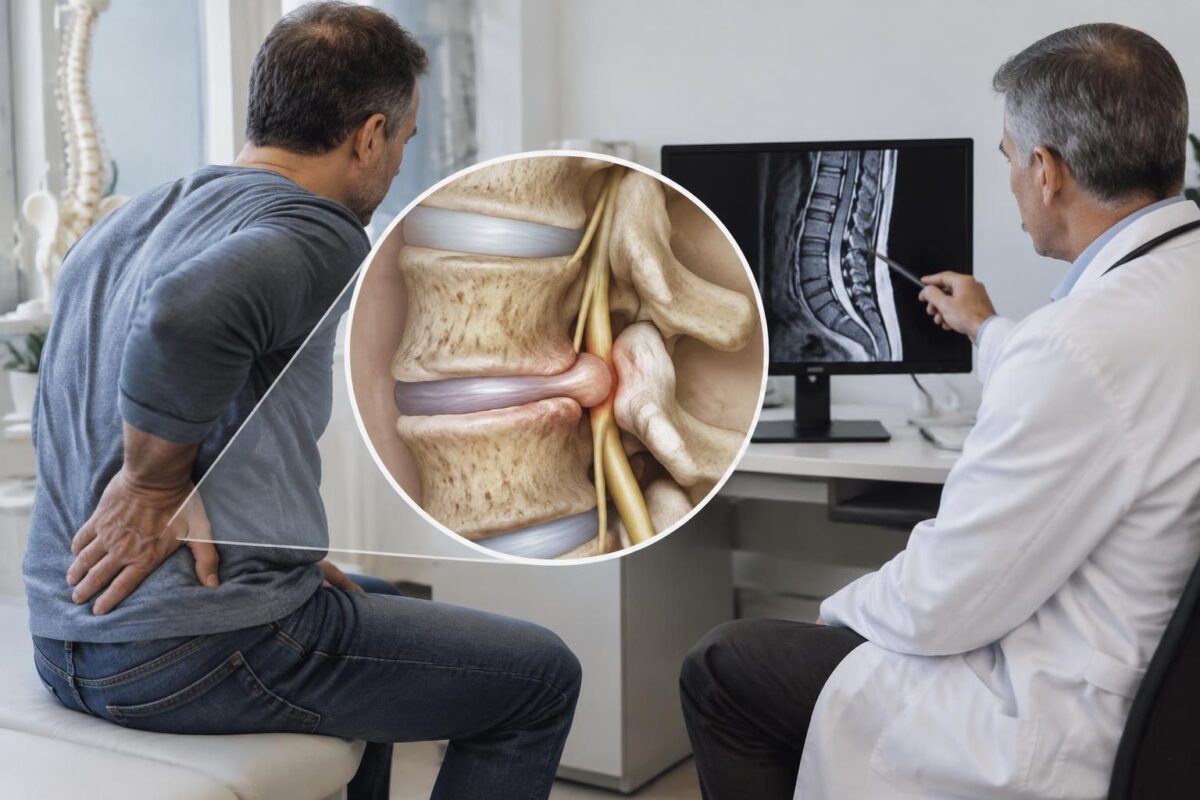
Intervertebral discs are structures located between the vertebrae. A protrusion refers to a bulging of the disc without necessarily breaking its outer layer. It can be present without causing pain. Visible changes on imaging are common and should always be interpreted in relation to symptoms and clinical examination.
When a lumbar nerve root is irritated or compressed, the pain can radiate from the lower back to the buttock, leg, and foot. Irritation of the L5 root may particularly accompany pain or tingling on the top of the foot and near the big toe. This trajectory can guide the evaluation, but is not sufficient to confirm the cause. Issues specific to the foot or toe can also cause similar pain.
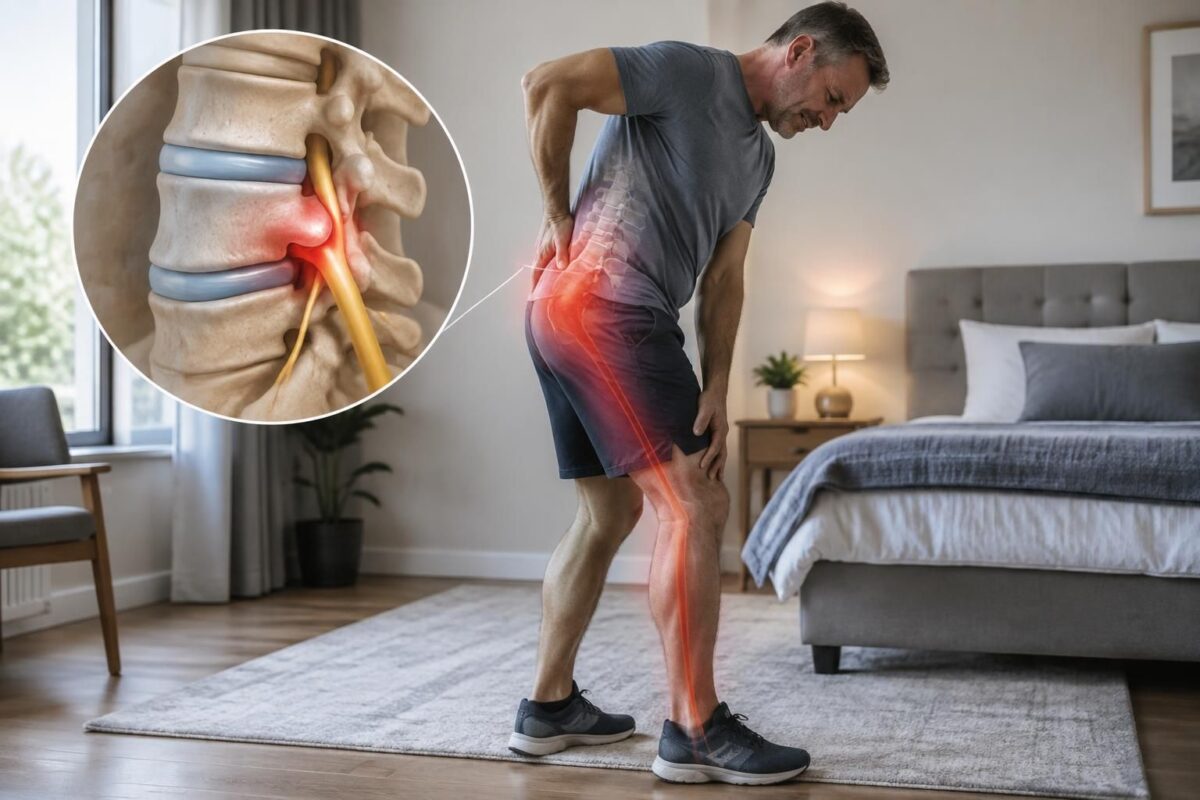
Disc herniation and pain radiating below the knee
IN BRIEF A disc protrusion is a deformation of a disc in the spine that can irritate a nerve root. If the pain extends below the knee, with tingling or weakness, this may suggest sciatica, although this alone does not…
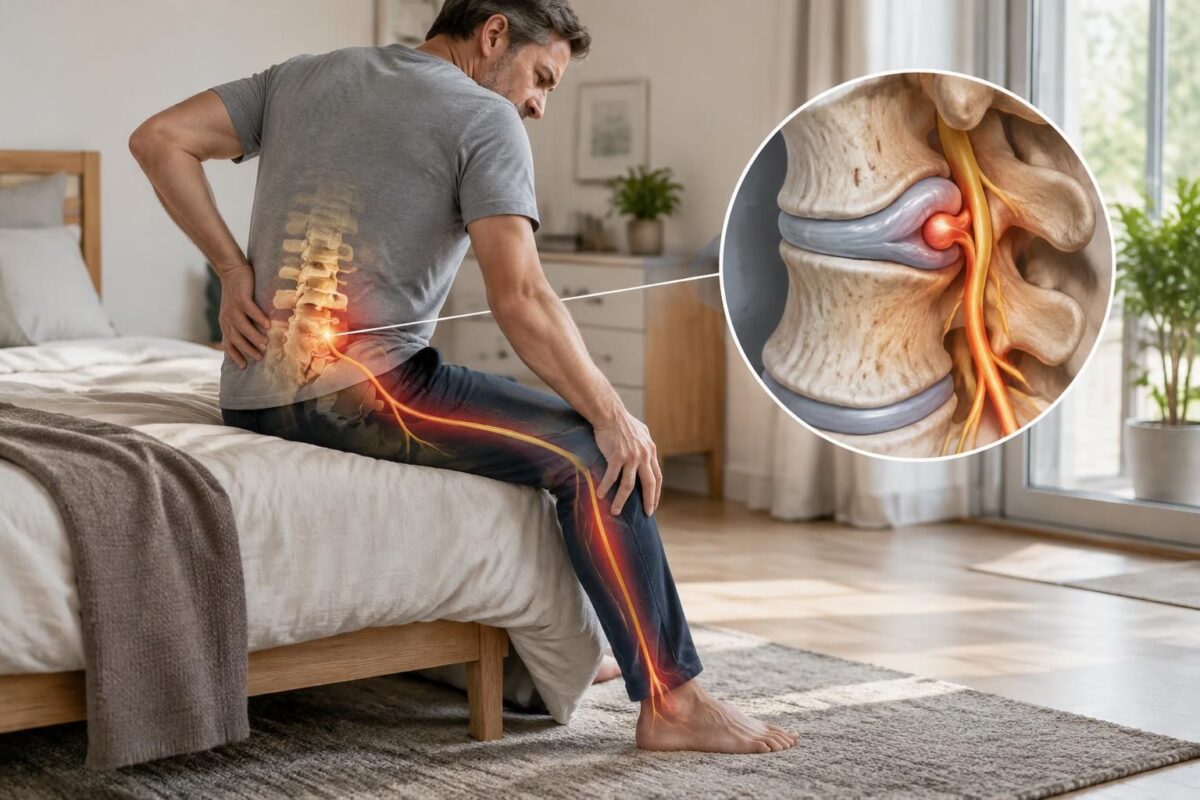
Intervertebral disc protrusion and neurological symptoms
IN BRIEF A disc protrusion is an intervertebral disc that bulges and can irritate a nerve root. It can cause pain, tingling, numbness, or weakness in an arm or leg, depending on its location. Clinical examination and, if necessary, imaging…
What symptoms to monitor?
Pain, numbness, or weakness
Note the starting point of the pain, its trajectory, intensity, and any actions that modify it. Also report any tingling, numbness, difficulty walking on heels, or lifting the foot. This information helps the professional verify if the signs correspond to nerve irritation and determine if further examinations are necessary.
Signs requiring urgent help
Seek immediate emergency care in case of loss of bladder or bowel control, numbness around the perineum, or significant or progressive weakness of a leg or foot. A fever associated with severe pain, a recent trauma, or rapid deterioration also justifies immediate evaluation.
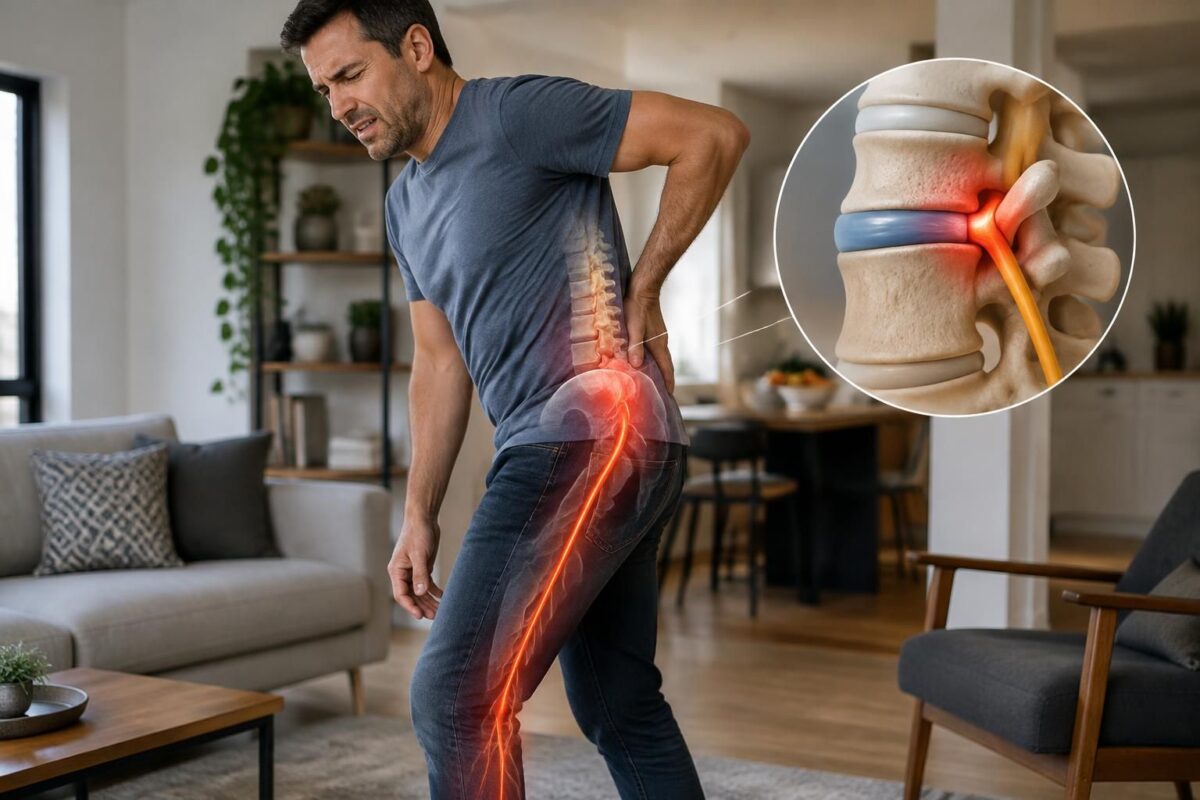
Disc herniation and recurrent sciatica
IN BRIEF A disc protrusion is a bulging of the disc that may be associated with recurring sciatica, without necessarily being the cause. The evaluation correlates symptoms, neurological examination, and imaging, if relevant. An appropriate plan can help improve function…
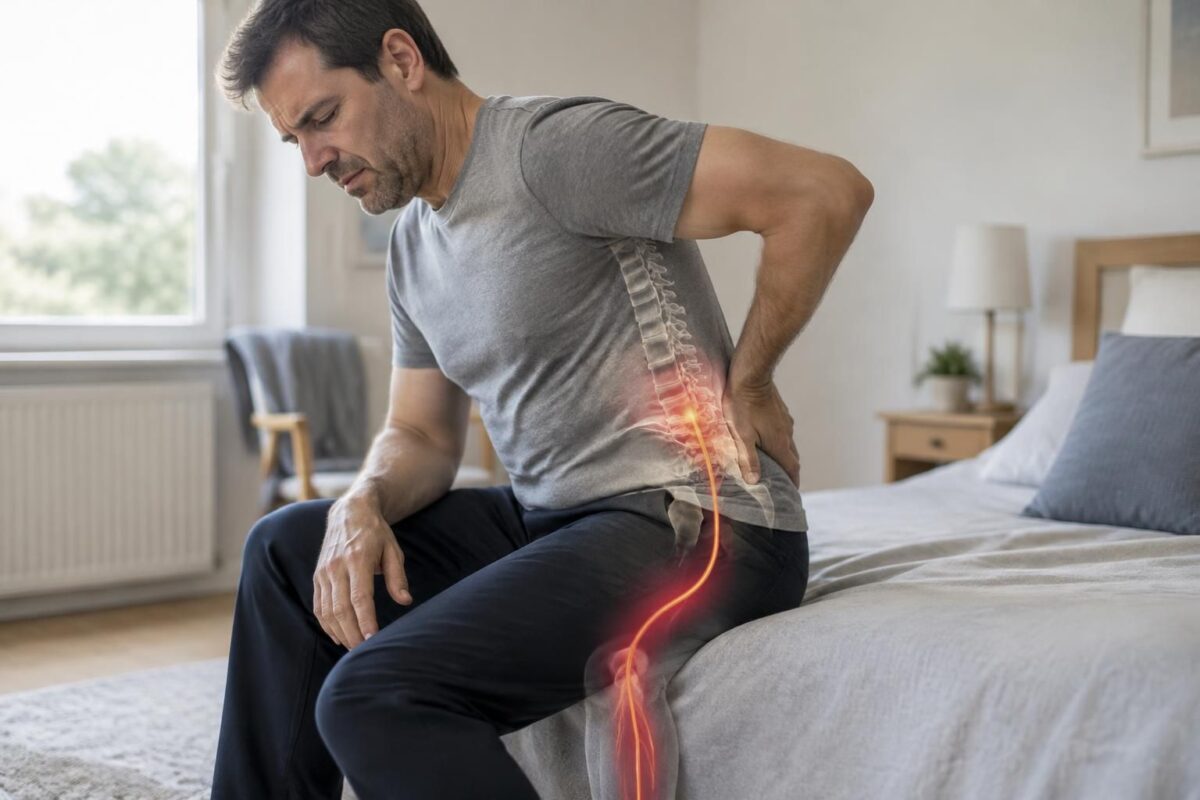
Disc herniation and persistent pain in the leg
IN BRIEF A disc protrusion is a bulging of a disc that can irritate a nerve and cause persistent pain in the leg, sometimes accompanied by tingling or numbness. Imaging alone does not confirm the origin of the symptoms: clinical…
What to do daily?
In the absence of signs of emergency, avoid prolonged strict rest. Try to stay active with short walks or light activities, adjusting their duration to your tolerance. Change positions regularly and interrupt prolonged sitting periods. Temporarily reduce movements that significantly worsen pain, such as carrying heavy loads or repeated bending, then gradually resume them according to progress.
Mobility or strengthening exercises can be helpful, but choose them with a professional if pain radiates down the leg or if you have neurological symptoms. Do not force a movement that significantly increases pain, numbness, or weakness. A qualified professional can also assess your situation and discuss appropriate approaches; manual therapies do not replace a medical diagnosis and do not mechanically eliminate the disc bulge.
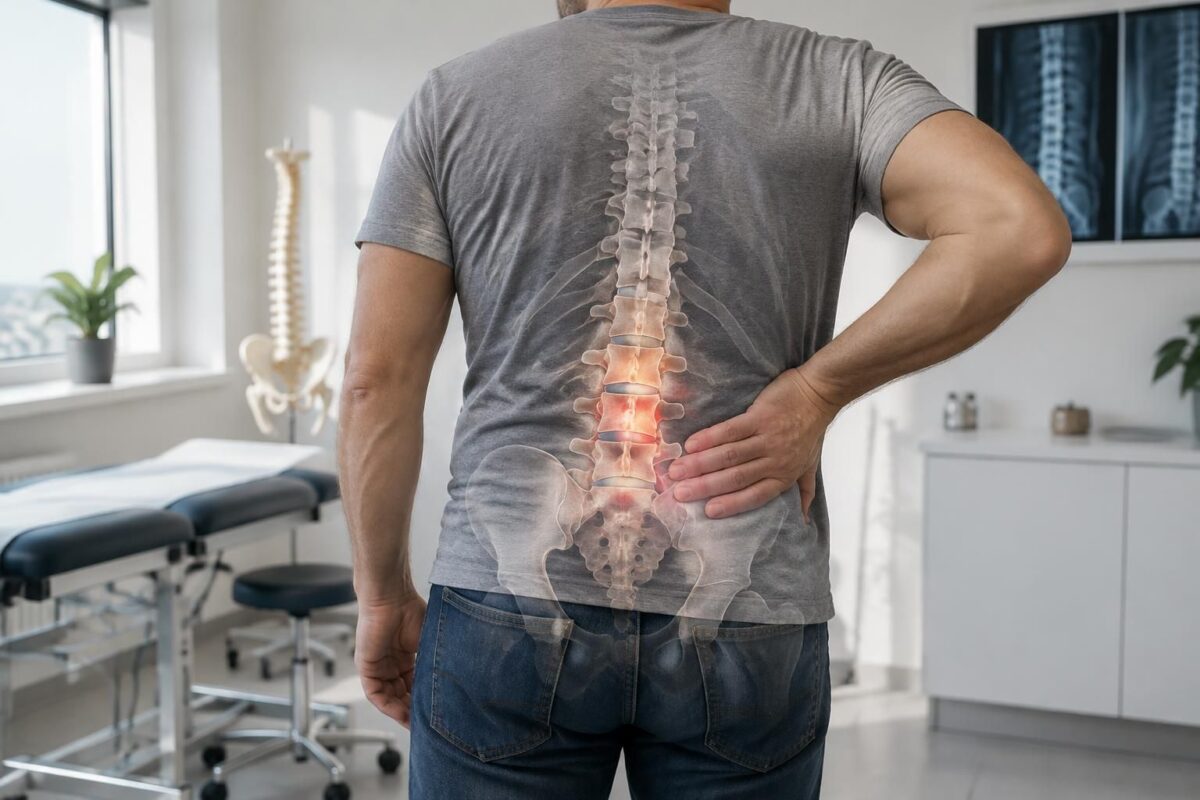
Disc herniation and lumbar degeneration
IN BRIEF A lumbar disc protrusion is a bulging of a disc often related to disc degeneration. It does not always cause symptoms but can contribute to lower back pain or pain radiating down the leg if a nerve is…
Disc protrusion and disc pinching: combined mechanisms
IN BRIEF A disc protrusion is a bulging of the disc, while a disc narrowing refers to a decrease in its height. These changes can coexist and sometimes irritate a nerve root, leading to pain or radiation, but they can…
When to seek an evaluation?
Have persistent, recurrent pain evaluated, or pain that limits walking, sleeping, or working. The diagnosis is based on the history of symptoms and examination; an MRI is not necessary in all situations, and its indication lies with a healthcare professional. Appropriate management may include activity advice, physiotherapy, or other options depending on the assessment. A work stoppage, if considered, depends on the limitations and requirements of the job: a gradual return or adapted tasks may sometimes be discussed.
About the author
Sylvain Desforges, B.Sc., D.O., N.D., Doctor of Osteopathy and naturopath, is the founding president of TAGMED and the ACMA association. His practice particularly focuses on chronic spinal pain, lower back pain, and pain associated with sciatica. The care offered may vary according to the assessment and include motorized neurovertebral decompression, specific osteopathy, or precision impactors.
Medical warning
This content is provided for educational purposes and does not replace a consultation, diagnosis, or treatment by a physician or another authorized healthcare professional. The author is neither a physician nor a specialist in a medical specialty recognized by the Collège des médecins du Québec. Osteopathy, manual medicine, and functional support do not replace medical follow-up.
| Compared element | To remember |
|---|---|
| Possible link | A lumbar protrusion can irritate a nerve root and cause pain down to the big toe. |
| Evocative trajectory | Pain starting from the lower back or buttock and descending into the leg can suggest sciatica. |
| Other possible sensations | Tingling, numbness, or weakness may accompany the pain. |
| MRI interpretation | A protrusion visible on imaging does not prove that it causes pain in the big toe. |
| Consult quickly | Significant or progressive weakness of the foot, or urinary or intestinal disturbances, requires urgent evaluation. |

Disc herniation and associated foraminal stenosis
IN BRIEF A disc protrusion associated with foraminal stenosis occurs when a bulging disc coexists with a narrowing of the opening through which a nerve root passes. This association can lead to lower back pain radiating into the leg, tingling,…

Spinal disc protrusion and nerve inflammation
IN BRIEF A disc protrusion is a bulging of the disc that can irritate or compress a nerve, without necessarily causing symptoms. When it leads to nerve inflammation, it can cause pain in the back or neck, sometimes accompanied by…
Testimonials on disc protrusion and pain in the big toe
Note: The testimonials below are fictional examples for educational purposes. Pain in the big toe alone does not allow for a conclusion of a disc protrusion or nerve injury.
Marc, 46 years old — lower back pain and tingling
“My pain started in the lower back, then it went down into the buttock and along the leg. I then felt tingling all the way to the big toe. The MRI showed a lumbar disc protrusion. My healthcare professional explained that the imaging had to be interpreted alongside my symptoms and examination, and that the protrusion might be associated with nerve irritation without necessarily being the sole cause.”
Isabelle, 53 years old — MRI result and foot pain
“I discovered a disc protrusion in my report, while my main discomfort was pain near the big toe. I thought the two had to be linked. After evaluation, I was reminded that foot pain can also stem from the foot itself or other causes. This helped me avoid drawing conclusions from the MRI alone.”
Étienne, 39 years old — symptoms vary by day
“At home, the pain in the big toe mostly appeared after sitting for a long time. I also had lower back stiffness, but not always intense back pain. I consulted to evaluate all my symptoms. The advice received focused on gradual movement and adapting my sitting periods, without claiming that it would make the disc bulge disappear.”
Nadia, 61 years old — better understanding the link between the back and the toe
“I felt pain starting from the buttock and descending to the foot, with an unusual sensation in the big toe. I was explained that irritation of a lumbar nerve root could sometimes produce symptoms in the leg or foot, but that an examination was necessary to determine if this applied to my case. This explanation helped me better describe my symptoms during my appointment.”
Pain in the big toe can sometimes accompany nerve irritation from the lower back, but it can also have a local origin, such as joint or tissue-related issues in the foot. The location, duration, associated sensations, and clinical examination help healthcare professionals direct the evaluation. A protrusion visible on imaging does not, on its own, prove that it is responsible for the pain.
Consult quickly if the pain is accompanied by a new or progressive weakness of the foot or leg. Loss of urinary or intestinal control, or numbness in the saddle area, requires urgent evaluation.
Disc protrusion and pain in the big toe: understanding the link
Pain in the big toe can sometimes be related to irritation of a nerve in the lower back. Among the possible causes is a lumbar disc protrusion, which is a bulging of the intervertebral disc. However, this link is not automatic: a protrusion can be visible on imaging without causing symptoms, while pain in the toe may have a local origin or be related to another health issue.
Between the vertebrae, the discs act as shock absorbers and facilitate the movements of the spine. Over time or due to repeated strain, a disc may deform and slightly exceed its usual contour. In a protrusion, its outer envelope generally remains intact. This distinguishes it from a herniated disc, where this envelope is cracked and disc material may protrude. However, imaging alone does not always identify the source of pain: results must be interpreted alongside symptoms and clinical examination.
When a lumbar protrusion irritates a nerve root, pain may follow the path of the nerve into the buttock, leg, and sometimes down to the foot. In particular, involvement of the L5 root may be accompanied by painful sensations or tingling towards the top of the foot and the big toe. Some people also describe numbness or difficulty in lifting the foot or the big toe. The location of the symptoms provides a clue but is not enough to confirm a diagnosis.
It is also possible that the pain originates directly from the toe, for example from a joint, a tendon, a local irritation, or trauma. Therefore, pain in the big toe should not be immediately attributed to the spine. A healthcare professional can examine the back, leg, and foot, check strength and sensitivity, and then determine if further tests are necessary. An MRI is not required in all situations, and its indication depends in particular on the duration of the symptoms, their evolution, and associated signs.
In the absence of warning signs, prolonged strict rest is rarely desirable. A gradual resumption of activities, with short walks and regular position changes, can help maintain mobility. Loads or movements that significantly worsen symptoms may be temporarily adjusted. Strengthening exercises and manual therapy should be chosen based on the person’s evaluation and tolerance; they do not mechanically resolve a protrusion nor replace medical advice.
Consult quickly if the pain intensifies, if weakness appears, or if walking becomes difficult. A loss of control of the bladder or bowels, numbness in the saddle area, or significant or progressive weakness requires urgent evaluation. These symptoms are rare but should not wait for a regular appointment.
About the author
Sylvain Desforges, B.Sc., D.O., N.D., Doctor of Osteopathy and Naturopath, is the founding president of TAGMED and the ACMA association. His practice focuses in particular on chronic spinal pain, low back pain, and pain compatible with sciatica. At the TAGMED Clinic, the approaches offered may include, depending on the evaluation, powered neurovertebral decompression, specific osteopathy, or precision percussion.
Medical Disclaimer
This information is provided for educational purposes and does not replace a consultation, diagnosis, or treatment by a physician or other licensed healthcare professional. The author is neither a physician nor a specialist in a medical specialty recognized by the Collège des médecins du Québec. Osteopathy, manual medicine, or functional support approaches do not constitute medical acts and do not replace medical follow-up.
A disc protrusion can sometimes irritate a nerve root and cause pain that travels down the leg to the big toe, especially when the pathway of the affected nerve is involved. However, a protrusion visible on imaging is not enough to explain the symptoms: clinical examination, the location of the pain, and the evolution of signs must also be taken into account.
Disc protrusion and big toe pain: what is the link?
The big toe can be affected when a lumbar nerve irritation leads to pain, tingling, or numbness extending into the leg and foot. Involvement of the lumbar region, particularly around L4-L5, may sometimes be accompanied by symptoms on the top of the foot or towards the big toe. This pathway may guide the evaluation, but it cannot alone confirm a protrusion or disc herniation.
The pain may be felt as a burning sensation, an electric shock, or a feeling of current running down the leg. It may also be accompanied by decreased sensitivity in the foot. To better understand these manifestations, consult our articles on the sensation of electric current in the calf and on the numb foot associated with a disc herniation.
An MRI image is not enough to establish the cause
A protrusion corresponds to a bulge of the disc with the envelope remaining intact, while a herniation involves a more significant damage to this envelope. However, these anatomical differences do not automatically predict the intensity of the pain: a small abnormality can coincide with significant symptoms, and a more visible protrusion may not cause any discomfort. To delve deeper into this distinction, see the explanations on protrusion and disc herniation, as well as the information on hernias and disc protrusions.
Thus, pain and numbness must be interpreted with the entire picture: foot strength, sensitivity, reflexes, duration of symptoms, and activities that aggravate or relieve them. Pain that occurs after walking, for example, deserves to be described precisely during the evaluation; you can also consult our page on pain and numbness after walking. For other references on possible manifestations, also read the information on symptoms of disc protrusion.
When to request an evaluation?
If the pain towards the big toe persists, returns frequently, or is accompanied by a loss of sensitivity, it is advisable to consult a healthcare professional to determine the cause and next steps. Recurring sciatic-type pain does not necessarily mean that the protrusion is worsening: it nevertheless justifies an appropriate evaluation, as explained in our article on disc protrusion and recurrent sciatica.
The intensity of the symptoms does not always correspond to the size of the abnormality observed on the MRI. Severe pain despite a small protrusion can be explained by various factors, which require assessment on a case-by-case basis. To learn more, check out our content on severe pain despite a small protrusion.
A new or progressive weakness in the foot, difficulty in lifting the big toe or walking on the heels, or a loss of sensitivity that spreads should be reported quickly to a professional. Sudden urinary or intestinal issues, insensitivity in the saddle area, or significant weakness in the legs require urgent consultation. Further details regarding the loss of sensitivity are also available in this article: herniated disc and loss of sensitivity: why evaluate the symptoms.
Useful steps in daily life
In the absence of urgent signs, prolonged strict rest is generally not the best strategy. Depending on tolerance and the recommendations of the professional guiding you, maintaining gentle movements — such as short walks — and changing positions regularly can help preserve mobility. However, avoid forcing through a significantly increasing pain or new neurological symptoms.
The choice of care depends on the assessment and your situation. Manual or functional support may sometimes be considered for comfort and mobility, but it does not claim to reposition a disc and does not replace medical advice. Follow-up should be adjusted if pain progresses, if numbness spreads, or if foot strength decreases.
About the author
Sylvain Desforges, B.Sc., D.O., N.D., Doctor of Osteopathy and Naturopath, is the founding president of TAGMED and the ACMA association. He dedicates his practice to chronic spinal pain, low back pain, and pain compatible with sciatica, particularly when the pain radiates down to the buttock, leg, calf, foot, or toes.
Through SOS Sciatique, he publishes educational content on the symptoms of sciatica, possible causes such as herniated discs, disc pinching, foraminal stenosis, or irritation of a lumbar nerve root, as well as non-surgical approaches that can be considered based on the assessment. At the TAGMED Clinic, treatments may include, depending on the case, motorized neurovertebral decompression, specific osteopathy, or precision impact therapy.
For an evaluation related to sciatica treatment in Montreal / Mont-Royal or sciatica treatment in Terrebonne, consult the services available at the TAGMED Clinic.
Medical warning
The information published on SOS Sciatique is provided for educational purposes and does not replace a consultation, diagnosis, opinion, or treatment performed by a physician or another authorized health professional. The author of this article is neither a physician nor a specialist in a medical specialty recognized by the Collège des médecins du Québec. The osteopathy, manual medicine, or functional support approaches described on this site do not constitute medical acts and are not intended to replace medical follow-up.
Consult a physician or emergency service in case of loss of urinary or intestinal control, anesthesia in the saddle area, significant or progressive weakness of the leg or foot, fever, recent trauma, severe pain, or rapid worsening. For more details, please read our Legal notice.

Sylvain Desforges, B.Sc., D.O., N.D., docteur en ostéopathie
Dr Sylvain Desforges, B.Sc., D.O., N.D., osteopath, is the founding president of TAGMED and of the ACMA association. He dedicates his practice to chronic spinal pain, low back pain and symptoms compatible with sciatica, particularly when pain radiates toward the buttock, leg, calf, foot or toes.
Through SOS Sciatique, he publishes educational content on sciatica symptoms, possible causes such as disc herniation, disc narrowing, foraminal stenosis or irritation of a lumbar nerve root, as well as non-surgical approaches that may be considered according to the evaluation. At Clinique TAGMED, care may include, depending on the case, motorized neurovertebral decompression, specific osteopathic care or precision percussion.
For an evaluation related to sciatica treatment in Montreal / Mount Royal or sciatica treatment in Terrebonne, please consult the services available at Clinique TAGMED.
Medical disclaimer
The information published on SOS Sciatique is provided for educational purposes only and does not replace a consultation, diagnosis, opinion or treatment provided by a physician or another authorized healthcare professional. The author of this article is neither a medical doctor nor a specialist in a medical specialty recognized by the Collège des médecins du Québec. The osteopathic, manual medicine or functional support approaches described on this site do not constitute medical acts and are not intended to replace medical follow-up.
Consult a physician or emergency service in cases of loss of bladder or bowel control, anesthesia in the saddle area, significant or progressive weakness in the leg or foot, fever, recent trauma, severe pain or rapid worsening of symptoms. For more details, please read our Legal Notice.