Osteopathic techniques to prevent postural disorders
28/06/2026
How Osteopathy Improves Sleep Quality
28/06/2026
In short
| In short, theosteopathy for the Leg pain is one Custom support which aims to improve the circulation (venous and lymphatic), reduce tension and promote balanced posture. Its benefits include better venous return, reduced heaviness and cramps, and an approach non-invasive based on Soft manual techniques. How does it work? a global diagnosis and a personalized plan, targeted mobilizations and manipulations of tissues and fascias, and simple advice tolifestyle to prevent recurrences. In Montreal, this service is particularly useful for people with circulatory disorders, water retention or sedentary lifestyle, and it can improve daily comfort without pain and medication. |
In terms of Leg pain, Losteopathy offers a Custom support who considers the body as a whole. By acting on the Musculoskeletal structures, organs and diaphragm, it aims to improve the circulation venous and lymphatic, to reduce tension and promote appropriate venous return.
- Definition and symptoms : Sensation of heaviness in the limbs, edema, nocturnal cramps and sometimes varicose veins, especially at the end of the day or during excessive heat.
- Approach : Mobilization and gentle techniques to release tension, work on the muscles of the pelvis and diaphragm, and postural corrections that support circulation and drainage.
- benefits : improvement of venous return and lymphatic drainage, reduction of muscle tension, stimulation of visceral functions related to circulation and prevention of aggravation.
- Indications and contraindications : indicated in the event of recurrent heavy legs, edema or diffuse pain without serious pathology; possible pregnancy with medical advice. Contraindicated in the presence of thrombosis, decompensated heart failure, local infections or recent or dermatological trauma preventing touch.
- course of treatment : anamnesis and overall assessment, follow-up of gentle manipulations, visceral and postural work, and practical advice (adapted physical activity, stretching, elevation of the legs) to support progress between sessions.
This article, written by an experienced healthcare professional, presents how theosteopathy offers a Custom support of Leg pain. He defines the heavy legs, exposes the circulatory mechanisms involved and describes the concrete benefits of an osteopathic approach. You will discover the indications, contraindications and the typical course of care adapted to each patient, as well as practical advice to prevent recurrences and sustainably improve the comfort of the lower limbs.
Definition and context
The Heavy legs are manifested by a feeling of gravity in the lower limbs. This impression is often linked to a Poor circulation venous and sometimes water retention. The phenomenon can be aggravated by heat, sedentary lifestyle and chronic venous disorders. The most frequent signs include a heaviness at the end of the day, edema around the ankles, nocturnal cramps and the appearance of varicose veins.
Benefits of osteopathy for the legs
In osteopathy, the body is approached as a whole. This approach overall can improve the bloodstream, lymphatic and the Venous return. Manual techniques relax the muscles of the legs and pelvis, reducing compressions that hinder flow. Work on the diaphragm and on the organs can support better circulatory dynamics. By promoting a more balanced posture, osteopathy can also help prevent the aggravation of venous disorders.
directions
Osteopathy may be indicated when: Regular feeling of heavy legs, recurrent edema, pain diffused in the legs without serious pathology, difficulties related to prolonged standing and, during pregnancy, management of circulatory disorders under medical advice.
contraindications
Situations require medical care. Consult a doctor before any session if you are presenting a Deep vein thrombosis, a decompensated heart failure or very advanced varicose veins requiring intervention. Other possible contraindications: local infections, recent traumas or serious skin conditions preventing touch.
as part of osteopathic treatment
The evaluation begins with an interrogation and an overall assessment. The treatment combines Sweet mobilizations To promote venous and lymphatic drainage, manipulations visceral when relevant, and postural corrections to improve body alignment. Work on the diaphragm and on fasial tensions can help unleash the constraints that influence circulation. Each plan is adapted to each patient and evolves according to the responses of the body.
Advice and prevention
Stay active with suitable activities like walking or swimming. Practice simple and regular stretching to maintain muscle mobility. Raise your legs at the end of the day to facilitate drainage. Adopt a favorable posture on a daily basis and favor stress management mechanisms that can help reduce overall body tension.
To deepen the links between osteopathy and posture, see the article on optimal body alignment: Osteopathy and posture — Find optimal body alignment.
To understand how osteopathy can reduce pain related to physical stress, see: Osteopathy and physical stress.
Resources on the impact of osteopathy after surgery can assess opportunities for improving mobility: Mobility after surgery and osteopathy.
Practical resources and remedies
For a personalized evaluation and treatment plan, you can go to Clinique TagMed: Tagmed Clinic.
To explore a global approach and advice dedicated to wellness, check out our dedicated page: Osteopathy and overall well-being — Restoring body balance.
Additional resources on the management of leg pain and their osteopathic aspects can also be found in posture and mobility articles:
Osteopathy and overall well-being, Posture and body alignment, Mobility after surgery.
In case of persistent pain, a doctor can assess the causes and direct you to osteopathy as a complementary treatment. For specific indications and specific cases, ask for a consultation adapted to your situation.
Medical disclaimer : The information and advice provided on this site does not replace the advice, diagnosis or treatment of a health professional. Please note that Dr. Sylvain Desforges osteopath is neither a doctor of medicine nor a doctor, and is not a specialist in a medical specialty as defined by the Collège des Médecins du Québec. Manual medicine, functional medicine and sports medicine as described on this site exclude any medical treatment or diagnosis made by a doctor or specialist doctor. Always consult your doctor for any medical questions. For more details, please read our full legal notice.
“Medical disclaimer: The information and advice provided on this site does not replace the health professional’s benefit, diagnosis or treatment. Please note that Dr. Sylvain Desforges osteopath is neither a doctor of medicine nor a doctor, and is not a specialist in a medical specialty as defined by the Collège des Médecins du Québec. Manual medicine, functional medicine and sports medicine as described on this site exclude any medical treatment or diagnosis made by a doctor or specialist doctor. Always consult your doctor for any medical questions. For more details, please read our full legal notice. »
- Overall assessment and Targeted anamnesis To identify circulatory, postural and painful causes.
- Identification of causes (venous, lymphatic, muscular, postural) in order to prioritize treatment.
- Custom goals comfort, mobility and recurrence prevention.
- Adapted course: Frequency, duration and adjustments according to the response to the comeback.
- Care plan individualized including patient priorities and limits.
- Collaboration with other health professional(s) when necessary.
- Gentle techniques for drain and loosen The tissues of the legs and pelvis.
- Mobilizations and visceral work to improve circulatory dynamics.
- Diaphragmatic stimulation and abdominal organs to promote venous return.
- Postural corrections and pond rebalancing to optimize alignment.
- Exercises at home and targeted stretching to maintain gains.
- Practical advice: positions, leg elevation, hydration and appropriate activity.

This article presents how theosteopathy can contribute to the Custom support of Leg pain, by acting on the mobility, the circulation and posture, while adapting to the patient’s lifestyle. You will discover how a global assessment and targeted techniques can reduce heaviness, improve venous return and promote overall well-being.
A global and personalized approach
In osteopathy, leg pain is approached as a whole: muscles, joints, organs and nervous system interact. The goal is to improve the Venous return and lymphatic drainage, release tension and promote better circulatory dynamics. This global approach makes it possible to adapt the care to each person, taking into account their activity, their posture and their daily comfort.
Evaluation and anamnesis
The first session combines anamnesis and functional assessment, in order to identify the possible causes: sedentary lifestyle, heat, venous disorders, professional postures or sports activities, and to detect any contraindications. This step makes it possible to draw up a personalized and realistic action plan to improve the overall function of the legs.
Techniques and interventions
Different techniques can be used: Sweet mobilizations limbs and joints, work on the fascias and muscles, and Visceral approaches Aiming to stimulate the diaphragm and organs involved in circulation. Postural corrections and breathing tips complete the treatment and reinforce long-term effects.
Treatment plan and follow-up
The treatment is personalized and progressive: the plan can combine several sessions, exercises at home and recommendations of adapted physical activity (regular walking, swimming), with a monitoring to adjust techniques and intensity. A scalable approach helps support progress and avoid recurrences.

How osteopathy improves the quality of life of active people
In short In short, theosteopathy is a global approach that Optimizes mobility and the function of the body of ACTIVE PEOPLE, for a better quality of life. It helps prevent injury and reduce Musculoskeletal pain While promoting the Sports recovery.…
Indications and precautions
Typical indications: Regular feeling of heavy legs, recurrent edema, diffuse pain, difficulty standing or walking for a long time, and management of circulatory disorders during pregnancy under medical supervision. The goal is to achieve better exertion tolerance and a reduction in daily discomfort.
Contraindications and limits: the osteopathic medicine Does not replace medical follow-up when serious pathologies are present. In the presence of deep vein thrombosis, decompensated heart failure, active local infections or recent trauma, it is necessary to consult a doctor quickly before considering a session.

Osteopathy and sports recovery: prepare the body for lasting performance
In short In short, Osteopathy and Sports recovery is one Global manual approach that sustainably prepares the body for the effort by restoring mobility and circulation After the effort. It is a discipline that acts on the sinews, the joints,…
Prevention and lifestyle
In addition to the sessions, plan a Regular physical activity Adapted (walking, swimming), targeted stretching and active breaks during long standing or sitting periods. The possible wearing of compression stockings or elevations of the legs at the end of the day can also promote drainage and reduce feelings of heaviness.
Why Osteopathy Is Essential For Recovery People
In short In short, Osteopathy in convalescence is an approach manual and holistic which helps to accelerate the recovery by restoring The balance, the mobility and a good circulation fabrics. it contributes to Reduce the pain, support the Back to…
Practical advice and expected results
Osteopathic treatment can helpImprove venous return, to reduce the Night cramps and muscle tension, and promote a general feeling of lightness in the legs. To optimize the results, combine the sessions with simple exercises, appropriate hydration and Conscious posture Throughout the day, remaining attentive to your body and its signals.
| Axis | key elements |
|---|---|
| Approach personalized | The approach is adapted to your profile and your symptoms to restore mobility and comfort quickly. |
| goals | improve the Venous return and relax the muscles to reduce heaviness and discomfort. |
| techniques | gentle mobilizations, work fascial, and action on the diaphragm to optimize circulation. |
| directions | Regular heaviness, edema, diffuse pain at the end of the day. |
| contraindications | Thrombosis, decompensated heart failure or local infections requiring medical advice. |
| Results | Progressive improvement in venous return and mobility, with gain in comfort. |
| Duration and follow-up | Regular sessions and personalized plan to consolidate progress. |
| Prevention | Adapted activity, stretching, elevation of the legs and improvement of posture. |
| complementarity | Non-invasive and complementary approach that does not exclude medical treatment when necessary. |

Osteopathic manipulations to strengthen post-traumatic muscles
In short In short, Osteopathic manipulations for Strengthen post-traumatic muscles constitute a gentle manual approach aimed at restoring the mobility, reduce the pain and facilitate the Functional rehabilitation After a injury. What is Is it? A series of precise gestures…
Testimonials on osteopathy and leg pain: personalized care
“Before meeting the team, I had a persistent heaviness in my legs every evening. With a Custom support and sessions ofosteopathy focused on my posture and my circulation, my Leg pain have decreased significantly and I feel lighter on a daily basis. »
“I stayed up all day and my ankles were swelling. Overall listening and evaluation made it possible to build a Custom Plan of care. After a few sessions, the circulation improves and the swelling decreases, which changes everything for my sports activities. »
“As a sportswoman, my legs were pulling after the effort. Osteopathic work gave me a better mobility and an recovery Faster, without pain. The practitioner guided me with simple exercises adapted to my rhythm, proof of a real Custom support. »
“After my pregnancy, the pain in my legs were recurring. Through an approach holistic and to a Custom Plan, my tensions decreased and my sleep improved. I highly recommend theosteopathy to find comfort. »
“I had diffuse pain and tensions that bothered my movements. Osteopathy offered me a lasting appeasement thanks to a Custom support, focused on drainage and posture. The results are maintained and I feel more confident during my daily journeys. »
“The global approach has changed everything: we work on muscles, fascias and breathing to improve the circulation and the posture. My Leg pain have decreased and my quality of life has increased, month after month, thanks to sessions adapted to my rhythm. »
DR Sylvain Desforges, a confirmed osteopath and expert in manual medicine, puts its expertise at the service of people suffering from Leg pain and heaviness of the lower limbs. His approach is guided by a holistic vision of the body and by the conviction that each patient deserves a Custom support adapted to his experience, his way of life and his objectives. His years of activity in the field of health led him to design approaches that combine science, manual know-how and attentive listening.
the problem of Heavy legs Covers a range of signs that testify to circulatory, venous or lymphatic dysfunction. Gravity felt at the end of the day, localized edema, nocturnal cramps and appearance of varicose veins can be clues. The proposed approach is part of a global assessment, in order to understand the context (professional activity, heat, sedentary lifestyle, medical history) and to target the factors likely to increase venous return and lymphatic drainage.
As part of his osteopathy and its practice manual, Dr. Desforges favors an intervention that restores the functional balance of the body. His work aims to improve the circulation venous and lymphatic, to release muscle tension in the lumbar segments and shoulders, and to optimize the functioning of organs linked to breathing and diaphragm. These techniques, carried out gently, make it possible to release the pressures that hinder blood return and circulatory dynamics, while respecting the patient’s tissue integrity.
The earnings of this approach materialize in a traffic improvement, a decrease in congestion, a Muscle relaxation increased and a Prevention of complications related to bad infusion. Through better posture and regained mobility, the tensions that promote venous stagnation are decreasing, and the possibilities of functional rehabilitation are opening up more widely.
Typical indications for osteopathic treatment targeted at Leg pain Include a regular feeling of heaviness, recurrent edema, diffuse pain without serious etiology and difficulties related to prolonged standing. The approach is also appropriate during pregnancy, when the circulatory disorders are accentuated, always after the agreement of the attending physician and according to the indications of each one.
In terms of contraindications, the practice assesses cases where certain pathologies require specific medical care. Deep vein thrombosis, decompensated heart failure, large varicose veins or local infections, recent trauma and severe skin damage may require another step or enhanced coordination with other health professionals.
The osteopathic treatment of Heavy legs unfolds in several stages: a Anamnesis and an Overall assessment of the patient, followed by Sweet mobilizations, Joint manipulations and Myofascial techniques targeted. Work can also include Visceral techniques and breathing exercises to stimulate the diaphragm and promote venous return. Practical advice, such as suitable stretching, walking exercises, postural advice and leg elevation methods, complete the care to optimize drainage and mobility.
At the heart of this approach, Dr. Desforges proposes an approach personalized and scalable, based on accurate assessment and regular reassessment. The objective is to support the patient towards a lasting reduction of symptoms and a better quality of life, while favoring realistic and measurable objectives. This method is part of a dynamic of prevention and continuous improvement, in order to help everyone regain control of their mobility and well-being.
This article presents an overview of Osteopathy and the Leg pain, by insisting on a Custom support. It explains how a global manual approach can improve circulation, mobility and posture, while specifying indications and points to monitor. You will discover the mechanisms of action, the course of a treatment and practical advice to prevent recurrences, all from a perspective oriented towards well-being and the return to a pain-free activity.

Osteopathy and prevention of work-related musculoskeletal disorders
In short theosteopathy is one Manual approach that restores body balance and prevents MSD related to work. Its advantages: reduction of tension, improvement of mobility and prevention of chronic pain. She is preventive and healing, suitable for office and trades…
Diagnosis and personalized approach
Each consultation begins with a Complete anamnesis and an overall body assessment to identify the possible causes of Heavy legs and to distinguish aggravation factors such as sedentary lifestyle, heat or circulatory disorders. The goal is to establish a Personalized treatment plan which takes into account your history, your habits and your morphology in order to optimize the venous and lymphatic return.

The benefits of osteopathy to treat muscle imbalances
In short theosteopathy is a manual approach to restore themuscle harmony and postural considering the body as a whole. Its main benefits include the reduction of aches and tensions, the improvement of the mobility and from the posture, and prevention…
Indications and contraindications
The use of Osteopathy is particularly suitable when you feel a regular feeling of heaviness, edema, diffuse pain or difficulty in maintaining prolonged standing posture. During pregnancy, it can be considered under medical control. However, some serious medical conditions require prior medical assessment and may constitute contraindications to osteopathic practice. A practitioner will refer you to the appropriate specialists if necessary.
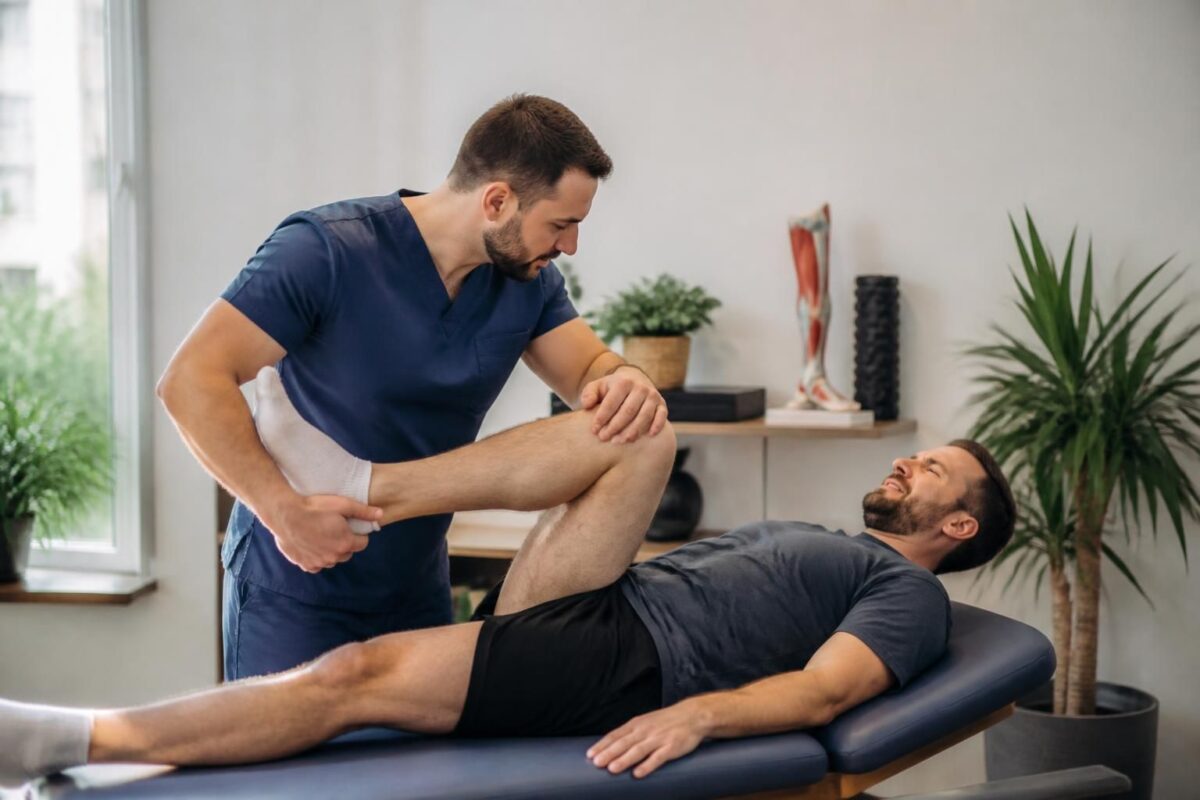
Osteopathy and chronic leg pain: regaining an optimal quality of life
In short In short, Osteopathy is one Global manual approach aimed at reducing Chronic leg pain and improve the quality of life. What is it? Non-drug therapy using the hands to identify restrictions and treat lesional chains. How does it…
Techniques and mechanisms of action
The treatment is based on gentle and adapted techniques Aiming to improve blood circulation and lymphatic circulation, to release muscle tension and rebalance the nervous system. The main interventions include Joint mobilizations, of Myofascial techniques, and targeted work on the diaphragm and circulation-related organs. Through these actions, osteopathy improves the Venous return, reduces congestion and promotes better mobility lower limbs.
How osteopathy supports recovery after complex surgery
In short In short, Post-operative osteopathy is an approach fresh which supports the recovery After a Complex surgery. It helps to reduce the pain and the fatigue, improves the mobility and accelerates the healing thanks to a better vascularization and…
Osteopathic treatment of heavy legs
the typical process includes a anamnesis and an Overall assessment to determine the areas to be treated. Treatment may include Sweet mobilizations To optimize drainage, visceral manipulations to stimulate the functioning of the organs involved in the circulation, and Postural corrections In order to improve the balance of the whole body. Practical advice on adapted physical activity, stretching and overweight management can complement the sessions and enhance the results.
Prevention and advice on a daily basis
To prolong the beneficial effects, favor a Regular physical activity adapted (walking, swimming), stretches targeted and positions to raise the legs when necessary. Proper hydration, a balanced diet and wearing compression stockings according to medical recommendations can also help prevent recurrences and support circulation.
Integration and resources
To deepen this subject, you can consult specialized resources such as the Santélog blog and content dedicated to optimizing muscle recovery and flexibility. Here are some useful references presented naturally in your care path:
– Osteopathy and chronic pain – Latest scientific data
– Osteopathy and leg pain – personalized care
– Muscle recovery and flexibility
– How osteopathy affects chronic inflammation
For athletes and people subject to physical exertion, osteopathy offers complementary approaches to optimize recovery and performance, as highlighted Why osteopathy is an essential approach for athletes and other resources dedicated to post-effort recovery.
Note that this information completes a personal assessment carried out by your osteopath and does not replace medical advice. For more details, you can check out the Legal Pain and Osteopathic Approach page, or explore the options available through the resources listed above.

Dr Sylvain Desforges, B.Sc., D.O., N.D., osteopath, is the founding president of TAGMED and of the ACMA association. He dedicates his practice to chronic spinal pain, low back pain and symptoms compatible with sciatica, particularly when pain radiates toward the buttock, leg, calf, foot or toes.
Through SOS Sciatique, he publishes educational content on sciatica symptoms, possible causes such as disc herniation, disc narrowing, foraminal stenosis or irritation of a lumbar nerve root, as well as non-surgical approaches that may be considered according to the evaluation. At Clinique TAGMED, care may include, depending on the case, motorized neurovertebral decompression, specific osteopathic care or precision percussion.
For an evaluation related to sciatica treatment in Montreal / Mount Royal or sciatica treatment in Terrebonne, please consult the services available at Clinique TAGMED.
Medical disclaimer
The information published on SOS Sciatique is provided for educational purposes only and does not replace a consultation, diagnosis, opinion or treatment provided by a physician or another authorized healthcare professional. The author of this article is neither a medical doctor nor a specialist in a medical specialty recognized by the Collège des médecins du Québec. The osteopathic, manual medicine or functional support approaches described on this site do not constitute medical acts and are not intended to replace medical follow-up.
Consult a physician or emergency service in cases of loss of bladder or bowel control, anesthesia in the saddle area, significant or progressive weakness in the leg or foot, fever, recent trauma, severe pain or rapid worsening of symptoms. For more details, please read our Legal Notice.